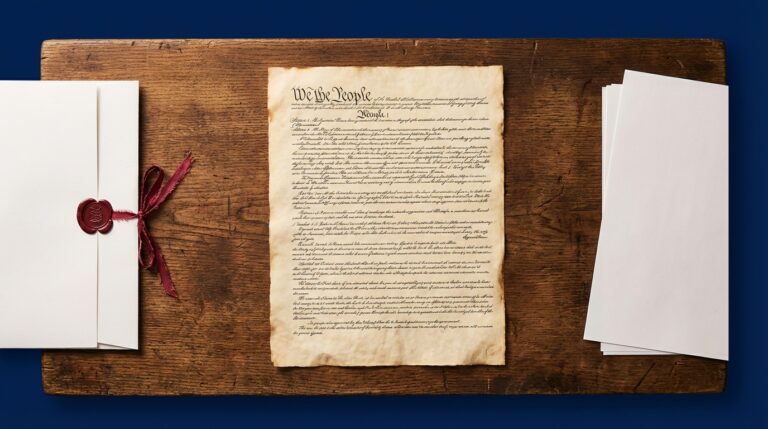
The article uses primary sources and respected explainers so readers can follow the doctrine from the Amendment's wording to current litigation trends through 2026.
What the 10 amendments says: the text and plain meaning
“The powers not delegated to the United States by the Constitution, nor prohibited by it to the States, are reserved to the States respectively, or to the people.” National Archives bill of rights transcript
The simple wording above is the starting point for how courts and scholars read the Tenth Amendment. In plain language it says that anything the Constitution does not give to the federal government remains with the states or the people, a point emphasized in legal summaries of the Amendment’s text and meaning Cornell LII Tenth Amendment entry and an explanatory essay at the Library of Congress Library of Congress essay.
Lawyers and commentators often treat the provision less as a source of new state powers and more as a structural rule about how federal and state authority fit together, shaping federalism doctrine without by itself creating affirmative powers for states Cornell LII Tenth Amendment entry.
Learn more and read the primary text
The National Archives provides the primary Bill of Rights transcript and the exact Tenth Amendment text for readers who want the original wording.
How the Tenth Amendment fit into the Bill of Rights and early debates
The Tenth Amendment was ratified in 1791 as part of the Bill of Rights, a set of first amendments adopted shortly after the Constitution to address concerns about centralized authority, and the National Archives preserves the text and ratification details National Archives bill of rights transcript.
Contemporaries debated the balance between federal and state power, and modern legal encyclopedias summarize both those early debates and later scholarly discussion about what the Amendment was meant to accomplish Cornell LII Tenth Amendment entry.
That historical background informs modern interpretation but does not settle every doctrinal dispute; primers and explainers underscore that history is part of the story, not the final word on how courts apply the clause today SCOTUSblog primer on the Tenth Amendment.

Key Supreme Court decisions that shaped the doctrine
New York v. United States (1992) is a leading decision for the modern outline of limits on federal power. In that case the Court held that Congress may not constitutionally commandeer state governments to enact or enforce federal regulatory programs, drawing a line against direct federal orders to state legislatures or officials New York v. United States opinion.
How did these decisions draw the constitutional line between national authority and state sovereignty? Courts have framed the question as whether Congress is directing state governments themselves, or regulating private individuals and entities, a distinction central to anti-commandeering doctrine.
The Tenth Amendment reserves powers not granted to the federal government to the states or the people, and courts use it to rule that the federal government may not directly compel state governments or officers to implement federal programs, a principle known as anti-commandeering.
Printz v. United States (1997) reinforced that distinction by holding that the federal government cannot require state officers to execute federal law, even when the law is part of a nationwide regulatory scheme; the decision emphasized limits on using state officers as federal agents Printz v. United States opinion and an academic discussion is available in law-review repositories academic article.
Most recently, Murphy v. NCAA (2018) applied and clarified anti-commandeering principles in a case about federal restrictions on state lawmaking; the Court struck down a federal law that directly regulated state lawmaking authority, affirming that Congress cannot use its laws to commandeer the legislative process of the states Murphy v. NCAA case summary.
How anti-commandeering works: mechanics and limits

Anti-commandeering is the doctrine that forbids the federal government from directly compelling state governments or state officers to implement or enforce federal regulatory programs, a principle grounded in the holdings of New York and Printz New York v. United States opinion.
In practice, the rule draws a distinction between measures that regulate private conduct and measures that order states or their officers to act for federal purposes; a federal law that sets standards for private individuals is generally permissible while a law that tells a state legislature to pass a regulation would be constitutionally suspect Printz v. United States opinion.
Legal reference works emphasize that this is a structural limit on federal compulsion, and not a provision that by itself enlarges state authority to override otherwise valid federal laws Cornell LII Tenth Amendment entry.
Where the Tenth Amendment does not give states a free pass: preemption and federal powers
The Tenth Amendment does not automatically defeat Congress’s other constitutional powers, including substantial authority under the Commerce Clause and the federal spending power; commentators note that courts balance these powers against structural federalism constraints rather than treating the Amendment as an absolute veto on federal action Cornell LII Tenth Amendment entry and law review discussions Cardozo Law Review.
Conditional federal grants are another common flashpoint: Congress can attach conditions to federal funding, and courts analyze whether such conditions cross a line into coercion or unlawfully direct state policy, an area of ongoing doctrinal refinement discussed in primers and cases that treat conditional spending apart from direct commandeering Murphy v. NCAA case summary.

Readers should note that preemption and supremacy principles can mean that state laws conflicting with valid federal statutes may be displaced, which is distinct from the anti-commandeering inquiry about whether federal law orders state officials to act.
Common misconceptions and pitfalls when people talk about the Tenth Amendment
One frequent myth is that the Tenth Amendment authorizes state nullification of federal law. Legal scholars and reference texts reject that view and explain that the Amendment does not provide a legal basis for a state to unilaterally invalidate federal statutes enacted under the Constitution Cornell LII Tenth Amendment entry.

Another error is to confuse a state’s refusal to help enforce federal law with the power to override federal law; anti-commandeering limits compel the federal government to use its own officers rather than ordering state officers to act, but they do not give states a license to enact laws that conflict with federal law under preemption principles SCOTUSblog primer on the Tenth Amendment.
Practical scenarios: how the Tenth Amendment can matter to state policy areas
A straightforward hypothetical shows the difference: if Congress requires background checks for private firearm transfers it is regulating individual conduct; if Congress attempted instead to require a state registry to administer those checks by ordering state personnel to run the system, that could raise anti-commandeering problems, a contrast courts have used to explain the doctrine Printz v. United States opinion.
Similarly, when federal immigration policy relies on directing state or local police to enforce federal standards, courts will consider whether the law crosses the anti-commandeering line or remains a permissible regulation of private conduct and federal actors, an area where litigation continues to test boundaries Cornell LII Tenth Amendment entry and our stronger borders page stronger borders.
Help readers locate authoritative case texts and primers
Use official sources where possible
Courts have applied these principles in different contexts, so a court considering an environmental regulation, a public health measure, or an immigration directive will look to the particular statutory scheme and the level of federal direction to state officials when deciding whether the Tenth Amendment and anti-commandeering concerns apply Murphy v. NCAA case summary.
What lawyers and courts are watching now: open questions through 2026
One major open question is how far conditional federal spending can go before it becomes coercive or an indirect form of commandeering; scholars and courts continue to debate the doctrinal tests that distinguish permissible conditions from unconstitutional pressure Cornell LII Tenth Amendment entry.
Another active issue is how lower courts apply anti-commandeering to novel policy domains such as environmental regulation, public health, and immigration, where federal programs increasingly interact with state systems and statutory frameworks, producing fact-specific litigation SCOTUSblog primer on the Tenth Amendment.
Observers also watch how courts reconcile anti-commandeering with preemption doctrines when federal statutes both regulate individuals and include provisions affecting state lawmaking; these tensions are resolved case by case and remain a subject of appeals and scholarly commentary Murphy v. NCAA case summary.
Conclusion and where to read the primary sources
In short, the Tenth Amendment is a constitutional text that courts use to limit direct federal compulsion of state governments, but it operates within a system where Congress retains substantial powers under other clauses of the Constitution, and those powers are balanced against structural federalism concerns Cornell LII Tenth Amendment entry.
For readers who want primary texts and reliable case opinions, start with the Bill of Rights transcript at the National Archives and the Supreme Court opinions for New York v. United States, Printz, and Murphy to see the holdings in context National Archives bill of rights transcript and our constitutional rights hub constitutional rights.
Further explanatory resources and ongoing coverage can be found at well-regarded legal explainers and case trackers that summarize doctrinal developments and list links to opinions as they issue SCOTUSblog primer on the Tenth Amendment and our news index news.
No. The Tenth Amendment does not give states a legal right to nullify valid federal laws; courts distinguish between refusing to enforce federal rules and laws that conflict with federal statutes, and preemption principles still apply.
Anti-commandeering is the constitutional principle that the federal government cannot directly compel state governments or state officers to implement or enforce federal regulatory programs.
Primary sources include the Bill of Rights transcript at the National Archives and Supreme Court opinions for New York v. United States, Printz v. United States, and Murphy v. NCAA, which are available through official opinion repositories and reputable case sites.
References
- https://www.archives.gov/founding-docs/bill-of-rights-transcript
- https://www.law.cornell.edu/wex/tenth_amendment
- https://constitution.congress.gov/browse/essay/amdt10-4-2/ALDE_00013627/
- https://www.scotusblog.com/2018/06/the-tenth-amendment/
- https://www.law.cornell.edu/supremecourt/text/505/144
- https://www.law.cornell.edu/supremecourt/text/521/898
- https://www.oyez.org/cases/2017/16-476
- https://repository.uclawsf.edu/hastings_constitutional_law_quaterly/vol52/iss2/5/
- https://cardozolawreview.com/commandeering-the-indian-child-welfare-act-native-american-rights-exception-to-tenth-amendment-challenges/
- https://michaelcarbonara.com/contact/
- https://michaelcarbonara.com/issue/stronger-borders/
- https://michaelcarbonara.com/issue/constitutional-rights/
- https://michaelcarbonara.com/news/