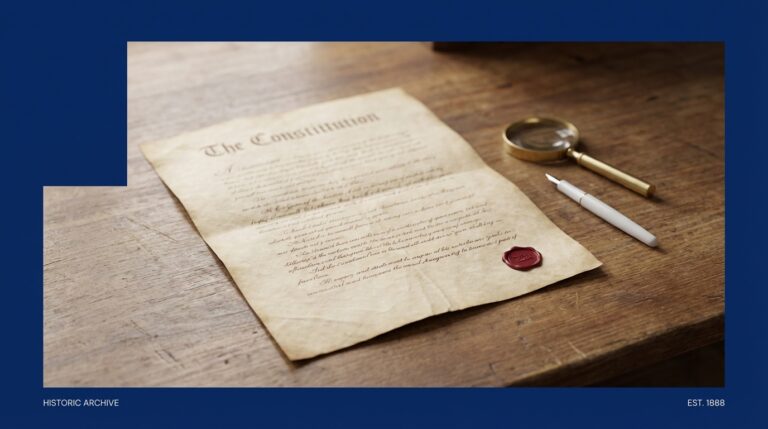
The goal is to give readers the primary authorities and practical tests they can consult when they encounter claims about free speech.
What the First Amendment actually says
Text and immediate meaning, 1st amendment free speech
The starting point is the constitutional text. The First Amendment bars Congress from making laws that abridge freedom of speech, the press, religion, assembly, and petition, and that language is the baseline for U.S. free-speech law U.S. National Archives and is discussed in more detail on our constitutional rights hub.
Those five protections are listed together for a reason. The text is read as a negative constraint on government action rather than an affirmative guarantee of particular outcomes, and courts and commentators treat that wording as the primary authority when they analyze disputes Legal Information Institute
Join the campaign mailing list to get updates
For primary sources, read the constitutional text and major court opinions cited here to see how courts interpret the protections.
One core practical point is simple: the First Amendment restricts government action. It does not by itself require private companies to carry or promote particular speech, and that distinction shapes many debates about modern communications Legal Information Institute
Court decisions apply the Amendment by resolving cases where government action is alleged. Judges read the text against precedent and doctrine to decide whether a law, regulation, or official act crosses constitutional lines, and scholarly summaries show that courts balance broad protection with defined exceptions Brennan Center for Justice

The main exceptions: what speech is not protected
Overview of legally recognized exceptions
Although political speech is highly protected, doctrine recognizes categories that receive little or no First Amendment protection. Principal categories include incitement, obscenity, defamation under the public-figure standard, true threats, and certain criminal or national-security speech Legal Information Institute
The First Amendment protects freedom of speech but lists four other related protections, so it functions as a coordinated set of limits on government action that together secure a broad space for public discussion while allowing narrowly defined exceptions.
Those categories exist because courts have treated them as presenting harms or risks different in kind from protected public discussion, and each category is tested by tailored legal standards rather than by a single rule Legal Information Institute

The main exceptions: why these exceptions exist
Why these exceptions exist
Court decisions explain that some speech can cause immediate harms or tangible wrongs that justify narrower regulation than ordinary political debate, and judges evaluate whether government action fits the narrowly defined tests for each exception Legal Information Institute
That approach preserves a strong zone for political discussion while allowing targeted rules where the evidence and legal standard support restriction, a pattern courts have followed in modern doctrine Legal Information Institute
The main exceptions: list and short definitions
How the categories are tested
Incitement is evaluated under an imminence and likelihood test, obscenity by a three-part standard, defamation by fault rules for public figures, and true threats by contextual analysis that looks at the intent and reasonable perception of the listener Legal Information Institute
Because each category uses a distinct test, courts treat these exceptions narrowly and require plaintiffs or governments to satisfy specific legal elements before they may punish or prohibit speech Legal Information Institute
Incitement law – understanding Brandenburg v. Ohio
The imminent-lawless-action test explained
Brandenburg v. Ohio set the modern standard for incitement: speech is unprotected only if it is directed to inciting imminent lawless action and is likely to produce such action, a two part focus on intent and likelihood Brandenburg v. Ohio case summary (see recent discussion of online incitement The evolution of Incitement Online).
That test protects many forms of provocative advocacy and permits punishment only when words are aimed at producing immediate unlawful conduct. A hypothetical that urges calm protest is likely protected; a direct call to immediately assault a named target in a specific place is more likely to fail the Brandenburg test Brandenburg v. Ohio case summary
How Brandenburg is applied today
How Brandenburg is applied today
Court and scholarly discussion shows Brandenburg remains controlling law for incitement claims, but applying it to online coordination, viral posts, and algorithmic promotion raises unsettled questions about imminence and likelihood Brandenburg v. Ohio case summary and longer treatments of the topic are available in academic work Digitizing Brandenburg and law-review analysis CAN THE BRANDENBURG INCITEMENT TEST COPE.
Judges today ask whether the context shows a real and immediate risk of lawless action, and they consider whether speech was targeted, time sensitive, and coupled with steps likely to produce unlawful conduct Brandenburg v. Ohio case summary
Defamation and the ‘actual malice’ rule
What New York Times Co. v. Sullivan established
New York Times Co. v. Sullivan created the actual malice standard for defamation claims involving public officials: to win, a plaintiff must show the defendant knew a statement was false or acted with reckless disregard for the truth, a rule that narrows liability for criticism of public figures New York Times Co. v. Sullivan case summary

The Sullivan rule means negligent errors are generally not enough to establish liability for statements about public officials, so political criticism is harder to punish under defamation law than private disputes over false statements New York Times Co. v. Sullivan case summary
How the rule affects criticism of public figures
How the rule affects criticism of public figures
Because public debate depends on robust criticism, Sullivan raises the burden on plaintiffs and makes it more difficult to use defamation law to chill political speech; courts require evidence that a speaker acted with knowledge or reckless disregard rather than mere negligence New York Times Co. v. Sullivan case summary
An example helps: a reporter who publishes a mistaken claim based on routine reporting is less likely to be liable unless evidence shows deliberate falsification or serious recklessness in checking facts New York Times Co. v. Sullivan case summary
Obscenity and the Miller test
The three-part Miller standard
Miller v. California established a three-part obscenity test that asks whether the average person, applying local community standards, would find the material appeals to prurient interest, whether it depicts sexual conduct in a patently offensive way, and whether the work lacks serious literary, artistic, political, or scientific value Miller v. California case summary
Miller covers a narrow category labeled obscene; most sexual or adult content does not meet all three Miller factors and therefore remains protected speech under the First Amendment Miller v. California case summary
When material can be regulated
When material can be regulated
Courts applying Miller look to context and evidence about the work as a whole, and they vary in how community standards are measured in different jurisdictions, which is why obscenity prosecutions are limited and fact specific Miller v. California case summary
Because the Miller test requires proof on specific elements, it prevents broad suppression of sexual expression that has serious value or a legitimate context Miller v. California case summary
Digital-era questions: platforms, amplification, and misinformation
Why platforms complicate First Amendment analysis
Traditional First Amendment doctrines remain the primary authorities, but scholars and policy groups emphasize that private platform moderation, algorithmic amplification, and coordinated misinformation complicate how those doctrines operate in practice Legal Information Institute and see our discussion of freedom of expression and social media.
Research through 2024 highlights unresolved questions about whether and how doctrines conceived for government action should shape platform conduct, and it notes that litigation and legislation continue to test those boundaries Brennan Center for Justice

Why platforms complicate legal analysis
Why platforms complicate legal analysis
Platform companies set content rules that can reduce visibility or remove content even when the First Amendment would bar government restriction, which is why public debate often focuses on platform policies rather than only on constitutional law Brennan Center for Justice
Legal scholars and policy groups recommend careful mapping of government action, private action, and statutory changes so courts can sort when constitutional constraints apply and when private moderation responds to other incentives Legal Information Institute
Practical scenarios: protests, online posts, and political ads
How rules apply to protests and assembly
Protest speech is generally protected, but incitement and true threats are not; when speech accompanying a protest crosses into directed, imminent calls for illegal action, the Brandenburg standard and true-threat analysis can justify legal response Brandenburg v. Ohio case summary
Courts look at context, the specificity of the call to action, and the proximity of speech to criminal acts when deciding whether a protester’s words are protected or punishable Legal Information Institute
Speech on social media and paid political content
Speech on social media and paid political content
Political ads and commentary are often legally protected, but false factual claims about identifiable public officials can raise defamation concerns subject to the Sullivan actual malice rule, which raises the plaintiff’s burden New York Times Co. v. Sullivan case summary
At the same time, platforms can remove or deamplify content under their terms, which may affect visibility even when the First Amendment would limit government suppression Brennan Center for Justice
Protected political criticism: scope and limits
Distinguishing opinion from false factual claims
Robust criticism of public officials sits at the heart of First Amendment protection, and Sullivan increases the difficulty of defamation claims aimed at political speech, making fault the central inquiry New York Times Co. v. Sullivan case summary
Opinion, rhetorical hyperbole, and value judgments are often protected, while demonstrably false factual assertions presented as fact may be actionable under the right circumstances Legal Information Institute
When harsh rhetoric becomes actionable
When harsh rhetoric becomes actionable
Courts distinguish threatening, targeted statements that a reasonable person would interpret as serious from heated but general political rhetoric; that contextual analysis separates protected expression from punishable threats or incitement Legal Information Institute
The speaker’s intent, the listener’s perception, and the factual setting all matter in deciding whether speech crosses the line into a punishable category Legal Information Institute
Clear limits: threats, incitement, and criminal speech
True threats doctrine in brief
True threats and certain criminal speech fall outside First Amendment protection because they are treated as actions or imminent danger rather than public discussion, and courts examine context closely before allowing punishment Legal Information Institute
National-security contexts may trigger different frameworks where statutes and classified evidence change the legal landscape, so courts balance speech concerns with other government interests in such cases Legal Information Institute
How private platforms and moderation fit into the picture
Why the First Amendment does not directly control private moderation
The First Amendment binds government actors; private platforms generally may craft their own rules and enforce them, which creates a gap between constitutional protection and what users experience on platforms Legal Information Institute
Policy debates consider whether new laws should constrain platform actions or require transparency and accountability, but those proposals are unsettled and under active consideration by lawmakers and courts Brennan Center for Justice
Common misunderstandings and pitfalls
What people often get wrong
Common errors include treating platform deplatforming as identical to government censorship, assuming absolute protection for all speech, or using slogans as substitutes for legal tests; these mistakes overlook the nuanced standards courts apply under the First Amendment Legal Information Institute
To evaluate claims about free speech, look for named primary authorities and the specific legal standard at issue rather than relying on generalized assertions about rights or outcomes Legal Information Institute
A simple checklist for evaluating ‘free speech’ claims
Questions to ask before sharing or reacting
Ask who the speaker and target are, whether the speech calls for imminent lawless action, whether the claim is a demonstrable false fact about a public official, and whether the content could meet an obscenity or threat standard; these questions map to core cases and tests Brandenburg v. Ohio case summary
When in doubt, consult the constitutional text and the leading cases named here for the elements courts use to decide whether speech is protected or actionable U.S. National Archives
Closing: what to take away about free speech in the U.S.
Summary of protections and limits
The First Amendment provides broad protection for speech and public debate but is not absolute; Brandenburg, Sullivan, and Miller identify principal doctrinal limits that remain central to modern law U.S. National Archives
Contemporary research highlights how digital platforms and algorithmic amplification raise unresolved questions that courts and legislatures continue to address Brennan Center for Justice
No. The First Amendment protects a broad range of speech, especially political debate, but courts recognize narrow exceptions such as incitement, obscenity, defamation of public figures, and true threats.
Generally no. The First Amendment limits government action, not private companies, though lawmakers and courts continue to discuss legal and policy approaches to platform practices.
Key decisions include Brandenburg for incitement, New York Times Co. v. Sullivan for public-figure defamation, and Miller for obscenity; these cases shape the principal doctrines.
For current analysis of digital-era questions, research centers and law summaries track new litigation and legislative proposals that may shape how doctrines apply to platforms and online speech.
References
- https://www.archives.gov/founding-docs/amendments-11-27
- https://www.law.cornell.edu/constitution/first_amendment
- https://www.brennancenter.org/our-work/research-reports/free-speech
- https://www.oyez.org/cases/1968/492
- https://www.oyez.org/cases/1963/39
- https://www.oyez.org/cases/1972/70
- https://michaelcarbonara.com/contact/
- https://michaelcarbonara.com/issue/constitutional-rights/
- https://michaelcarbonara.com/first-amendment-explained-five-freedoms/
- https://www.medialaws.eu/the-evolution-of-incitement-online-from-brandenburg-v-ohio-to-depiction-of-zwarte-piet/
- https://scholarship.law.bu.edu/faculty_scholarship/1527/
- https://bclawreview.bc.edu/articles/3136/files/662f9d422847c.pdf
- https://michaelcarbonara.com/freedom-of-expression-and-social-media-impact/