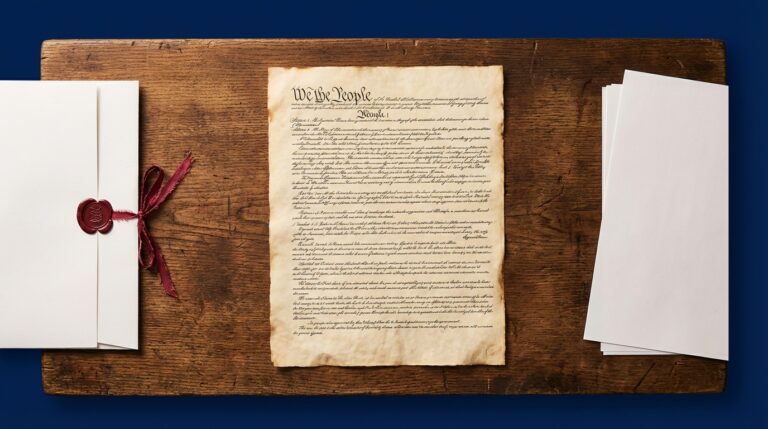
The guide is aimed at voters, students, and civic-minded readers who want a clear, neutral summary of the legal standards for unprotected speech and how to approach borderline cases.
What the First Amendment protects and why some speech can be limited
The First Amendment broadly protects speech, political debate, and many forms of expression. At the same time, the Supreme Court has identified narrow categories of speech that the Constitution does not protect; those limits are specific and come from particular legal tests and cases. The main unprotected categories this article covers are incitement to imminent lawless action, true threats, obscenity, child pornography, and some defamatory falsehoods, and later sections explain the tests courts use to evaluate each category.
These exceptions are not free-floating rules. The Court has repeatedly framed them as context-dependent standards that apply when certain factual elements are met, and judges compare statements or works against those tests to decide whether government restriction is lawful. That process means outcomes can differ with facts, medium, and later appellate decisions in a given jurisdiction. For a foundational case on incitement, readers should look to the original opinion in Brandenburg, which sets the controlling test in that area Brandenburg v. Ohio, 395 U.S. 444 (1969) (also available on Justia: Brandenburg v. Ohio).
Courts decide by identifying which legal test applies to the speech category and then comparing the specific facts against that test, using controlling Supreme Court precedent and relevant appellate decisions to resolve close cases.
Because courts rely on tests that weigh facts, it is important to see how the specific elements operate before assuming a restriction is lawful. The remaining sections name the tests and offer practical steps to compare speech against them, then describe how modern platforms and timing can affect decisions. The goal is to give a clear framework so readers can better understand limits of free speech and how to evaluate contested statements without treating the rules as simple slogans.
Quick guide: the main legal tests courts use
Court decisions provide targeted legal tests rather than broad bans. Three of the most important tests are the Brandenburg imminence-and-intent standard for incitement, the objective-threat analysis used for true threats, and the Miller obscenity test; the Court also treats child sexual exploitation differently under a categorical rule. Each test asks a different factual question, so matching a statement to the right test is a key first step.
To summarize in plain terms: Brandenburg asks whether speech is directed to producing imminent lawless action and likely to do so, and courts require both intent and likelihood. For a basic statement of that rule, see the original opinion in Brandenburg v. Ohio Brandenburg v. Ohio, 395 U.S. 444 (1969). A public summary is also available from Columbia’s Global Freedom of Expression project: Brandenburg v. Ohio. The objective-threat approach asks whether a reasonable recipient would view the communication as a serious intent to harm, which is the approach recognized in Virginia v. Black Virginia v. Black, 538 U.S. 343 (2003).
Miller’s three-part test asks whether a work appeals to the prurient interest under contemporary community standards, depicts sexual conduct in a patently offensive way, and lacks serious literary, artistic, political, or scientific value; a plain description of that framework appears in Miller v. California Miller v. California, 413 U.S. 15 (1973). For child sexual material, the Court has treated it as categorically unprotected even when the Miller test might not apply, as explained in New York v. Ferber New York v. Ferber, 458 U.S. 747 (1982). Finally, defamation analysis turns on falsity, reputational harm, and the plaintiff’s status as a public or private figure, following the standards in New York Times Co. v. Sullivan and related cases New York Times Co. v. Sullivan, 376 U.S. 254 (1964).
These tests are the baseline. How they apply in specific cases can shift with later appellate rulings and with factual changes such as the speed and reach of social media. When readers ask Is my speech protected by the First Amendment, the right starting point is to identify which test fits the statement and then compare the facts to that test.
Incitement: when advocacy crosses into imminent lawless action
Brandenburg sets the main rule for incitement: speech that is directed to inciting imminent lawless action and is likely to produce such action is not protected. The Court framed the test so that mere advocacy of illegal action in the abstract is usually protected, while targeted calls that aim to produce immediate wrongdoing may be restricted. The two required elements-purposeful direction and likelihood of imminent lawless action-must generally be shown together for a restriction to stand Brandenburg v. Ohio, 395 U.S. 444 (1969).

In practice, courts look at the speaker’s intent, the words used, the audience, and the context. For example, a speech that urges a crowd to commit immediate violence at that moment will be assessed differently than an ideological statement that discusses illegal conduct in general terms. Timing matters: courts assess whether the communication was close enough in time and likely enough in effect to produce disorder or lawless action right away.
Join the conversation on civic priorities
For more on how courts evaluate incitement, see primary case sources and appellate guidance.
Online contexts raise difficult questions under Brandenburg, because reposts, rapid amplification, and comments can change whether a call to action is both directed and likely to succeed immediately. Courts have begun to apply the Brandenburg factors to social-media speech, but outcomes often turn on factual records, platform mechanics, and how a message is framed or amplified. Given those variables, close cases often depend on recent appellate decisions in the jurisdiction where the speech occurred. See scholarly discussion of terrorist incitement and social media at Fordham Law Review: Leibowitz, CRIMINALIZING TERRORIST INCITEMENT ON SOCIAL MEDIA.
Those who want to assess a particular post should map the statements to Brandenburg’s elements: was the post purposefully directed at producing imminent lawless action, and was it likely to produce that action given the audience, timing, and channel? If the facts make those elements plausible, courts may treat such speech as outside First Amendment protection, but courts resolve those determinations case-by-case.
True threats: how courts assess threats of violence
The Court recognizes that threatened violence can be punished when a communication amounts to a true threat rather than protected rhetoric. Virginia v. Black illustrates the principle that courts must look at context and an objective standard to decide whether a statement expresses a serious intent to commit harm Virginia v. Black, 538 U.S. 343 (2003). The inquiry asks how a reasonable recipient would perceive the statement, given context and the communicator’s history or conduct.

Not all violent or harsh language is a true threat. Courts distinguish protected hyperbole and political rhetoric from actionable threats by considering speaker intent, specific phrasing, the surrounding circumstances, and whether a reasonable person would interpret the remark as a serious expression of intent to injure. Statements that lack indicators of seriousness, such as obvious sarcasm or rhetorical exaggeration, are more likely to be protected.
Because context is decisive, statements sent privately, paired with identifiable means to act, or directed to a vulnerable or frightened target are more likely to meet the objective-threat standard. If a communication causes a well-grounded fear of violence, courts will examine whether the objective facts support a true-threat finding. For uncertain cases, consider seeking up-to-date appellate rulings or professional counsel to clarify how courts have applied Virginia v. Black principles in similar factual settings.
Obscenity and child-protection rules: Miller and Ferber explained
Miller sets a three-part test for obscenity. First, the work must appeal to the prurient interest under contemporary community standards. Second, it must depict sexual conduct in a patently offensive way as defined by state law or community norms. Third, the work, taken as a whole, must lack serious literary, artistic, political, or scientific value. Courts apply all three parts before labeling material obscene and therefore outside First Amendment protection Miller v. California, 413 U.S. 15 (1973).
In applying Miller, courts ask about community standards and the work’s overall value. That means a book or film with recognized artistic or scientific merit may escape the label of obscenity even if some passages are offensive. Because community standards can vary, results depend on where a case is litigated and how courts interpret those local norms in context.
Child sexual material is treated differently. New York v. Ferber makes child pornography categorically unprotected; the Court held that protecting children from sexual exploitation justifies prohibiting such material, even if the material would not meet a typical obscenity test New York v. Ferber, 458 U.S. 747 (1982). That categorical rule reflects child-protection interests and limits the applicability of community-standards reasoning in this area.
A quick Miller test checklist to compare material against the three Miller factors
Use as a starting screen, not legal advice
When assessing sexual content, first map the work to Miller’s factors, then consider whether any evidence shows serious value or whether the content involves minors, which triggers the Ferber rule. Because these are fact-focused inquiries, close calls commonly turn on expert testimony, context, and how judges apply community standards at trial.
Defamation: when false statements lose First Amendment protection
Defamation law limits speech when a false statement harms another’s reputation, but the legal standards vary with the plaintiff’s status. New York Times Co. v. Sullivan established the actual-malice requirement for public officials and public-figure plaintiffs, which means a plaintiff must show the speaker knew the statement was false or acted with reckless disregard for the truth in certain cases New York Times Co. v. Sullivan, 376 U.S. 254 (1964).

For private-figure plaintiffs, courts allow different standards, and the Court in Gertz recognized that states may set a lower fault requirement for private individuals while still protecting debate on public issues. See Gertz v. Robert Welch for how courts differentiate public and private claims and the related remedies Gertz v. Robert Welch, Inc., 418 U.S. 323 (1974).
Because defamation claims turn on falsity, reputational harm, and proof of fault, they require careful fact-finding. Courts balance reputation and speech interests, and remedies depend on whether a plaintiff is a public figure or private individual, the nature of the false statement, and the proof offered in court. Readers evaluating a potential claim should map the status of the parties and whether the alleged falsehood meets the required fault standard in the relevant jurisdiction.
How to evaluate borderline cases today and practical steps
When a statement sits near a legal boundary, use a step-by-step approach. First, identify the likely category: incitement, true threat, obscenity, child-protection, or defamation. Second, map the statement’s facts to the controlling test for that category. Third, check recent appellate decisions in the jurisdiction because courts refine how tests apply to new facts and technology. For the Brandenburg incitement framework, start with the original opinion but then search for post-Brandenburg appellate rulings that handle modern platforms Brandenburg v. Ohio, 395 U.S. 444 (1969).
Here is a short checklist you can follow for a practical screen. 1) What category does the statement best fit? 2) Who is the audience and what is the timing? 3) What is the speaker’s intent or motive as shown by words and conduct? 4) Would a reasonable recipient view the communication as a serious threat? 5) Does the work have demonstrable artistic, political, or scientific value? 6) Are there clear falsity and reputational injury for defamation claims? Working through those points helps structure whether a communication is likely protected.
Digital-age factors often complicate these questions. Reposts, virality, anonymity, and platform mechanics can change an assessment of likelihood or imminence under Brandenburg and can shift how a reasonable reader perceives a statement under the true-threat standard. Because appellate courts continue to adapt older tests to new media, it is important for close cases to look to the most recent relevant appellate decisions.
Finally, remember that these tests provide a legal framework, not a simple checklist that yields a mechanical result. If the facts suggest an actionable element for a given test, courts may still weigh competing interests and constitutional limits. For precise legal certainty in a specific dispute, consult primary cases and recent precedents in the appropriate jurisdiction.
Common mistakes, pitfalls, and a short wrap-up
Common errors include treating slogans or political rhetoric as legal rules, assuming all political speech is absolutely protected regardless of context, and misapplying community standards developed for physical media to online platforms without attention to factual differences. Readers should avoid equating passionate advocacy with incitement simply because the speaker uses strong language.
To recap the five core unprotected categories: incitement to imminent lawless action under Brandenburg, true threats under an objective-threat analysis like the one in Virginia v. Black, obscenity judged under Miller’s three-part test, child pornography treated categorically under Ferber, and defamatory falsehoods governed by standards in Sullivan and Gertz. Each category has a distinct legal test and requires specific facts to support government restriction Brandenburg v. Ohio, 395 U.S. 444 (1969).
Because application depends on jurisdiction and recent appellate rulings, readers should consult current decisions when evaluating a close case. The primary Supreme Court opinions named in this guide are the authoritative starting points, but factual developments and technological change mean courts continue to refine how the tests operate. That is why up-to-date case law matters for borderline matters.

For readers who want to follow this topic, start with the cited Supreme Court opinions and then search for appellate decisions that apply those tests to modern contexts. That approach will show how courts handle new factual scenarios while remaining grounded in longstanding legal principles.
The main categories are incitement to imminent lawless action, true threats, obscenity, child sexual exploitation, and certain defamatory falsehoods.
No. Courts distinguish protected offensive speech from unprotected categories by applying specific tests that depend on intent, imminence, context, and factual proof.
Yes. Courts apply the same legal tests to digital speech, but outcomes depend on timing, audience, amplification, and recent appellate rulings in the relevant jurisdiction.
This guide presents neutral, sourced context and is not legal advice. For individual disputes, consider reviewing primary rulings and seeking professional counsel.
References
- https://www.law.cornell.edu/supremecourt/text/395/444
- https://supreme.justia.com/cases/federal/us/395/444/
- https://globalfreedomofexpression.columbia.edu/cases/brandenburg-v-ohio/
- https://fordhamlawreview.org/wp-content/uploads/2017/10/Leibowitz_November_v86.pdf
- https://www.law.cornell.edu/supremecourt/text/538/343
- https://www.law.cornell.edu/supremecourt/text/413/15
- https://www.law.cornell.edu/supremecourt/text/458/747
- https://www.law.cornell.edu/supremecourt/text/376/254
- https://michaelcarbonara.com/contact/
- https://michaelcarbonara.com/issue/constitutional-rights/
- https://michaelcarbonara.com/news/
- https://michaelcarbonara.com/about/
- https://www.law.cornell.edu/supremecourt/text/418/323