
The piece is aimed at voters, journalists, students, and local readers who need a sourced, neutral reference. It relies on primary government portals and oversight reports, and it emphasizes clear attribution and date-stamped figures for any cited total.
What we mean by federal government jobs: definitions and scope
When people ask how many united states federal government jobs there are, they are usually asking for a simple total. In practice, that total depends on definitions. Federal employment commonly includes civilian federal employees and active-duty military, and authoritative counts for each come from different agencies.
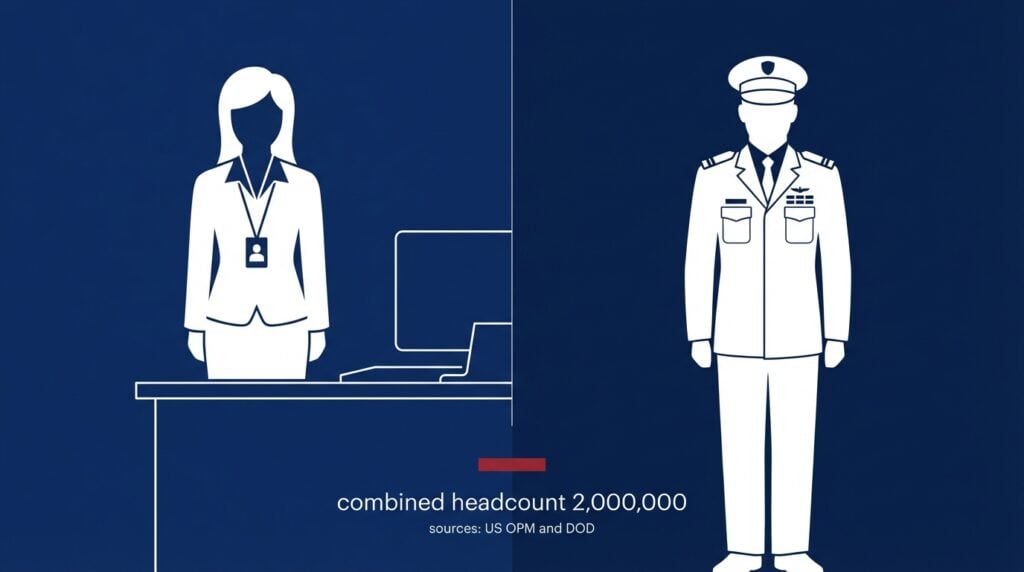
Civilian federal employees are the staff paid through civilian agency payrolls. Active-duty military personnel are the full-time uniformed force under Department of Defense authority. To estimate a single federal workforce number, both categories are typically combined, with each category measured and published separately.
Headcount and full-time equivalent, or FTE, are different measures. Headcount counts people. FTE converts part-time work into a full-time equivalent number. Some data portals report headcount, others report FTE, so comparing series requires checking which measure is used. The U.S. Postal Service is often reported separately because of its distinct status and funding model; including or excluding USPS will change totals.
Because OPM and DoD publish separate series, any combined federal jobs figure should state what is included and which snapshot date was used. For civilian headcounts, the OPM Federal Workforce Data portal is the standard source to consult for definitions and agency-level breakdowns, and DoD monthly reports provide the active-duty totals.

Quick answer: the best available combined total and how it was calculated
Short answer, with qualification: combining the most recent civilian headcounts and active-duty strengths produces an overall federal workforce on the order of roughly 3.3 million people in the mid-2020s, when using the standardized civilian totals and DoD active-duty counts as published by the agencies.
This combined estimate adds OPM civilian headcounts to the Department of Defense active-duty strength. It excludes most private contractors and typically treats USPS as a special case that may be included or excluded depending on the dataset. For the civilian piece, OPM Federal Workforce Data is the primary reference for agency-level headcounts and demographic detail, while DoD strength reports cover the military side. See OPM workforce size and composition for a related OPM analytic view: https://data.opm.gov/explore-data/analytics/workforce-size-and-composition
Limitations apply. Month-to-month or year-to-year differences can reflect hiring, separations, or reporting choices. For the most precise statement of methodology, consult the primary portals where the datasets are published.
Stay informed and get involved with Michael Carbonara
Check the original OPM, DoD, and BLS data portals to confirm the snapshot and inclusion choices before using any single federal jobs figure.
Authoritative data sources: OPM, DoD/DMDC, and BLS explained
Three official sources are central to reporting federal employment. OPM publishes civilian personnel data, DoD and the Defense Manpower Data Center publish active-duty military strengths, and the Bureau of Labor Statistics provides a payroll employment series useful for trends. Each has a particular purpose and format.

OPM’s Federal Workforce Data portal provides agency-level civilian headcounts, hires and separations, and demographic breakdowns, and it is the starting point for civilian counts.
Combining the most recent civilian headcounts from OPM with DoD active-duty strength counts yields a combined federal workforce on the order of roughly 3.3 million people in the mid-2020s, with variation depending on inclusion choices such as USPS and whether figures are headcount or FTE.
DoD and the Defense Manpower Data Center publish monthly counts of active-duty military strength by service. These counts are the authoritative source for active-duty totals and should be matched by date when combining with civilian snapshots.
The Bureau of Labor Statistics maintains the Current Employment Statistics payroll series for the federal government. That series is designed for trend analysis and seasonal adjustment and can be useful to interpret short-term changes that do not show up the same way in headcount snapshots.
BLS CES federal government series
Civilian workforce breakdown: major agencies and how counts vary
Not all civilian employees are equal in size. Large civilian employer components often include Department of Defense civilian staff, the Department of Veterans Affairs, and the U.S. Postal Service, though USPS is frequently reported separately because of its unique structure and financing.
OPM provides agency-level tables that let readers see which agencies have the largest civilian headcounts, and it also reports hires and separations so users can follow workforce flows over time.
FedScope archive and agency tables
Agency reporting choices affect totals. For example, whether an internal unit is counted on an agency table or under a parent department can change how a local story is framed. Reporters and researchers should pull the agency-level files to confirm how the components add up to a consolidated federal count.
Active-duty military counts: how DoD reports strength and how to read it
DoD publishes monthly active-duty strength totals that report the number of service members on active duty across the armed services. Recent published counts place active-duty strength at about 1.3 million personnel, making the military a substantial portion of the combined federal workforce.

When combining civilian and military figures, use DoD monthly reports dated to the same reference period as the civilian snapshot to avoid mixing different dates or seasonal effects. Active-duty is distinct from reserve components and from civilian DoD staff, and those distinctions matter for accurate totals.
Reserve strength and civilian DoD employees are usually reported in separate series. If a story needs a count for the full DoD workforce that includes civilians and reserve personnel, state explicitly which elements are being combined and why.
How BLS data and trend series help interpret short-term changes
BLS’s Current Employment Statistics federal payroll series measures payroll employment on a consistent monthly basis and is designed for trend analysis and seasonal adjustment, making it useful for short-term comparisons and for identifying patterns that a single snapshot can miss.
Because CES is a payroll employment series, it may not match a headcount snapshot from OPM or DoD for a particular date. Use CES to show direction and seasonality, and use OPM and DoD for precise headcounts on a reference date.
BLS CES federal government series

For reporters seeking a tight narrative on recent hiring or layoffs, combine a BLS trend paragraph with a dated OPM or DoD snapshot to show both trajectory and scale without implying that the series are interchangeable.
Where to get the most up-to-date totals and how to verify them
Use primary data portals for verification. For civilian headcounts, go to the OPM Federal Workforce Data portal. For more context on related commentary, see the site homepage: https://michaelcarbonara.com/
When verifying a reported number, follow a short checklist: identify the dataset and date; confirm whether USPS is included; check whether the figure is headcount or FTE; and confirm whether contractors are excluded. If methodology is unclear, consult CRS or GAO overviews for context on definitions and reporting practice.
BLS CES federal government series
For detailed methodological background, Congressional Research Service reports and GAO studies offer helpful discussions of reporting choices and common measurement issues.
Common pitfalls and mistakes when citing federal employment numbers
Mixing headcount and FTE is a frequent source of error. A headcount counts individuals. FTE converts part-time hours to a full-time equivalent figure. Always check which measure a dataset reports before comparing numbers from different sources.
Another common mistake is including contractors or state and local workers by accident when a figure is described as federal employment. Contractors are not federal employees and should not be combined with OPM or DoD headcounts.
Timeline mismatches are also common. Combining a DoD monthly strength for one date with an OPM snapshot for a different reporting period can misstate change. Match dates, or explain the mismatch in any reporting.
quick verification checklist for a reported federal jobs number
Use primary data portals first
Examples and scenarios: three ways reporters and readers combine the data
Scenario 1, a snapshot combine: match the latest OPM civilian headcount file to the latest DoD active-duty report dated to the same reference period, and add the totals. State what is included and whether USPS is counted. This produces a straightforward combined headcount for the reference date.
Scenario 2, trend analysis: use BLS CES to describe short-term change and pair it with dated OPM or DoD snapshots. CES will show direction and seasonality, while snapshots provide the scale in headcount terms.
BLS CES federal government series
Scenario 3, focused agency story: pull an agency-level table from the OPM portal to report the civilian headcount for a specific department or regional office. For local reporting, the agency breakdown can show the federal footprint in a community more clearly than a national combined total.
Quick recap and where readers should look next
Key takeaways: the combined mid-2020s estimate is on the order of 3.3 million people when civilian headcounts from OPM and active-duty counts from DoD are added, with caveats about inclusion of USPS, contractors, and FTE versus headcount.
Always state the source and date when citing a federal jobs figure. For ongoing work, bookmark or query the OPM data portal, the DMDC/DoD reports, and BLS CES to keep figures up to date, and see related commentary on Michael Carbonara’s strength and security page. For deeper methodological context, CRS and GAO reports are useful references; see this CRS product for an example analysis: https://www.congress.gov/crs-product/R47716 and find alternate compilations such as https://usafacts.org/articles/how-many-people-work-for-the-federal-government/.
BLS CES federal government series
For readers who want author background, see About.
A federal government job usually refers to either a civilian federal employee paid through agency payrolls or an active-duty military position; contractors are not federal employees.
Differences arise from inclusion choices such as USPS, whether a dataset reports headcount or FTE, date mismatches, and whether contractors or reserve components are counted.
Check the OPM Federal Workforce Data portal for civilian counts, DoD/DMDC monthly reports for active-duty strengths, and BLS CES for trend information.
For updates, go straight to the OPM portal for civilian counts, DoD/DMDC for active-duty strengths, and BLS CES for trend context.
References
- https://data.opm.gov/
- https://www.dmdc.osd.mil/appj/dwp/dwp_reports.jsp
- https://www.bls.gov/ces/
- https://www.fedscope.opm.gov/
- https://crsreports.congress.gov/
- https://www.gao.gov/
- https://data.opm.gov/explore-data/analytics/workforce-size-and-composition
- https://michaelcarbonara.com/contact/
- https://michaelcarbonara.com/
- https://michaelcarbonara.com/strength-and-security/
- https://www.congress.gov/crs-product/R47716
- https://usafacts.org/articles/how-many-people-work-for-the-federal-government/
- https://michaelcarbonara.com/about/
{“@context”:”https://schema.org”,”@graph”:[{“@type”:”FAQPage”,”mainEntity”:[{“@type”:”Question”,”name”:”How many federal government jobs are there in the United States?”,”acceptedAnswer”:{“@type”:”Answer”,”text”:”Combining the most recent civilian headcounts from OPM with DoD active-duty strength counts yields a combined federal workforce on the order of roughly 3.3 million people in the mid-2020s, with variation depending on inclusion choices such as USPS and whether figures are headcount or FTE.”}},{“@type”:”Question”,”name”:”What counts as a federal government job?”,”acceptedAnswer”:{“@type”:”Answer”,”text”:”A federal government job usually refers to either a civilian federal employee paid through agency payrolls or an active-duty military position; contractors are not federal employees.”}},{“@type”:”Question”,”name”:”Why do totals for federal jobs differ across sources?”,”acceptedAnswer”:{“@type”:”Answer”,”text”:”Differences arise from inclusion choices such as USPS, whether a dataset reports headcount or FTE, date mismatches, and whether contractors or reserve components are counted.”}},{“@type”:”Question”,”name”:”Where can I find the most recent official numbers?”,”acceptedAnswer”:{“@type”:”Answer”,”text”:”Check the OPM Federal Workforce Data portal for civilian counts, DoD/DMDC monthly reports for active-duty strengths, and BLS CES for trend information.”}}]},{“@type”:”BreadcrumbList”,”itemListElement”:[{“@type”:”ListItem”,”position”:1,”name”:”Home”,”item”:”https://michaelcarbonara.com”},{“@type”:”ListItem”,”position”:2,”name”:”Blog”,”item”:”https://michaelcarbonara.com/blog”},{“@type”:”ListItem”,”position”:3,”name”:”Artikel”,”item”:”https://michaelcarbonara.com”}]},{“@type”:”WebSite”,”name”:”Michael Carbonara”,”url”:”https://michaelcarbonara.com”},{“@type”:”BlogPosting”,”mainEntityOfPage”:{“@type”:”WebPage”,”@id”:”https://michaelcarbonara.com”},”publisher”:{“@type”:”Organization”,”name”:”Michael Carbonara”,”logo”:{“@type”:”ImageObject”,”url”:”https://lh3.googleusercontent.com/d/1eomrpqryWDWU8PPJMN7y_iqX_l1jOlw9=s250″}},”image”:[“https://lh3.googleusercontent.com/d/1CDD4WsrxkWOoUa2zRBhvq9bHe1W76J9r=s1200″,”https://lh3.googleusercontent.com/d/1kH0j9bsusG5HWzde1bpRheR9tbiu2BXR=s1200″,”https://lh3.googleusercontent.com/d/1eomrpqryWDWU8PPJMN7y_iqX_l1jOlw9=s250”]}]}