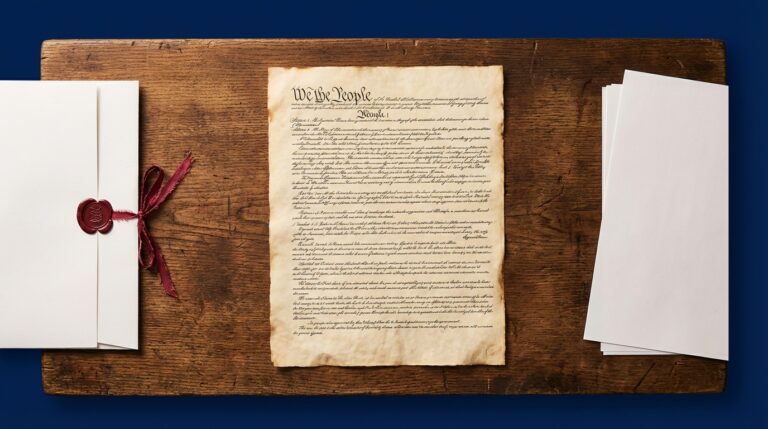
This guide summarizes each clause in clear language, points readers to the full text held by the National Archives, and highlights key court decisions that shape how the amendment works today.
Quick answer: What the Fifth Amendment protects in the bill of rights
The Fifth Amendment, ratified December 15, 1791 as part of the bill of rights, provides five principal protections: a grand jury requirement for serious federal crimes, protection against double jeopardy, the privilege against compelled self-incrimination, the guarantee of due process, and the Takings Clause requiring just compensation. The National Archives hosts the amendment text as the authoritative primary source, which readers can consult for the exact wording and historical framing National Archives Bill of Rights transcript
In short, these protections operate across criminal procedure and property law and are interpreted through later court decisions and annotated legal guides such as the Constitution Annotated and legal overviews that explain clause-by-clause effects Constitution Annotated amendment V About
Read the Fifth Amendment and join the campaign updates
For the full wording see the National Archives transcript and consult clause-by-clause resources like the Constitution Annotated for annotated explanations.
Where the amendment comes from and why it appears in the bill of rights
Ratification and placement in the Bill of Rights
The Fifth Amendment was ratified on December 15, 1791 and was included among the first ten amendments commonly called the Bill of Rights; the original transcript gives the exact language and placement in that set of amendments National Archives Bill of Rights transcript and related educational materials at the Reagan Library Reagan Library lesson plan
Readers who want an interpretive guide should treat the primary text and modern annotations as complementary. The Constitution Annotated offers clause-by-clause discussion that explains how language in the amendment has been applied in later cases Constitution Annotated amendment V See related coverage on the site constitutional rights.
How legal reference works today: primary text versus annotation
When you read the amendment text, you see the original wording but not the later rules that courts have developed. For practical rights and procedures, authoritative summaries such as those from legal information services provide plain-language explanations and cite key cases Cornell LII Fifth Amendment overview and the LII Wex page LII Wex: Fifth Amendment
Those annotated sources also flag areas of active debate into 2025 and 2026, for example how the privilege and due process apply to digital evidence and biometric questions, helping readers follow new rulings and proposals Interactive Constitution amendment V
Clause-by-clause: the five core protections of the Fifth Amendment

Grand jury indictment requirement
Textually, the amendment provides that no person shall be held to answer for a capital, or otherwise infamous crime, unless on a presentment or indictment of a grand jury. That clause means federal law generally requires a grand jury indictment before prosecuting serious federal crimes, and you can read the primary phrasing in the National Archives transcript National Archives Bill of Rights transcript
Authoritative commentary explains that the grand jury requirement applies to federal capital or infamous crimes but not to most state prosecutions, where state constitutions or statutes govern charging procedures; the Constitution Annotated provides a clause-level discussion of how that limitation works Constitution Annotated amendment V
The Fifth Amendment contains five protections: grand jury indictment for certain federal crimes, protection against double jeopardy, privilege against compelled self-incrimination, due process, and just compensation for takings; the National Archives publishes the amendment text and annotated guides explain how courts interpret it.
Protection against double jeopardy
The amendment protects against multiple prosecutions or punishments for the same offense, a principle called double jeopardy; courts have developed tests and exceptions that define when retrials or separate punishments are barred under the amendment Constitution Annotated amendment V
That protection prevents successive prosecutions for the same offense under most circumstances, but case law and some statutory rules create narrow exceptions and analytic tests that determine application in complex cases Cornell LII Fifth Amendment overview
Privilege against compelled self-incrimination
The amendment bars the government from forcing a person to testify against themselves in a criminal case; this privilege underlies rules that protect a suspect’s choice to remain silent during police questioning Cornell LII Fifth Amendment overview
For custodial questioning, the Supreme Court’s decision in Miranda v. Arizona set the modern framework that governs when police must give warnings and how courts treat statements obtained in custody Miranda v. Arizona opinion text
Due process guarantee

The amendment’s due process clause ensures that the federal government must follow fair procedures before depriving a person of life, liberty, or property; courts read that clause to protect both procedural fairness and certain substantive rights in defined contexts Constitution Annotated amendment V
Practically, due process is the legal test courts use to assess whether government action followed required procedures and respected protected interests, with detailed analyses available in clause-by-clause resources Cornell LII Fifth Amendment overview
Takings Clause and just compensation
The Takings Clause provides that private property shall not be taken for public use without just compensation, requiring the government to pay for property it acquires under eminent domain; the clause text and discussion are set out in primary and annotated sources National Archives Bill of Rights transcript
Legal summaries explain that what counts as public use and how compensation is calculated depend on case law and statutes, which is why readers often consult the Constitution Annotated and legal overviews for the doctrine’s practical contours Constitution Annotated amendment V
Key Supreme Court decisions and how they shape Fifth Amendment doctrine
Miranda v. Arizona and compelled self-incrimination
Miranda v. Arizona is the primary Supreme Court case that defined modern procedures for custodial interrogation and the privilege against compelled self-incrimination; the decision explains when police must provide warnings and how courts treat statements taken in custody Miranda v. Arizona opinion text
In practice, Miranda governs custodial settings and the admissibility of statements, but courts and scholars also discuss limits and applications as contexts change, so annotated case summaries remain useful for current practice Cornell LII Fifth Amendment overview
Double jeopardy cases and established tests
Supreme Court precedent establishes tests for double jeopardy questions, such as whether two prosecutions are for the same offense or whether separate punishments are permissible; authoritative annotated analyses explain these tests in detail Constitution Annotated amendment V
Those precedents shape when courts will bar retrials or multiple punishments, and readers looking for doctrinal summaries should consult clause-by-clause resources that track key decisions and statutory adjustments Cornell LII Fifth Amendment overview
Kelo and Takings Clause precedent
The Supreme Court’s decision in Kelo v. City of New London affirmed a broad reading of public use for eminent domain, a ruling that prompted legislative responses in many states and remains central to contemporary takings debates Kelo v. City of New London opinion text
Because Kelo expanded the practical reach of public-use takings, many states enacted reforms to narrow eminent domain powers, and readers can consult annotated sources for state-level summaries and follow-up commentary Interactive Constitution amendment V
How the Takings Clause works and why Kelo shifted the debate
What counts as public use
The Takings Clause requires that private property taken for a public use be compensated, but defining public use has been the subject of judicial interpretation and legislative response; the Kelo decision is a central reference for that line of cases Kelo v. City of New London opinion text
After Kelo, many state legislatures adopted reforms to limit takings for economic development projects, reflecting a political and statutory reaction to the Court’s broad reading of public use Interactive Constitution amendment V
Just compensation and how it is calculated
Just compensation is measured by principles that aim to put the property owner in the position they would have occupied absent the taking, but valuation methods and procedural rules vary by jurisdiction and are discussed in the Constitution Annotated and legal primers Constitution Annotated amendment V
When compensation disputes arise, courts use appraisal methods and statutory guidance to set payment, and authoritative summaries are the practical starting point for understanding how valuations are applied in specific cases Cornell LII Fifth Amendment overview
State-level responses to Kelo
Following Kelo, many state legislatures enacted changes to restrict eminent domain for private redevelopment or to require higher procedural safeguards, an outcome documented in legal commentary and state summaries Interactive Constitution amendment V
Those reforms illustrate how a Supreme Court interpretation can lead to varied state responses that reshape how the Takings Clause operates in practice without changing the constitutional text Constitution Annotated amendment V

Common misunderstandings and legal pitfalls to avoid
When the Fifth Amendment applies and when it does not
Myth: The grand jury clause applies to all prosecutions. Fact: The grand jury indictment requirement in the amendment applies to federal capital or infamous crimes; states may use other charging tools under their own laws and constitutions Constitution Annotated amendment V
Myth: Invoking the Fifth stops all questioning. Fact: The privilege protects against compelled testimony, but its practical effect depends on context, whether the person is in custody, and the specific procedural posture of a case Cornell LII Fifth Amendment overview
Miranda is not a magic shield outside custodial settings
Miranda warnings apply to custodial interrogation; they do not automatically prevent all questioning in noncustodial settings, a distinction that appears in case summaries and practice guides Miranda v. Arizona opinion text
Understanding when Miranda is required helps avoid assuming the privilege applies in every interaction with law enforcement, and annotated legal resources explain the custodial test and the consequences of failure to warn Constitution Annotated amendment V
Difference between federal and state procedures
Procedural protections can vary between federal prosecutions and state cases; for example, the grand jury clause operates specifically in the federal context as described in detailed clause analyses Constitution Annotated amendment V
Readers should check both federal sources and relevant state materials when determining how Fifth Amendment principles apply to a particular case or jurisdiction Cornell LII Fifth Amendment overview
Practical examples and scenarios: how courts apply the Fifth Amendment
An arrest and the Miranda warning in practice
Scenario: A person is taken into custody and questioned about an alleged offense. Under modern rules, police must provide Miranda warnings before custodial interrogation if they intend to use statements in prosecution, and courts exclude statements obtained in violation of Miranda under many circumstances Miranda v. Arizona opinion text
Takeaway: If a person is in custody and not told their rights, a court may suppress statements made during interrogation, but the suppression analysis depends on the factual record and subsequent proceedings Cornell LII Fifth Amendment overview
quick reference to lookup cases and clause explanations
Use official transcripts and annotated guides
When a witness can refuse to testify
Scenario: A witness in court is asked a question that could incriminate them. The witness may invoke the Fifth Amendment privilege against compelled self-incrimination to refuse to answer, and courts use established rules to assess the claim Cornell LII Fifth Amendment overview
Takeaway: Invoking the privilege generally protects against compelled testimony that would be self-incriminating, but procedural steps and judicial rulings determine when the invocation is upheld in a specific case Constitution Annotated amendment V

Eminent domain case example
Scenario: A city uses eminent domain to transfer privately held land to a developer for a mixed-use project. Kelo is often cited when courts evaluate whether such a taking satisfies the public-use standard, and that decision influenced many state legislative responses Kelo v. City of New London opinion text
Takeaway: Property owners faced with takings for redevelopment often rely on state reforms and constitutional claims to challenge the taking or to seek fairer compensation; annotated sources and state statutes are the next step for specific case planning Constitution Annotated amendment V
Looking ahead: open questions and reliable sources to watch
Digital evidence, compelled decryption, and biometric issues
Open issue: Courts and scholars are debating how the privilege and due process apply to compelled decryption and biometric evidence, with annotated legal commentary tracking developments and case filings Cornell LII Fifth Amendment overview
Readers should follow primary opinions and reputable annotated guides to see how courts apply historic tests to new technologies and enforcement methods Constitution Annotated amendment V
Potential legislative changes after Kelo-era reforms
Open issue: Kelo spurred state reforms, and future legislative activity may continue to refine how takings are limited or compensated in particular states; authoritative sources track those statutory changes and their effects Interactive Constitution amendment V
For updates, the Constitution Annotated, Cornell LII, and primary Supreme Court opinions are reliable resources that journalistic and civic readers commonly use to follow doctrine as it evolves and our news page.
Further reading and authoritative resources
Primary sources: read the Fifth Amendment’s exact wording at the National Archives transcript and consult Supreme Court opinions for the definitive legal holdings National Archives Bill of Rights transcript and educational summaries like the Annenberg Classroom Annenberg Classroom
Annotated guides: the Constitution Annotated and the Cornell LII Fifth Amendment overview are practical starting points for plain-language summaries and clause-by-clause discussion Constitution Annotated amendment V
The grand jury clause specifically applies to federal capital or infamous crimes; states may use their own charging procedures and protections vary by state and statute.
Miranda warnings are required before custodial interrogation when statements taken in custody may be used in prosecution; applicability depends on the custody and interrogation facts in each case.
Kelo broadened the Court's public-use reading, which led many states to adopt legislative reforms limiting certain takings and adding procedural safeguards.
If you need to follow new rulings or state-level changes, authoritative resources and primary opinions will show how courts apply these clauses to modern issues.
References
- https://www.archives.gov/founding-docs/bill-of-rights-transcript
- https://constitution.congress.gov/constitution/amendment-5/
- https://www.law.cornell.edu/constitution/fifth_amendment
- https://constitutioncenter.org/interactive-constitution/amendments/amendment-v
- https://www.law.cornell.edu/supremecourt/text/384/436
- https://www.law.cornell.edu/supremecourt/text/545/469
- https://michaelcarbonara.com/contact/
- https://michaelcarbonara.com/issue/constitutional-rights/
- https://michaelcarbonara.com/news/
- https://michaelcarbonara.com/about/
- https://www.law.cornell.edu/wex/fifth_amendment
- https://www.reaganlibrary.gov/education/lesson-plans/high-school/constitutional-amendments/constitutional-amendments-amendment-5
- https://www.annenbergclassroom.org/resource/fifth-amendment/