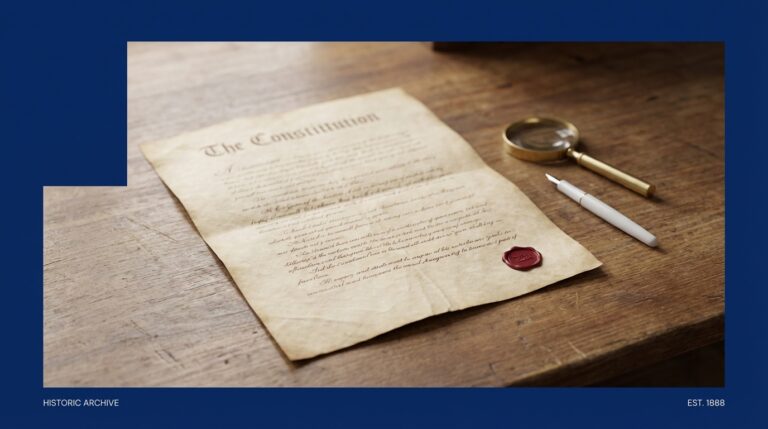
This explainer lays out the basic idea, how the Constitution and Federalist No. 51 describe it, the principal tools each branch uses, and the contemporary questions scholars are studying. It aims to give readers clear, sourced context for understanding why the system exists and how it operates in practice.
What checks and balances are and why they matter
Short definition: checks and balances government
Checks and balances are the set of constitutional arrangements that divide power so no single branch can rule unchecked. The Constitution establishes a division of functions among separate branches to prevent concentration of power, and that foundation remains central to how the national government is organized today, as shown in the original text of the document Constitution text at the National Archives.
The purpose of these arrangements is straightforward: assign lawmaking, execution, and adjudication to different institutions and then give each institution tools to limit the others. That structure aims to protect constitutional limits and to make unilateral action more difficult when it would exceed legal authority.
Stay informed about civic sources and updates
For a short look at the original legal text and a foundational explanation, consult primary sources and trusted modern summaries before reading further.
In everyday terms, checks and balances affect how quickly laws change, how agencies implement rules, and how disputes over constitutional limits reach the courts. Individual citizens may notice these effects in the timing of legislation, the pace of confirmations, or when courts resolve questions about what the law allows.
Where the idea comes from: the Constitution and Federalist No. 51
Text in the Constitution that creates separate branches
The legal basis for separation of powers is in the Constitution, which assigns distinct functions and structures to the legislative, executive, and judicial branches. The Constitution sets out those structures and powers in articles and clauses that define Congress, the presidency, and the federal judiciary Constitution text at the National Archives.

Madison’s argument in Federalist No. 51
In Federalist No. 51, James Madison explained the philosophical logic behind separating power: ambition must be made to counteract ambition. That line captures the framers’ idea that institutions should check each other so private interests and government actors cannot concentrate authority unchecked Federalist No. 51 at the Avalon Project.
Scholars and modern legal analysis continue to cite these sources when explaining the system. Federalist No. 51 provides the argumentative frame while the Constitution supplies the legal text that institutions rely on in practice.

The legal basis for separation of powers is in the Constitution, which assigns distinct functions and structures to the legislative, executive, and judicial branches. The Constitution sets out those structures and powers in articles and clauses that define Congress, the presidency, and the federal judiciary Constitution text at the National Archives.
The three branches and their core functions
Legislative: lawmaking and budget authority
Congress is charged with making laws, setting authorizing policy, and controlling appropriations. Those responsibilities give the legislature a central role in shaping public policy and limiting executive action through statutory rules and funding choices, as summarized in contemporary legal references Separation of Powers overview at Cornell Law School.

Congress also creates administrative agencies and sets the legal standards those agencies must follow. That link between lawmaking and oversight means legislative choices often determine the tools available to the executive branch.
They expected that institutional rivalry and separate incentives would prevent concentration of power, a logic James Madison summarized as ambition counteracting ambition.
Executive: execution of laws and administration
The President and the executive branch carry out laws, manage federal agencies, and administer programs. Execution and administration are distinct from making law; the executive acts under statutes and regulations that Congress supplies, and courts review that execution when legal questions arise.
The executive branch also proposes budgets and policy priorities, but its actions are subject to congressional control through appropriations and to judicial review if they raise constitutional issues.
Judicial: interpretation of law and review
The federal courts interpret statutes and the Constitution and resolve disputes about how laws apply. The judiciary’s role includes reviewing whether legislative or executive actions comply with the Constitution, and that review function serves as a legal check on other branches Marbury v. Madison summary at Oyez.
Courts decide cases brought by parties with standing and can invalidate laws or actions that conflict with constitutional limits, which shapes how policy and administration proceed over time.
How Congress checks the executive and the courts
Appropriations and budget control
Congress can use its appropriations power to shape or restrict executive priorities by controlling funding. Budget and spending authority are powerful practical levers because they determine which programs can operate and at what levels; this dynamic is described in contemporary legal and policy analyses Separation of Powers overview at Cornell Law School.
Because appropriations are renewed on schedules and often require negotiation, they create incentives for compromise and also for standoffs when branches disagree.
Oversight and investigations
Congressional oversight uses hearings, document requests, and committee investigations to gather facts and to hold officials accountable. Oversight is a procedural tool that relies on the legislature’s investigatory authorities rather than on courts for immediate coercive effect, and analysts note it functions within political as well as legal boundaries Brookings Institution analysis on institutional resilience.
Oversight can expose problems, shape public debate, and inform legislation, but its impact depends on majority support in the relevant committees and on follow-up actions such as subpoenas or appropriations choices.
Impeachment and removal
Impeachment provides a constitutional mechanism for removing officials who have committed serious misconduct. The Constitution sets out impeachment in a legal framework; the House brings charges and the Senate tries removal, which ties a legal process to political judgment and limits on the executive and other federal officials Constitution text at the National Archives.
Impeachment is both legal and political: it follows procedures in the Constitution but its use depends on political will and the votes of legislators, so it serves as a high-stakes check rather than an everyday tool.
How the executive is checked: vetoes, appointments, and limits
Presidential veto and congressional override
The President can veto legislation, which requires Congress to reconsider a bill or attempt an override. The veto power is a designed check on legislative action, and Congress can override a veto by the supermajority required in the Constitution, creating a two-way control over lawmaking Constitution text at the National Archives.
Vetoes shape bargaining between branches because they change the votes needed to enact laws and encourage compromise when majorities are uncertain.

Advice and consent on appointments
The Senate’s advice-and-consent role for major appointments gives the legislature a direct say in who leads executive agencies and the judiciary. Confirmation votes influence the personnel who will interpret and apply the law, and the requirement of Senate approval creates a structural check on appointments.
Because appointments have long-term effects on policy and legal interpretation, the confirmation process is a significant tool for shaping the direction of government administration.
Statutory and judicial limits on executive power
Legislatures can limit executive discretion by passing statutes that define or constrain administrative authority. Courts can also review executive actions and set legal limits if officials exceed statutory or constitutional authority, which creates a layered system of checks between branches Separation of Powers overview at Cornell Law School.
Those statutory and judicial limits intersect: courts often consider statutes when reviewing whether executive action is lawful, and Congress can modify statutes to respond to judicial decisions.
How courts check the other branches: judicial review and Marbury v. Madison
What judicial review means
Judicial review is the authority of courts to assess whether laws or executive acts conflict with the Constitution and to declare them invalid if they do. That power makes courts the ultimate interpreters of constitutional text in individual cases and a central legal check on both legislature and executive authority Marbury v. Madison summary at Oyez.
Judicial review operates through cases and controversies; courts do not issue advisory opinions but decide real disputes brought before them, which channels constitutional questions into the judiciary.
Marbury v. Madison and its significance
Marbury v. Madison is the landmark case historically associated with judicial review because the Supreme Court there asserted the power to invalidate acts that conflict with the Constitution. The decision remains a central reference point in understanding the judiciary’s role in checking other branches Marbury v. Madison summary at Oyez.
While the case set an enduring principle, how judicial review works in practice depends on court procedures, standards of review, and the specific legal issues that parties bring to court.
Specific institutional tools: impeachment, oversight, and advice and consent
How each tool works procedurally
Impeachment begins in the House, which can vote to impeach federal officials; the Senate then holds a trial and may remove an official upon conviction. Those steps are defined in constitutional text and amplified by chamber rules and precedents Constitution text at the National Archives.
Advice and consent for appointments follows Senate procedures that include committee hearings and floor votes. Oversight uses committee authorities such as subpoenas and hearings to collect information relevant to legislative decisions.
Quick procedural checklist for impeachment steps
Use as a procedural reference
Limits and political context
Each tool has legal rules and political dimensions. For example, impeachment follows constitutional steps but is influenced by partisan calculations and public opinion. Oversight can expose wrongdoing but may not lead to legal penalties without evidence that meets judicial standards Brookings Institution analysis on institutional resilience.
That mixture of law and politics means procedural tools can check authority but their effectiveness often depends on political will and institutional norms.
Concrete historical and recent examples of the system in action
Marbury and early judicial review
Marbury v. Madison is often taught as the foundational example of judicial review, illustrating how the courts can rule laws or actions inconsistent with the Constitution. The case is central in historical summaries of the judiciary’s role Marbury v. Madison summary at Oyez.
Recent oversight and litigation in the 2020s
Since the 2020s, analysts have documented stresses on checks and balances from political polarization, increased use of litigation, and challenges to institutional norms. These trends are active topics in contemporary institutional analysis and scholarly debate rather than settled conclusions Brookings Institution analysis on institutional resilience.
Observers note that aggressive oversight and more frequent legal challenges change how quickly disputes move and how institutions interact, while scholars study resilience and possible reforms.
Vetoes and overrides in practice
Presidential vetoes and congressional override attempts provide concrete examples of branch interaction. A veto forces Congress to choose between amending legislation or attempting the supermajority required for override, which illustrates how the veto can shape legislative strategy.
These interactions are routine examples of checks and balances at work: they reflect rules written in the Constitution and developed in practice by political actors.
Why the framers set overlapping powers: ambition counteracting ambition
Madison’s logic explained
Federalist No. 51 argues that institutional competition can restrain abuse because each branch has incentives to protect its own authority. Madison framed the solution as a system where personal and institutional ambition check one another rather than relying on virtue alone Federalist No. 51 at the Avalon Project.
The framers built structural friction into the system, for example by separating elections, creating different term lengths, and distributing appointment powers, to reduce the risk that power would gather in a single office or body.
How overlapping powers create incentives
When branches share authority or have intersecting roles, they must negotiate outcomes. That overlap creates incentives to bargain, to build coalitions, or to seek judicial resolution when political compromise fails.
Those incentives are deliberate: the framers treated friction and competition as safeguards that make abuse of concentrated power harder.
Contemporary pressures: polarization, norms, and litigation
Scholarly observations since the 2020s
Analysts since the 2020s have highlighted that partisan polarization and frequent litigation can strain institutional checks and the norms that support them. These observations are part of an active research agenda and do not settle whether the system is fundamentally broken or resilient Brookings Institution analysis on institutional resilience.
Scholars emphasize that formal rules operate alongside informal norms; when norms erode, legal checks still apply but practical effectiveness can change.
How norms affect formal checks
Norms such as restraint in using certain tools, respect for precedent, and cooperation across branches help the written rules function as intended. If norms weaken, actors may use formal powers in new ways that test institutional limits.
Policy debates and scholarly work continue to assess which reforms could strengthen resilience without producing unwanted trade offs.
Common misconceptions about checks and balances
Checks as short term fixes rather than structural safeguards
A common myth is that checks and balances guarantee particular policy outcomes. In reality, they are structural safeguards that shape procedures and incentives; they do not promise specific legislative results or political bargains. Legal summaries make clear the system defines roles and limits but not fixed policy effects Separation of Powers overview at Cornell Law School.
That difference matters: the system constrains authority and provides remedies for legal violations, but politics still determines many short-term outcomes.
Mistaking political outcomes for constitutional certainty
Another misconception is that when institutions clash, the Constitution always prescribes a clear winner. Many conflicts require legal interpretation or political resolution, and courts decide discrete legal questions brought before them rather than resolving every political dispute by decree.
Thus, political tension can test the system without proving a constitutional violation; legal safeguards kick in when actions cross statutory or constitutional lines.
How checks and balances affect everyday government decisions
Policy timing and compromise
Budget cycles, committee rules, and the need for majorities shape how and when policies become law. These practical constraints reflect the separation of powers and make timing and compromise central parts of policymaking, as described in legal and procedural summaries Separation of Powers overview at Cornell Law School.
Lawmakers plan around appropriations deadlines and committee schedules, which can accelerate or delay policy depending on political alignment and priorities.
Administrative rulemaking and judicial oversight
Agencies issue rules under statutory authority, and those rules can be challenged in court if they exceed statutory or constitutional bounds. Judicial review of agency action is a common way courts check executive administration and ensure conformity with law Marbury v. Madison summary at Oyez.
Appointees and confirmations also influence long term policy direction, because officials in agencies and on courts help enforce or reinterpret statutory schemes over time.
Open questions and debates about reform and resilience
Proposed fixes and their trade offs
Scholars have proposed reforms ranging from procedural changes in Congress to adjustments in executive practice and judicial administration. Each proposal brings trade offs: strengthening one check can weaken flexibility, while preserving norms can limit accountability in some cases. Contemporary analyses lay out these trade offs without prescribing a single solution Brookings Institution analysis on institutional resilience.
Debates include whether formal rules, renewed norms, or structural changes would better preserve balance and function in a highly polarized environment.
What scholars are watching next
Researchers are watching how changes in litigation patterns, administrative practice, and political behavior affect institutional resilience. They also study whether reforms can attract bipartisan support and how new technologies influence governance processes.
These are active questions for legal scholars and institutional analysts; there is not a settled consensus about the best path forward.
Key takeaways and where to read the primary sources
Short summary
Three brief takeaways: first, the Constitution creates separation of powers to prevent concentration of power; second, specific tools like vetoes, oversight, and judicial review let branches limit each other; third, scholars continue to study how political pressures affect the system’s resilience.
Primary sources and modern analyses to consult
To read primary texts and modern summaries, start with the Constitution text and Federalist No. 51 for foundation, then consult accessible legal summaries and policy analyses such as Cornell’s Legal Information Institute, the Bill of Rights Institute, the Encyclopaedia Britannica, and recent institutional work by analysts at Brookings for contemporary context Constitution text at the National Archives.
These sources provide both the original legal framework and up-to-date discussion of how checks and balances operate in practice.
The main purpose is to prevent concentration of power by distributing functions among branches and giving each branch tools to limit the others.
Judicial review lets courts decide legal and constitutional questions in cases before them, but courts resolve disputes brought to them rather than making policy directly.
Scholars note increased strain from polarization and litigation, but they describe these trends as subjects of ongoing study rather than definitive collapse.
For voters researching candidates, including Michael Carbonara, campaign pages and primary filings provide statements of priorities but should be read alongside constitutional and legal sources for institutional context.