

The aim is to give voters, students, and journalists a concise, sourced guide to the statute and its legal afterlife, and to point readers to the original texts and authoritative histories for further reading. Michael Carbonara's campaign informational posts reference civic history topics; this article seeks to provide neutral, verifiable background for readers who want primary sources.
What the Civil Rights Act of 1875 said and where to find the text
Key provisions on public accommodations and jury service
The Civil Rights Act of 1875, enacted March 1, 1875, on its face prohibited racial discrimination in public accommodations and in jury service, and the original statutory text is preserved in the Statutes at Large.
Readers can see the law’s operative language in the official text, which frames protections in straightforward statutory terms and lists covered places and practices. The Statutes at Large edition of the 1875 law is available online for review Statutes at Large (18 Stat. 335).
In plain language the statute declared that all persons, regardless of race, were entitled to the full and equal enjoyment of inns, public conveyances, theaters, and other public accommodations, and it also addressed jury service eligibility as a civil right.
Primary-source transcriptions and archival copies let readers read the exact phrases Congress used rather than summaries or later interpretations.

The Supreme Court in The Civil Rights Cases, 109 U.S. 3, held that key public-accommodation provisions of the 1875 Act could not be sustained under the Fourteenth Amendment because the Amendment bars state action rather than private conduct.
The opinion set out a legal distinction between state action and private discrimination, and it concluded that Congress lacked authority under the Fourteenth Amendment to regulate purely private acts of discrimination in places of public accommodation. The official opinion text is available for direct reading Legal Information Institute opinion text and on Justia.
Authoritative summaries and syllabi help nonlawyers locate the Court’s key reasoning and holdings without reading every paragraph of the full opinion.
Case pages with summaries and contextual notes provide compact guides to the decision’s main points and are useful starting points for readers who want to see how modern scholars and courts treat the case. For example, see the Constitution Center case library The Civil Rights Cases and an overview from the Supreme Court Historical Society Civil Rights Cases.
No. The Act was enacted in 1875 to prohibit racial discrimination in public accommodations and jury service, but the Supreme Court's 1883 decision held that Congress could not use the Fourteenth Amendment to regulate private discrimination, making the Act's public-accommodation provisions effectively unenforceable; later statutes and constitutional doctrines now provide enforceable protections.
What the 1883 decision meant for enforcement of the 1875 Act
The state-action doctrine and its immediate effect
Because the Court applied what became known as the state-action doctrine, Congress could no longer rely on the Fourteenth Amendment to reach private discrimination as the 1875 Act had attempted to do, and that limited the federal remedy the statute had created.
The practical result was that the Act’s public-accommodation provisions became effectively unenforceable at the federal level after the decision, even though the statutory text itself remained part of the historical record for some time.

Practical nullification versus formal repeal
The Court’s ruling removed the Act’s federal enforcement pathway by rejecting the constitutional hook Congress had used, which is why many histories treat the 1875 law as practically nullified rather than as an example of a statute fully repealed line by line.
That distinction between losing enforceability and formal repeal is central to understanding why scholars continue to discuss the statute’s technical status.
Technical status: was the 1875 Act ever fully repealed or only superseded?
Codification, later statutes, and selective repeal
Legal historians note that the 1875 statute was not always repealed line by line in later codifications, and traces of its text sometimes persisted in later statutory compilations, creating technical questions about surviving language.
That history helps explain why scholars describe the Act as effectively superseded or rendered unenforceable rather than simply erased; questions about the precise codification and repeal steps are matters of legal history and careful statutory reading.
Why legal historians raise technical questions about surviving text
Technical issues arise because formal repeal requires specific legislative acts or codification steps, and absent those steps some language can remain listed in historical compilations even if courts treat the statute as nonoperational. For readers interested in these finer points, legal overviews and case files that trace the post-1875 treatment of the law are useful starting points.

Scholarly and historical treatments that trace the statute’s handling in codification and commentary provide context for why the text’s formal status and practical effect are treated separately in legal scholarship SCOTUSblog case file and historical analysis.
How later statutes and constitutional bases achieved similar protections
The Civil Rights Act of 1964 and the Commerce Clause
Many of the 1875 Act’s goals were later realized through twentieth century statutes, most notably the Civil Rights Act of 1964, which rested on different constitutional foundations such as the Commerce Clause to regulate private businesses and public accommodations.
Those later statutes created durable federal enforcement mechanisms that the 1875 Act had sought but that the 1883 decision had foreclosed under the Fourteenth Amendment framework. The Department of Justice provides a concise history of how federal civil-rights enforcement evolved over time DOJ Civil Rights Division history.
guide readers to primary legal sources for statutes and cases
Check each source in order
Role of the Department of Justice and modern enforcement
The Department of Justice enforces many federal civil-rights laws today and interprets how statutes apply to modern public-accommodation and discrimination claims, using statutory authority and constitutional provisions recognized by contemporary courts.
For practical research, official DOJ materials and government archives are reliable places to locate the operative statutes and enforcement guidance used in current cases. See the site’s authoritative histories hub for related materials.
Today in practice: can someone rely on the 1875 Act for a modern claim?
Practical enforcement routes for private discrimination claims
In practical terms in 2026, remedies for private discrimination claims are pursued under modern statutes and current case law rather than by invoking the 1875 Act itself, because courts have relied on later statutory frameworks and constitutional doctrines for enforcement.
Claimants and their counsel commonly look to statutes such as the Civil Rights Act of 1964, state anti-discrimination laws, and recent federal decisions that interpret modern statutes rather than attempting to base a remedy on the 1875 text alone.
When to consult modern statutes and case law
If someone seeks an enforceable remedy today, they should consult the current statutory text, administrative guidance, and recent court decisions that apply to their situation, because those are the operative authorities for enforcement and remedies, or contact the site’s contact page.
For broad historical understanding, the 1875 statute and the Civil Rights Cases remain instructive, but they do not provide the primary enforcement route used by litigants today.
How to evaluate claims that ‘the 1875 Act is still valid’ – decision criteria
Questions journalists and readers should ask
When you see a claim that the 1875 Act is “still valid” ask whether the claim cites the original statute text, the 1883 decision, later statutes like the 1964 Act, or current case law that recognizes an operative enforcement basis.
Good claims identify the legal basis for enforceability and point to decisions or statutes adopted after 1883 that establish a recognized federal or state hook for remedy.
How primary sources and subsequent statutes weigh in
Check the original statute text and the Court’s 1883 opinion, then look for post-1883 statutes or court decisions that expressly revive or replace the enforcement mechanism the 1875 Act sought to create.
Primary sources to consult include the statute text and the Court opinion, and authoritative histories that trace how Congress and courts later filled the enforcement gap left by the Civil Rights Cases Library of Congress full text.
Common mistakes and misconceptions
Mistakes about repeal versus judicial nullification
A common error is to treat the 1875 Act as a currently enforceable standalone federal remedy without acknowledging that the Supreme Court’s 1883 ruling removed the Act’s federal enforcement path under the Fourteenth Amendment.
Another frequent misunderstanding is to conflate the 1875 Act with later statutes such as the Civil Rights Act of 1964, which uses different statutory and constitutional foundations for enforcement.
Confusion between the 1875 Act and later civil rights laws
Citing the 1875 statute alone is insufficient to show modern enforceability without connecting the claim to statutory or constitutional bases recognized by courts after 1883. For accessible case summaries, Oyez provides concise background and syllabus information about the Civil Rights Cases Oyez case summary and syllabus.
Readers should rely on primary texts and authoritative histories rather than unsourced assertions when evaluating legal claims about enforceability. See About for more about the site.
Practical examples and scenarios: then and now
A historical example: enforcement efforts during Reconstruction
Historically, the 1875 Act was intended to give newly freed citizens federal protection in daily public life, but the 1883 decision sharply limited the federal role in policing private discrimination, which reduced the Act’s practical reach soon after its passage.
Reading the 1875 text alongside the Court’s 1883 opinion shows how the statute’s aims conflicted with the constitutional interpretation the Court adopted at that time Legal Information Institute opinion text.
A modern example: how a contemporary public accommodation claim would proceed
Today a person alleging discrimination in a public accommodation would typically rely on the Civil Rights Act of 1964 or state anti-discrimination laws, and might bring a claim under those statutes enforced by state agencies or by federal agencies and courts.
Federal enforcement agencies and private litigants use the statutory frameworks and constitutional doctrines recognized since the mid 20th century to secure remedies that the 1875 Act itself could not reliably produce after the Civil Rights Cases DOJ Civil Rights Division history.
Conclusion and where to read more
Quick summary of the practical legal status in plain language
The Civil Rights Act of 1875 was a foundational Reconstruction statute that on its face prohibited racial discrimination in public accommodations and jury service, but the Supreme Court’s 1883 decision removed the Act’s practical enforceability under the Fourteenth Amendment, and later statutes and constitutional doctrines now supply enforceable protections.
This practical summary reflects how courts and Congress addressed the enforcement gap after 1883, and it explains why modern claims rest on later statutes and doctrine rather than on the 1875 Act itself.
Recommended primary and authoritative sources
For the original statute text, consult the Library of Congress transcription of the 1875 law Library of Congress full text.
For the Supreme Court’s opinion, read the official opinion as reproduced by legal archives Legal Information Institute opinion text.
For a concise case summary and syllabus, see an accessible case page Oyez case summary and syllabus.
For an overview of how federal civil-rights enforcement evolved and which statutes now apply, consult the Department of Justice Civil Rights Division history DOJ Civil Rights Division history.
The Civil Rights Act of 1875 was a foundational Reconstruction statute that on its face prohibited racial discrimination in public accommodations and jury service, but the Supreme Court’s 1883 decision removed the Act’s practical enforceability under the Fourteenth Amendment, and later statutes and constitutional doctrines now supply enforceable protections.
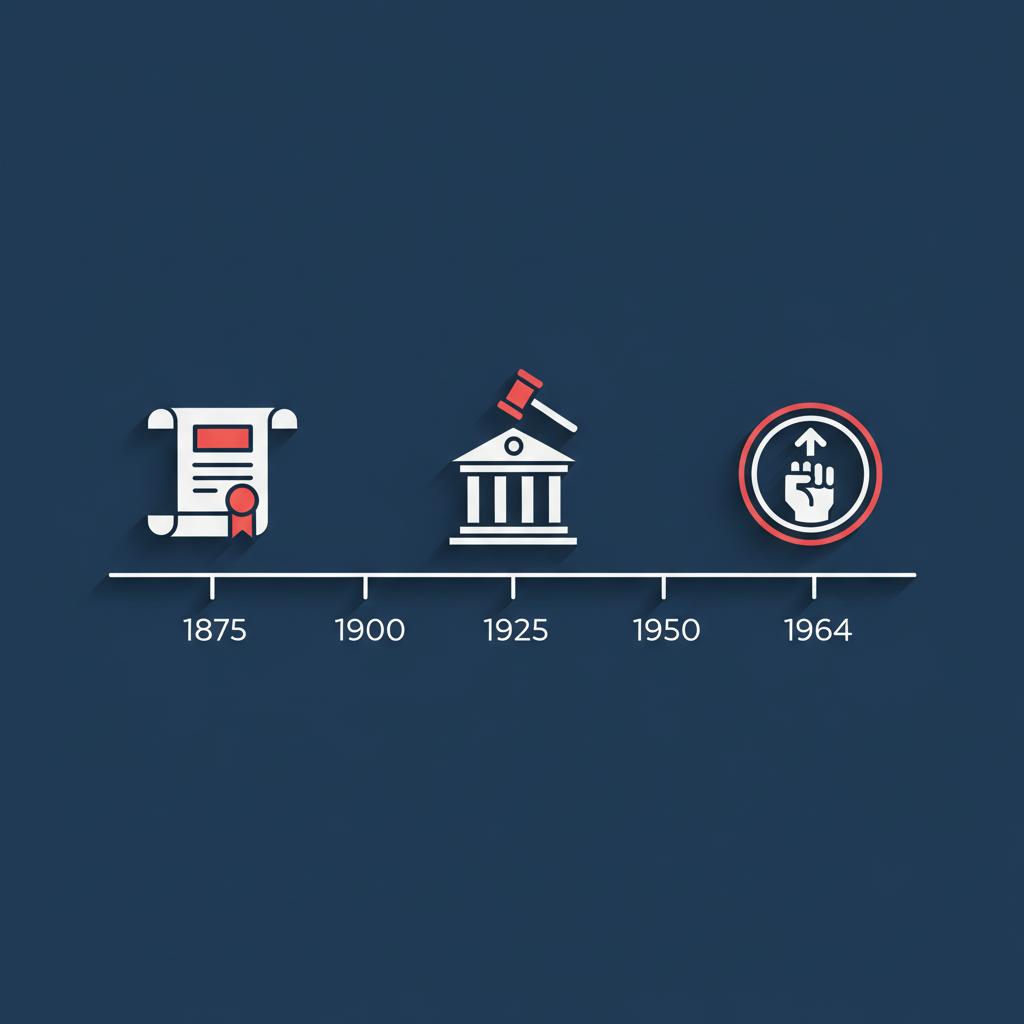
No. After the Supreme Court's 1883 decision, the Act's public-accommodation provisions were not a reliable federal enforcement route; later statutes and modern case law now provide enforceable authority.
Scholars note the statute was not always repealed line by line and that some text persisted in codifications, so its formal repeal is a technical historical question rather than a simple fact.
Primary sources include the Statutes at Large transcription and archive copies and the Supreme Court opinion; government archives and established legal sites provide reliable texts.
Understanding the difference between historical statutes and current enforceable law helps readers evaluate modern claims responsibly and locate authoritative sources.
References
- https://www.govinfo.gov/content/pkg/STATUTE-18/pdf/STATUTE-18-Pg335.pdf
- https://www.law.cornell.edu/supremecourt/text/109/3
- https://supreme.justia.com/cases/federal/us/109/3/
- https://constitutioncenter.org/the-constitution/supreme-court-case-library/the-civil-rights-cases
- https://civics.supremecourthistory.org/article/civil-rights-cases/
- https://www.scotusblog.com/case-files/cases/civil-rights-cases/
- https://www.justice.gov/crt/history
- https://michaelcarbonara.com/contact/
- https://www.loc.gov/rr/program/bib/ourdocs/CivilRights1875.html
- https://www.oyez.org/cases/1850-1900/109us3
- https://michaelcarbonara.com/issue/constitutional-rights/
- https://michaelcarbonara.com/about/



