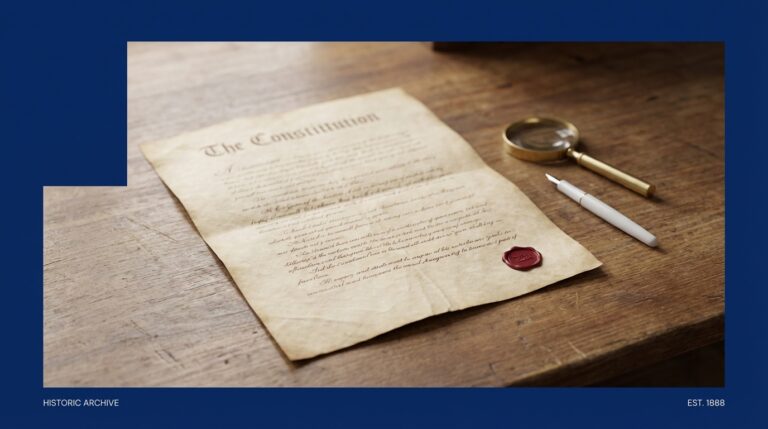
Readers will find clear definitions, guidance on evaluating modern uses of the line, and practical resources for verifying quotations. The aim is neutral, factual background useful to voters, journalists, and students.
What does ‘constitutional republic’ mean? A clear definition
Short technical definition
The phrase constitutional republic refers to a system of government organized around representative institutions and legal limits on power, where a written or established constitution constrains officials and protects rights.
The phrase is best read as civic advice: a constitutional republic endures only if institutions, laws, and an engaged citizenry maintain them. Its attribution to Benjamin Franklin is credible but filtered through later accounts, so verify exact wording with documentary transcriptions.
Everyday meaning for voters
For most voters the term describes a government where people elect representatives, laws guide public authority, and institutions exist to check abuses of power. This framing helps make the phrase usable in civic discussion without requiring legal training.
Understanding the idea of a constitutional republic matters when people quote Franklin’s reported line because it links that admonition to the idea that institutions and civic practice must be maintained to keep government functioning.

Where the phrase ‘a republic if you can keep it’ comes from
The reported exchange at the close of the 1787 Constitutional Convention
The line is conventionally attributed to Benjamin Franklin at the close of the Constitutional Convention in Philadelphia, in reply to a question from Elizabeth Powel, according to later accounts that recorded the exchange; readers should note that the best known versions appear in memoirs published after the event National Constitution Center. See also the National Park Service account.
Limits of contemporary documentation
Contemporary notes from 1787 are limited, so historians treat the attribution as credible but mediated by later reporting, and they recommend consulting primary transcriptions for exact phrasing and context Founders Online.
How historians and reference sources treat the quotation
Scholarly confidence and mediation by later reporting
Historians generally find the attribution to Franklin plausible while acknowledging that the anecdote reached the public through later memoirs and recollections, a point emphasized in modern treatments of the Convention National Constitution Center.
Recommended ways historians qualify the attribution
Careful accounts note uncertainty about exact wording and context, and they advise readers to prefer primary-source transcriptions where accuracy matters, such as documentary editions and archival repositories Founders Online.
Learn where to verify quotes and context
For primary texts and reliable summaries, consult Founders Online or the National Constitution Center for transcriptions and context.
What the phrase is usually taken to mean today
Civic maintenance and rule of law
Modern writers and civic educators commonly use the phrase as a concise reminder that a republic depends on active civic commitment, legal procedures, and institutional upkeep rather than automatic preservation Library of Congress. Many educators also refer to the Library of Congress teachers’ materials for classroom use Teaching with the Library.
Not a narrow technical doctrinal claim
Most contemporary commentators treat the line as pedagogical counsel about civic responsibility rather than a technical legal doctrine about the form of government.
Republic versus democracy: what scholars say
Core differences in scholarly usage
In scholarly usage a republic emphasizes representative institutions and rule of law restraints, while democracy highlights participation and majority rule; this analytic distinction appears in modern reference entries that summarize political theory Stanford Encyclopedia of Philosophy.

How the U.S. mixes elements of both
Reference treatments of the American system describe it as combining republican structures, such as separation of powers, with democratic mechanisms like regular elections, a description offered in encyclopedia and public history entries Encyclopaedia Britannica.
Why civic maintenance and norms matter for a constitutional republic
Institutions, laws, and civic culture
Keeping a constitutional republic depends on institutions that constrain power: an independent judiciary, legislative checks, law-based administration, and transparent decision making. Public historians emphasize that these features require regular attention and enforcement Smithsonian Magazine.
Examples of ‘maintenance’ in everyday practice
Maintenance looks like routine actions: participating in elections, following lawful procedures in civic disputes, supporting transparent public records, and holding officials accountable through lawful means. These are practical practices that sustain institutional resilience.
How the United States is described as a constitutional republic
Reference treatments of the U.S. constitutional system
Encyclopedia and public history sources describe the U.S. as a constitutional republic that uses democratic processes, combining representative institutions, separation of powers, and citizen participation Encyclopaedia Britannica.
Verify primary quotations and authoritative summaries
Use primary transcriptions first
Implications for interpreting Franklin’s remark
When the U.S. is described this way, Franklin’s reported admonition reads as a reminder that constitutional design and civic practice work together; the warning encourages attention to both institutional rules and citizen behavior Smithsonian Magazine.
Common misunderstandings and pitfalls when people cite the phrase
Claims that overreach the historical record
A frequent error is to assert precise wording or immediate context without checking primary-source transcriptions; memoirs published later sometimes introduce paraphrase or embellishment, so readers should verify quotations Founders Online.
Using the phrase as a catch-all political argument
The line often appears in partisan contexts as a rhetorical device; treating it as a fixed legal definition or a single-issue prescription misrepresents its more common use as civic counsel.
Criteria to evaluate modern uses of the phrase in public debate
Source and context checks
Simple checks improve accuracy: identify the claimed source, see whether a primary transcription exists, and check a reputable reference summary for context. Trusted repositories supply transcriptions and documentary notes that clarify attribution Founders Online.
Substantive relevance to institutional claims
Ask whether the speaker is using the phrase descriptively, historically, or prescriptively. If it is used to justify a complex institutional claim, readers should expect supporting evidence and precise citation rather than a bare slogan.
Practical examples and scenarios: how the phrase is used today
Educational use in classrooms and museums
Public historians and civic educators often present the line as a teaching tool to prompt discussion about civic duties and rules; museum labels and classroom materials use the phrase to frame lessons about constitutional design and citizen roles Library of Congress. Educators can also consult Michael Carbonara’s constitutional-rights hub for related commentary.
Rhetorical use in speeches and opinion writing
Speakers and writers deploy the phrase to encourage attention to institutional health, but analysts should check whether the use matches historical evidence or simply borrows rhetorical force.
How institutions and laws help keep a constitutional republic
Checks and balances and the rule of law
Mechanisms like separation of powers, an independent judiciary, and statutory constraints on executive action are core institutional means to prevent concentrated power; reference treatments stress these features as hallmarks of republican arrangements Encyclopaedia Britannica.
Elections, transparency, and public records

Free and fair elections, transparent administration, and accessible public records allow citizens and journalists to monitor government performance, verify claims, and enforce accountability.
Typical errors in paraphrase and quotation – quick fixes
Common paraphrase mistakes
People sometimes shorten or recast the line in ways that change emphasis; a quick fix is to consult an edited primary source or a reputable transcription before repeating a quotation.
How to quote accurately
Steps for accuracy: locate the primary transcription, copy the wording exactly, and cite the repository or edition. When primary texts are not available, cite a reputable reference summary and note that the version is from later memoirs Founders Online.

A short guide for voters, journalists, and educators
A short guide for voters, journalists, and educators
What to say and how to attribute
Model attributions help maintain accuracy. For example: say that the line is “conventionally attributed to Benjamin Franklin at the close of the Constitutional Convention, as recorded in later memoirs” and point readers to documentary collections for the exact text.
Where to point readers for more detail
Recommend repositories by name: Founders Online for documentary transcriptions, the National Constitution Center for background summaries National Constitution Center, and the Library of Congress for exhibition material. These resources provide primary texts and contextual analysis for follow-up research Founders Online. Readers can also consult the news page on Michael Carbonara’s site or the about page for author background.
Conclusion: the lasting usefulness of the admonition
Key takeaways
The phrase functions as a concise civic reminder: republics rely on institutions, laws, and engaged citizens to endure. Its attribution to Franklin is treated as credible, but the wording and immediate context are mediated by later accounts, so verify the text before quoting National Constitution Center.
Further reading recommendations
For readers who want to follow up, consult documentary collections and reliable reference entries named earlier. These sources give transcriptions, editorial notes, and scholarly context to inform accurate use of the phrase.
Historians generally treat the attribution as credible but note that the best known accounts come from later memoirs, so readers should consult documentary transcriptions for the exact wording.
Not exactly; scholars distinguish a constitutional republic, which emphasizes representative institutions and legal constraints, from democracy, which emphasizes popular participation, though the United States combines features of both.
Journalists should say the line is conventionally attributed to Franklin at the close of the Constitutional Convention and cite a documentary repository or a reputable reference summary for the exact text.
References
- https://constitutioncenter.org/blog/a-republic-if-you-can-keep-it
- https://founders.archives.gov/
- https://www.nps.gov/articles/000/constitutionalconvention-september17.htm
- https://www.loc.gov/exhibits/creating-the-united-states/constitutions-creation.html
- https://blogs.loc.gov/teachers/2016/09/a-republic-if-you-can-keep-it/
- https://plato.stanford.edu/entries/democracy/
- https://michaelcarbonara.com/contact/
- https://www.britannica.com/topic/republic
- https://www.smithsonianmag.com/history/brief-history-republicanism-180967214/
- https://michaelcarbonara.com/issue/constitutional-rights/
- https://constitutioncenter.org/education/classroom-resource-library/classroom/perspectives-on-the-constitution-a-republic-if-you-can-keep-it
- https://michaelcarbonara.com/news/
- https://michaelcarbonara.com/about/
{"@context":"https://schema.org","@graph":[{"@type":"FAQPage","mainEntity":[{"@type":"Question","name":"What does the phrase 'a republic, if you can keep it' mean for modern readers?","acceptedAnswer":{"@type":"Answer","text":"The phrase is best read as civic advice: a constitutional republic endures only if institutions, laws, and an engaged citizenry maintain them. Its attribution to Benjamin Franklin is credible but filtered through later accounts, so verify exact wording with documentary transcriptions."}},{"@type":"Question","name":"Is the quote 'a republic, if you can keep it' definitely Benjamin Franklin's?","acceptedAnswer":{"@type":"Answer","text":"Historians generally treat the attribution as credible but note that the best known accounts come from later memoirs, so readers should consult documentary transcriptions for the exact wording."}},{"@type":"Question","name":"Does 'constitutional republic' mean the same as democracy?","acceptedAnswer":{"@type":"Answer","text":"Not exactly; scholars distinguish a constitutional republic, which emphasizes representative institutions and legal constraints, from democracy, which emphasizes popular participation, though the United States combines features of both."}},{"@type":"Question","name":"How should journalists attribute the phrase when using it?","acceptedAnswer":{"@type":"Answer","text":"Journalists should say the line is conventionally attributed to Franklin at the close of the Constitutional Convention and cite a documentary repository or a reputable reference summary for the exact text."}}]},{"@type":"BreadcrumbList","itemListElement":[{"@type":"ListItem","position":1,"name":"Home","item":"https://michaelcarbonara.com"},{"@type":"ListItem","position":2,"name":"Blog","item":"https://michaelcarbonara.com/news/%22%7D,%7B%22@type%22:%22ListItem%22,%22position%22:3,%22name%22:%22Artikel%22,%22item%22:%22https://michaelcarbonara.com%22%7D]%7D,%7B%22@type%22:%22WebSite%22,%22name%22:%22Michael Carbonara","url":"https://michaelcarbonara.com"},{"@type":"BlogPosting","mainEntityOfPage":{"@type":"WebPage","@id":"https://michaelcarbonara.com"},"publisher":{"@type":"Organization","name":"Michael Carbonara","logo":{"@type":"ImageObject","url":"https://lh3.googleusercontent.com/d/1eomrpqryWDWU8PPJMN7y_iqX_l1jOlw9=s250"}},"image":["https://lh3.googleusercontent.com/d/1V5U815Ev1tELjjCo2ZX_jLRwjMqah2qr=s1200","https://lh3.googleusercontent.com/d/1zcbEmtEsl1TZtOuBMj9qAgkG2i-bJOLN=s1200","https://lh3.googleusercontent.com/d/1eomrpqryWDWU8PPJMN7y_iqX_l1jOlw9=s250"]}]}