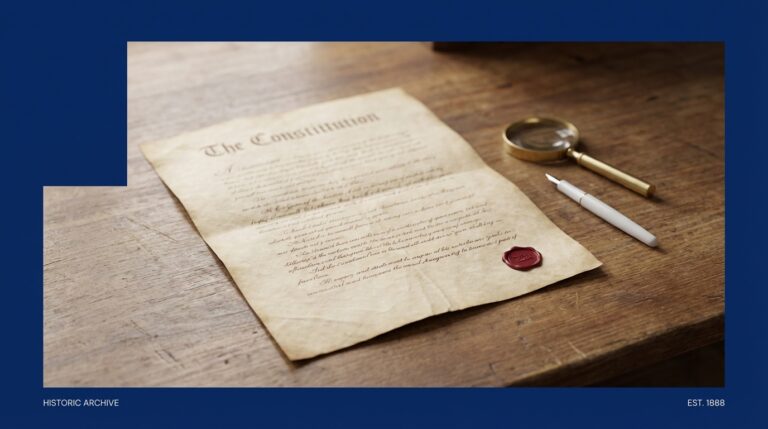
The goal is practical clarity. You will find definitions, historical context from the framers, an explanation of judicial review, comparisons with other systems, and a short checklist of primary sources to consult.
Short answer: Is the United States a constitutional republic?
Yes. The United States is best described as a constitutional republic, a system whose authority rests on a written Constitution and representative institutions, rather than direct popular lawmaking, according to the constitutional text as preserved by the National Archives National Archives transcription.
quick primary-source checklist for verifying constitutional features
use primary texts first
A constitutional republic combines representative lawmaking with constitutional limits on government power, a definition used in legal reference summaries and encyclopedias Cornell Law School Wex.
Below you will find definitions, how the Constitution sets institutions, the role of judicial review, framers context, comparisons with other systems, common misunderstandings, and practical checks to verify claims.
What does the term constitutional republic mean?
At its core a constitutional republic is a system that pairs representative government with a written constitution that constrains authority and secures the rule of law, as explained in legal summaries and reference entries Cornell Law School Wex.
That description stresses two ideas: representatives make laws and a constitution sets limits on what government may do. Encyclopaedia Britannica outlines these aspects when describing constitutional government Encyclopaedia Britannica.
In practice this means elected bodies enact ordinary law, while the written constitution defines structures, rights, and boundary rules. Authors sometimes use related phrases such as constitutional democracy or constitutional government, and usage varies by author and emphasis Encyclopaedia Britannica.
How the U.S. Constitution creates representative institutions
The Constitution is the written charter that vests lawmaking authority in representative institutions, notably in Congress, and it establishes the federal structure of government National Archives transcription.
Congress is the primary legislative body under the constitutional design. Members of the House and Senate are chosen through elections, and those elections supply the democratic element that selects representatives to make laws on behalf of voters.
Yes. The United States is best described as a constitutional republic because it bases authority on a written Constitution and on representative institutions subject to constitutional limits.
Representative lawmaking differs from direct lawmaking because laws are passed by elected legislators rather than by voters directly submitting statutes for immediate enactment.
In short, the Constitution sets the institutions and elections supply the mechanism for choosing who serves in those institutions, which together describe the representative framework of U.S. government National Archives transcription.
Separation of powers and checks and balances
The framers designed separate branches to prevent concentration of power and to protect liberties, an argument developed clearly in Federalist No. 51 where Madison discusses the need for checks and balances Federalist No. 51.

Examples of checks include Congress passing laws and overriding vetoes, the president vetoing legislation, and courts declaring laws inconsistent with the Constitution through judicial review.
The purpose of separation of powers is to reduce the risk of factional dominance and to keep any one branch from accumulating unchecked authority, a point emphasized in framers commentary and later summaries Federalist No. 51.
Judicial review and Marbury v. Madison
Judicial review is the practice by which courts interpret the Constitution and assess whether laws or executive actions fit within its limits. The Supreme Court articulated this power in Marbury v. Madison, a foundational decision from 1803 Marbury v. Madison.
The decision held that it is a role of the judiciary to say what the law is, and that courts can refuse to apply statutes that violate constitutional provisions.
Join the campaign and stay updated
For primary-source reading, consult the text of Marbury v. Madison and the Constitution to see how judicial review operates in case law rather than as a separate constitutional clause.
In practice judicial review functions through litigation: a law is challenged, courts examine constitutional claims, and higher courts can affirm or reverse earlier rulings, shaping constitutional doctrine over time Marbury v. Madison.
The framers’ perspective and Federalist commentary
Framers worried about factions and the dangers of unchecked majority rule, and they built structural features to manage those concerns. Federalist No. 51 explains the reasoning for separating powers and for internal controls Federalist No. 51.
The Federalist essays shaped early interpretation by offering public explanations for the constitutional plan. These essays remain a key historical source for understanding the framers’ intent, though modern scholars place Federalist commentary in a broader interpretive context.
Applying 18th-century arguments directly to modern policy debates requires care. Scholars note that the framers wrote for a different political and social environment and that subsequent practice and case law have adapted constitutional meaning over time.
How a constitutional republic differs from direct democracy and other systems
A constitutional republic assigns lawmaking primarily to elected representatives, while a direct democracy emphasizes popular enactment through referenda; this distinction is highlighted in legal and encyclopedic definitions Cornell Law School Wex.
Comparatively, constitutional monarchies pair a monarch with constitutional rules and often parliamentary governments where executive authority depends on legislative confidence, which differs from the U.S. separation of powers model Encyclopaedia Britannica.

Some writers use the terms constitutional republic and constitutional democracy interchangeably. That overlap often reflects emphasis rather than a change in institutional facts, and scholars document such terminology differences in reference summaries Cornell Law School Wex.
Contemporary debates about terminology and practice
Many scholars prefer the label constitutional democracy when they want to emphasize democratic processes alongside constitutional limits. Others stick with constitutional republic to stress representative lawmaking, and those differences reflect definitional choices more than new institutional facts Stanford Encyclopedia of Philosophy.
There are active discussions about how polarization, institutional strain, and proposed reforms affect the balance between majority rule and rights. These are open scholarly questions rather than settled empirical judgments, and readers should treat them as ongoing debates Stanford Encyclopedia of Philosophy.
Decision criteria: How to evaluate claims about the U.S. system
Use a short checklist when evaluating claims: look for a written constitution, check whether laws are passed by elected representatives, verify the presence of separation of powers, and confirm whether courts can review laws for constitutionality. The Constitution and key court opinions are primary sources for these checks National Archives transcription.
Primary sources to consult include the Constitution text and landmark Supreme Court opinions such as Marbury v. Madison. Legal reference entries provide concise definitions and helpful summaries Marbury v. Madison.
When authors use labels as political shorthand, check citations. If a writer asserts the United States is a pure democracy or a pure republic as an empirical claim, examine whether they rely on primary constitutional text or on partisan rhetoric.
Typical misunderstandings and common errors
A common error is treating political slogans as precise constitutional descriptions. Terms used in campaign messaging often compress complex legal meanings into brief phrases, which can mislead if taken as technical definitions Cornell Law School Wex.
Another mistake is to conflate direct democracy and representative rule. In the U.S. system ordinary lawmaking takes place through elected legislatures, not by direct popular enactment, though referenda exist in some states for particular measures Encyclopaedia Britannica.
To avoid these errors, prefer primary documents, check citations, and use neutral legal summaries when possible.
Practical example: How a contested law reaches the courts

If a court finds a statutory provision inconsistent with the Constitution it can refuse to apply that law, and higher courts can either affirm or overturn that decision, producing precedents that shape future cases.
Marbury v. Madison provided the early articulation of how courts assume the authority to interpret the Constitution and to invalidate contrary statutes, and that practice has continued through established case law Marbury v. Madison.
Quick guide for further reading and primary sources
Start with the Constitution text as the principal primary source. The National Archives provides a transcription of the document that is useful for direct citation and reading National Archives transcription.
Federalist No. 51 offers a concise statement of framers’ rationale for division of powers, and Marbury v. Madison is the classic case establishing judicial review, both of which are core texts for further reading Federalist No. 51.
Legal reference entries such as Cornell’s Wex or surveys in encyclopedias provide accessible summaries and definitions for readers seeking context Cornell Law School Wex.
Conclusion: What it means and what remains debated
The core conclusion is straightforward: the United States is best described as a constitutional republic because its government is grounded in a written Constitution and operates through representative institutions that are subject to constitutional limits National Archives transcription.
At the same time terminology varies and scholars sometimes prefer related labels like constitutional democracy when emphasizing democratic processes, so readers should note definitional choices when encountering different usages Stanford Encyclopedia of Philosophy.

A constitutional republic pairs representative lawmaking with a written constitution that limits government power and secures the rule of law.
The United States has democratic elements such as elections but is described as a constitutional republic because elected representatives make laws within constitutional limits.
Consult the Constitution text and landmark Supreme Court opinions as primary sources, and use neutral legal reference summaries for definitions.
This article aims to inform rather than to settle ongoing scholarly debates about terminology; when in doubt, check the primary documents and respected legal summaries.
{"@context":"https://schema.org","@graph":[{"@type":"FAQPage","mainEntity":[{"@type":"Question","name":"Is the United States a constitutional republic?","acceptedAnswer":{"@type":"Answer","text":"Yes. The United States is best described as a constitutional republic because it bases authority on a written Constitution and on representative institutions subject to constitutional limits."}},{"@type":"Question","name":"What is a constitutional republic?","acceptedAnswer":{"@type":"Answer","text":"A constitutional republic pairs representative lawmaking with a written constitution that limits government power and secures the rule of law."}},{"@type":"Question","name":"Is the United States a democracy or a republic?","acceptedAnswer":{"@type":"Answer","text":"The United States has democratic elements such as elections but is described as a constitutional republic because elected representatives make laws within constitutional limits."}},{"@type":"Question","name":"Where should I look to verify claims about the U.S. system?","acceptedAnswer":{"@type":"Answer","text":"Consult the Constitution text and landmark Supreme Court opinions as primary sources, and use neutral legal reference summaries for definitions."}}]},{"@type":"BreadcrumbList","itemListElement":[{"@type":"ListItem","position":1,"name":"Home","item":"https://michaelcarbonara.com"},{"@type":"ListItem","position":2,"name":"Blog","item":"https://michaelcarbonara.com/news/%22%7D,%7B%22@type%22:%22ListItem%22,%22position%22:3,%22name%22:%22Artikel%22,%22item%22:%22https://michaelcarbonara.com%22%7D]%7D,%7B%22@type%22:%22WebSite%22,%22name%22:%22Michael Carbonara","url":"https://michaelcarbonara.com"},{"@type":"BlogPosting","mainEntityOfPage":{"@type":"WebPage","@id":"https://michaelcarbonara.com"},"publisher":{"@type":"Organization","name":"Michael Carbonara","logo":{"@type":"ImageObject","url":"https://lh3.googleusercontent.com/d/1eomrpqryWDWU8PPJMN7y_iqX_l1jOlw9=s250"}},"image":["https://lh3.googleusercontent.com/d/1qQqRVHuGmW4TE0k23H4YW-P7ypNLQYly=s1200","https://lh3.googleusercontent.com/d/1_qCuUe6FEPpt0PSi2AtdpzVuCgiCQMhU=s1200","https://lh3.googleusercontent.com/d/1eomrpqryWDWU8PPJMN7y_iqX_l1jOlw9=s250"]}]}