The article is intended as voter informational context rather than advocacy. It points readers to primary sources such as PRRI state profiles and the U.S. Religion Census for those who want the underlying tables and county breakdowns.
Quick overview: faith and family values florida, a concise answer
One-line summary
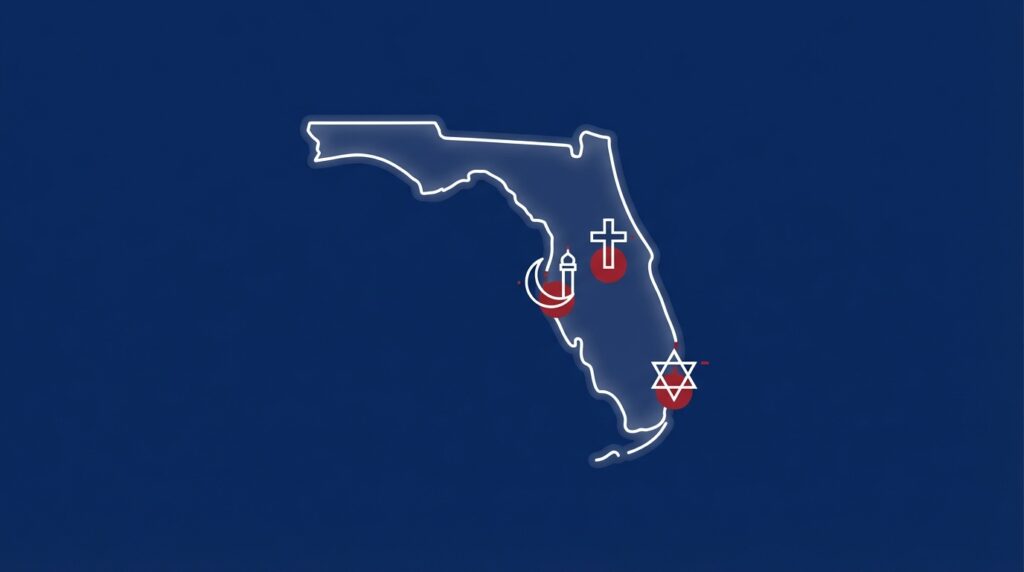
Three religions commonly cited in Florida are Christianity, Judaism, and Islam, with state surveys and congregation counts documenting Christianity as the largest group and Jewish communities concentrated in South Florida counties, while Muslim residents form a smaller but visible minority PRRI American Values Atlas and recent PRRI county reporting PRRI 2023 census.
Why this matters for local readers
Voters and residents often ask what religions are present in their communities because faith communities shape civic life, local services, and neighborhood networks, and these patterns vary across counties RCMS county data.
The phrase faith and family values florida appears here to reflect how some local conversations link civic priorities and community life, without asserting policy conclusions.
Knowing the broad presence of Christianity, Judaism, and Islam helps readers find community contacts and understand local civic organizations, while relying on named sources for exact counts and trends Jewish population state estimates.

What the data say: three religion-level snapshots for Florida
Christianity at a glance
Christianity is the largest religious affiliation in Florida, constituting a majority of residents in state-level surveys and congregation tallies, a point supported by recent PRRI state profiles PRRI American Values Atlas.
Within Christianity, Roman Catholic and multiple Protestant denominations together make up most of the religiously identified population in different parts of the state, as shown in congregation counts and denominational tables RCMS denominational counts.
Jewish community at a glance
Florida ranks among the states with the largest Jewish populations by state, with major concentrations in Miami-Dade, Broward, and Palm Beach counties according to state estimates and community sources Jewish population state estimates.
Local federation directories and community counts help map congregations in South Florida where Jewish communities are most concentrated Greater Miami Jewish Federation.
Muslim and other faith communities at a glance
Muslim residents are a smaller religious minority in Florida, typically concentrated in urban and suburban centers; survey-based estimates and national analyses offer the best available prevalence context for these communities Pew Research Center analysis and the state Religious Landscape Study for Florida Pew RLS Florida.
Stay informed and get involved with the campaign
For more detailed state profiles and congregation tables, consult the PRRI state profiles and the RCMS county tables mentioned above.
This snapshot level is intended to name the three religions and to point to the primary sources readers can consult for county detail.
Christianity in Florida: denominations, geography, and how counts are measured
Roman Catholic presence in South Florida
Roman Catholic communities are especially prominent in South Florida counties where historical migration and immigration patterns have supported larger Catholic congregations, a pattern visible in RCMS county tables RCMS county counts.

That regional concentration means Catholic parishes and diocesan structures often provide local community services and civic engagement in ways that vary from county to county.
Protestant denominational variety and county differences
Protestant denominational presence in Florida includes mainline and evangelical traditions, as well as historically Black churches, with different counties showing different mixes of denominations in congregation-level data RCMS denominational tables.
Reading those tables side by side with state survey profiles helps explain why one county may show higher shares of a given Protestant tradition while another shows stronger Catholic representation.
How the RCMS records congregational counts
The U.S. Religion Census records congregations and membership by denomination and county, providing a snapshot from its study year that is widely used for county-level comparisons and denominational breakdowns RCMS documentation.

Readers should keep in mind that RCMS data reflect the 2020 study year, which affects how the counts are interpreted for 2026 readers and why complementary survey profiles are useful.
Judaism in Florida: size, South Florida concentration, and community resources
State estimates and largest counties
Florida is among the states with the largest Jewish populations by state, with particularly large communities in Miami-Dade, Broward, and Palm Beach counties according to state-level estimates and community compilations Jewish population state estimates.
Concentration in South Florida shapes local communal life, charitable organizations, and cultural institutions in those counties.
Christianity, Judaism, and Islam are three religions present in Florida; state profiles and congregation counts show Christianity as the largest group, Jewish populations concentrated in South Florida, and Muslim communities as a smaller urban minority.
Local federation directories are a practical way to locate congregations and services in South Florida, and regional federation pages list synagogues, schools, and community programs Greater Miami Jewish Federation.
Local community organizations and directories
Community federation counts and directories complement state and federal surveys by listing active congregations and local programs, which is helpful when planning to contact a congregation or service provider.
Using both state estimates and local directories offers a fuller picture than either source alone, especially in counties with dynamic population change.
What the numbers mean for local civic life
Where Jewish populations are concentrated, local civic life often includes federation-supported social services, cultural events, and interfaith activity, which are reflected in community directories and local reporting.
Those practical community functions are best understood through the combination of state estimates and local federation resources rather than relying only on headline counts Greater Miami Jewish Federation.
Muslim and other non-Christian faith communities in Florida
Prevalence and urban concentration
Muslim communities in Florida are smaller than the largest religious groups and are often found in metropolitan and suburban areas where immigrant and second generation populations cluster; national and state survey work helps estimate prevalence Pew Research Center analysis.
Other non-Christian faiths, including Hindu, Buddhist, Sikh, and newer religious movements, are present in pockets and metropolitan centers but in smaller numbers compared with the major traditions already discussed.
Data limitations and best estimates
Because state-level surveys and national analyses use different methods, readers should treat Muslim prevalence estimates and counts as best estimates rather than exact headcounts, and consult multiple sources for local planning PRRI state profiles and RCMS archives RCMS data archive.
Local mosque directories, interfaith councils, and community groups often provide the most up-to-date information on active congregations in a given metro area.
Other smaller faith groups to be aware of
Florida hosts a range of smaller faith communities that contribute to civic life in concentrated neighborhoods; these groups may not appear prominently in statewide summaries but matter at the county and city level.
For local engagement it is practical to combine state survey context with local listings and community contacts to find active congregations and services.
How religious data are collected and what that means for readers
Surveys versus congregation counts
Survey-based estimates such as PRRI or Pew ask individuals about religious affiliation and provide recent state profiles, while congregation counts such as the RCMS record institutional presence by denomination and county, producing complementary but different measures PRRI state profiles and ARDA/RCMS documentation RCMS archive.
Surveys capture individual affiliation and beliefs, and congregation counts capture organizational presence; both are useful depending on the question a reader wants to answer RCMS methodology.
Common timing and coverage issues
RCMS data reflect the 2020 study year, which means local congregation changes after that year may not be included and readers should check for updated directories or local studies when precise current counts are needed RCMS 2020 tables.

How to read margins, study years, and caveats
When comparing county tables and state surveys, check the study year, whether counts refer to congregations or individuals, and whether local directories have updated listings, because these differences affect interpretation for readers and researchers PRRI state profiles.
Attribution matters: when citing a percentage or count, name the source and the study year so readers can follow the primary table themselves.
Practical examples: county snapshots and how to read them
Miami-Dade snapshot
Miami-Dade County shows a strong Jewish presence alongside significant Catholic and other Christian congregations, a pattern visible in RCMS county tables and local federation directories for South Florida RCMS county tables.
Local directories such as the Greater Miami Jewish Federation provide lists of synagogues and programs that help translate state estimates into practical contacts Greater Miami Jewish Federation.
A mid-Florida county snapshot
In a mid-Florida county outside South Florida, county tables often show a larger share of Protestant congregations and smaller non-Christian populations, illustrating how the balance of faith communities in Florida shifts between regions RCMS county data.
Comparing the mid-Florida snapshot with Miami-Dade highlights why county context and study year are critical when readers interpret what religions are present in Florida.
How to compare county results responsibly
To compare counties responsibly, use the same source for each county, note the study year, and avoid treating a single county table as representative of statewide trends PRRI state profiles.
Where possible, combine survey-based state profiles with county-level RCMS tables and local directories to produce a rounded view of faith communities.
Where to find congregations and community contacts
State and local locators
Research locators such as the PRRI state profiles and ARDA/RCMS tables are practical starting points for statewide and county-level searches PRRI state profiles.
Local city and county directories, interfaith councils, and federation pages offer more detailed, current listings for congregations and community services. Check local event listings as well events page.
Quick checklist to locate congregations and community contacts
Use multiple sources for verification
Community federation directories
In South Florida, federation directories list synagogues, community centers, and support services, which is useful for people seeking local connections or cultural programs Greater Miami Jewish Federation.
Similar local directories and interfaith groups exist in other metro areas, and they often provide the most current activity listings.
Interfaith and civic resources
Interfaith councils and civic centers can help interested residents find places of worship, volunteer opportunities, and neighborhood service providers, and these groups often maintain searchable directories or referral services.
When contacting a congregation, check both the research locators and local federation pages to confirm service times and program availability (or use the campaign contact page) campaign contact.
Common mistakes and pitfalls when reading religious-demographic claims
Confusing affiliation with attendance or membership
Affiliation, congregation membership, and attendance are different measures: surveys capture self-identified affiliation, RCMS captures organizational counts, and attendance measures how often people participate, so avoid conflating these concepts when you read a claim PRRI guidance.
When a report cites a number labeled membership or congregation, check whether that figure refers to registered members or to reported attendance figures.
Using outdated data as current fact
RCMS 2020 provides detailed county-level counts but is dated for questions about 2024 to 2026 changes, so verify whether a local directory or a newer survey has updated listings before treating a count as current RCMS 2020 tables.
Surveys such as PRRI from 2023 offer more recent state-level profiles but may not capture rapid local changes at the parish or synagogue level.
Misreading county counts as statewide trends
County-level totals can differ sharply across Florida, so avoid extrapolating a single county pattern to the whole state; instead, compare multiple county tables or use state profiles to assess statewide patterns PRRI state profiles.
Always name the source and the study year when reporting a figure so readers can check the primary material themselves.
Takeaways and next steps for readers
Summary of the three religions and what the evidence shows
The three religions named here are Christianity, Judaism, and Islam; PRRI state profiles and the RCMS congregation counts are the primary sources that support the summary points offered above PRRI state profiles.
Christianity is the largest religious affiliation in Florida, Jewish communities are large and concentrated in South Florida counties, and Muslim communities are smaller and mostly urban, according to the sources cited in this article RCMS and related tables.
Where county-level changes are likely after 2020, consult local directories, interfaith councils, or direct contacts with congregations for the most current information.
How to follow updates and where to look for newer data
Bookmark PRRI state profiles, the ARDA RCMS county tables, and local federation directories to follow updates on congregation listings and state-level affiliation estimates PRRI state profiles. Learn more about the site and campaign about.
Where county-level changes are likely after 2020, consult local directories, interfaith councils, or direct contacts with congregations for the most current information.
Suggested primary sources to bookmark
Primary sources to save for follow up are PRRI state profiles for recent affiliation estimates, ARDA/RCMS county tables for denominational and congregation counts, and local federation directories for active community listings RCMS county tables.
Attribution and study year transparency will help readers and reporters use these sources responsibly.
Christianity, Judaism, and Islam are three religions commonly cited in Florida; state profiles and congregation counts document Christianity as the largest group, with Jewish communities concentrated in South Florida and Muslim communities present in urban areas.
Key sources include the PRRI state profiles for affiliation estimates, the U.S. Religion Census RCMS county tables for congregation counts, and local federation directories for community listings.
Start with PRRI state profiles and ARDA/RCMS county tables for research context, then use local federation directories, interfaith councils, or municipal resource pages to find current congregation contacts and service times.
References
- https://www.prri.org/research/american-values-atlas/
- https://www.thearda.com/RCMS2010/rcms2010.asp?U=12&S=FL
- https://www.jewishvirtuallibrary.org/jewish-population-in-the-united-states-by-state
- https://www.jewishmiami.org/
- https://www.pewresearch.org/fact-tank/2017/01/03/how-many-muslims-are-there-in-the-u-s/
- https://michaelcarbonara.com/contact/
- https://prri.org/research/census-2023-american-religion/
- https://www.thearda.com/data-archive?fid=RCMSCY20
- https://www.pewresearch.org/religious-landscape-study/state/florida/
- https://michaelcarbonara.com/events/
- https://michaelcarbonara.com/about/