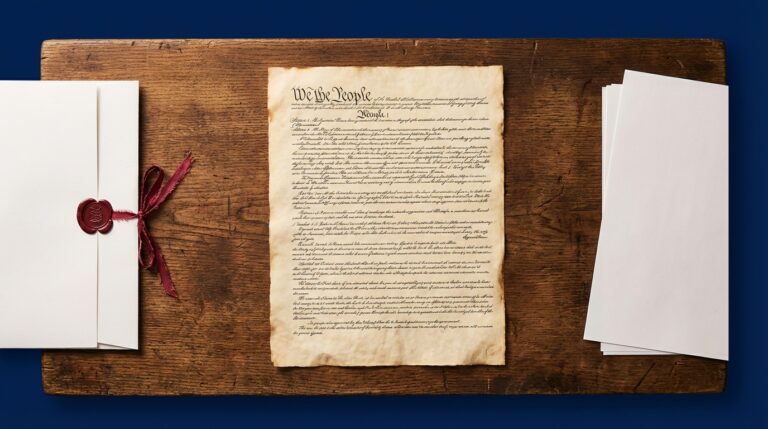
The piece centers the National Archives transcription of the Amendment and links that text to the main judicial tests courts use to limit or protect expression. The goal is factual clarity without advocacy.
What the First Amendment actually says
Verbatim text and authoritative source: first ten amendments to the constitution
The exact wording of the First Amendment is the starting point for legal and civic discussion. The National Archives publishes the Amendment as part of the 1791 Bill of Rights; using that transcription ensures citations are consistent with primary historical documents. National Archives Bill of Rights transcription
Congress shall make no law respecting an establishment of religion, or prohibiting the free exercise thereof; or abridging the freedom of speech, or of the press; or the right of the people peaceably to assemble, and to petition the Government for a redress of grievances.
When you cite the Amendment in legal or informational writing, point readers to the National Archives transcription as the authoritative source and include the ratification date 1791 where relevant. That primary citation is what courts and historians use as the textual baseline. National Archives Bill of Rights transcription

The Bill of Rights, including the First Amendment, was adopted in 1791 to respond to concerns raised during ratification of the Constitution. Framers and state proponents argued for clear limits on federal power over religion and expression, and the amendments addressed those concerns in concise text. Reagan Library lesson plan educational freedom

The two religion clauses explained
Establishment Clause

The Establishment Clause prevents the government from creating an official religion or preferring one faith over another. Courts evaluate government actions under tests that ask whether the action endorses religion or coerces participation.
Legal explainers summarize how the clause operates in practice and provide clause by clause guidance useful to students and civic readers. For a practical legal explainer on how courts approach establishment questions, consult a reliable legal reference. Cornell LII First Amendment overview
Quick checklist for identifying Establishment and Free Exercise issues
Use as a first step not a legal conclusion
Free Exercise Clause
The Free Exercise Clause protects individuals’ rights to practice religion without undue government interference, while courts balance those rights against compelling government interests in specific cases.
Court decisions treat the two religion clauses differently, and interpretation remains an ongoing judicial task rather than a single fixed rule. For clause specific summaries and case law context, see authoritative legal explainers. Cornell LII First Amendment overview
Speech, press, assembly and petition: the five protections
The First Amendment lists five protections: religion, speech, press, assembly, and petition. Each protection covers a range of activities that courts and civic organizations describe in practical terms.
Freedom of speech covers spoken and written expression as well as symbolic acts; freedom of the press protects reporting and commentary; the right to assemble protects peaceful public gatherings; and the petition clause allows individuals to ask government for remedies. Civil liberties groups provide user focused examples for each protection. ACLU free speech guide
When speech can be limited: legal tests and exceptions
Not all expression is fully protected. Courts apply tests to determine when government may regulate speech, and one of the central tests for incitement asks whether speech is directed to inciting imminent lawless action and is likely to produce such action.
That standard comes from a key Supreme Court ruling, which set the modern threshold for government punishment of incitement and remains a cornerstone of First Amendment limits. Brandenburg v. Ohio overview
Get source links and updates on civic materials
For primary sources and concise legal summaries, consult the National Archives transcription and reputable legal explainers to verify specific language and citation details.
Beyond incitement, courts have identified categories that receive lesser or no protection in some contexts, including obscenity and true threats, with each category defined through case law rather than the text alone.
Readers should note that these exceptions are judicially developed, applied case by case, and often require careful factual analysis before concluding speech falls outside protection. For practical rights summaries see civil liberties guidance. ACLU free speech guide
Landmark Supreme Court cases that shape limits
Brandenburg v. Ohio established the imminent lawless action test for incitement, limiting government power to punish speech unless it is aimed at producing immediate illegal activity and likely to do so. This decision is a central precedent in modern First Amendment doctrine. Brandenburg v. Ohio overview
Another foundational case, New York Times Co. v. Sullivan, created the actual malice standard for public official libel claims, which raises the bar for plaintiffs and protects more robust criticism of public figures. That decision remains a primary reference in libel law. New York Times Co. v. Sullivan overview
How the courts evaluate public figure speech and libel
The actual malice standard means a public official or public figure must show that a defamatory statement was made with knowledge it was false or with reckless disregard for the truth, a heightened requirement that affects many news reporting disputes.
Because the rule protects debate about public affairs, courts apply it when plaintiffs are government officials or figures who seek to limit critical reporting; the standard influences how journalists and litigants frame evidence in libel cases. New York Times Co. v. Sullivan overview
The full First Amendment is the text published in the 1791 Bill of Rights that prohibits laws establishing religion or restricting its exercise and protects freedom of speech, press, assembly, and petition; the National Archives transcription is the authoritative source.
When a dispute involves a private person rather than a public figure, different standards can apply and state law interacts with federal precedent in varied ways. For guidance about a particular case consult legal resources and counsel. ACLU free speech guide
Modern challenges: platforms, private actors, and new technology
The First Amendment restricts government action, not decisions by private companies, so platform moderation is generally governed by private terms and commercial law rather than constitutional text.
Legal and policy debates continue about how constitutional principles should inform regulation or oversight of large platforms and about the public role of private actors in shaping public discourse. Public opinion research shows broad support for free expression combined with concerns about certain harms and moderation practices. Pew Research Center analysis

A practical framework for readers: how to judge if expression is protected
Start by asking whether the challenged restriction is government action. If a private actor removed content, the First Amendment is not the legal check; if a government entity acted, proceed to doctrinal tests.
Next, ask whether the speech is directed to and likely to produce imminent lawless action. If not, check whether it falls into a judicially defined excluded category such as obscenity or true threats. When in doubt about legal consequences seek legal counsel or a civil liberties organization for case specific guidance. Brandenburg v. Ohio overview
Common misconceptions and mistakes to avoid
A frequent error is to treat the First Amendment as a shield against any private consequence for speech. The Amendment limits government power and does not automatically prevent a private platform, employer, or association from setting rules or taking action. Cornell LII First Amendment overview
Another mistake is assuming all controversial speech is unprotected. Courts have carved narrow categories that receive less protection and apply tests case by case, so blanket claims of absolute protection are often inaccurate. For rights clarifications rely on primary texts and reputable legal explainers. Cornell LII First Amendment overview
Practical scenarios: everyday examples and what they mean
Protest scenario: A city can impose neutral time place and manner restrictions on a public demonstration, such as requiring permits or limiting hours, so long as the rules are content neutral and narrowly tailored to government interests.
Social media scenario: If a platform removes a post under its terms of service, that is private moderation not government censorship; different rules apply when government officials pressure platforms to remove content. For practical readouts consult civil liberties guidance. ACLU free speech guide
Defamation scenario: A public official alleging libel must meet the actual malice standard, which means proving the publisher knew the statement was false or acted with reckless disregard for the truth. This standard shapes how such cases proceed in court. New York Times Co. v. Sullivan overview
How to find authoritative sources and primary texts
For the authoritative primary text of the First Amendment use the National Archives transcription of the Bill of Rights, which presents the Amendment as ratified in 1791 and is widely cited by courts and scholars. National Archives Bill of Rights transcription See the Library of Congress transcription at U.S. Constitution – First Amendment.
For clause by clause explanation consult established legal explainers such as Cornell LII and civil liberties organizations like the ACLU for practical rights guidance and plain language summaries. Cornell LII First Amendment overview See the Archives Foundation overview at Amendments to the U.S. Constitution and our constitutional rights hub.
Summary and takeaway for readers
The authoritative wording of the First Amendment is the National Archives transcription in the 1791 Bill of Rights and it lists five core protections that form the basis for modern doctrine. National Archives Bill of Rights transcription For ongoing coverage see our news page.
Two landmark standards to keep in mind are the Brandenburg imminent lawless action test for incitement and the actual malice rule from New York Times Co. v. Sullivan for libel against public figures. Those decisions are central to how courts limit or protect expression in practice. Brandenburg v. Ohio overview
Questions remain about how those constitutional principles interact with private platforms and changing technology, and public opinion studies show support for free expression alongside concern about certain harms, which keeps the debate active. Pew Research Center analysis
The First Amendment prohibits laws establishing religion or restricting its exercise and protects freedom of speech, press, assembly, and petition; the National Archives transcription is the authoritative text.
No. The First Amendment limits government action; private platforms and companies generally set and enforce their own rules unless government action affects those decisions.
Courts permit restrictions when speech meets judicially defined exceptions such as incitement to imminent lawless action, obscenity, or true threats, based on case by case analysis.
This explainer is a starting point; for legal claims use counsel and verify citations against the primary texts and opinions referenced here.
References
- https://www.archives.gov/founding-docs/bill-of-rights-transcript
- https://michaelcarbonara.com/contact/
- https://www.reaganlibrary.gov/education/lesson-plans/high-school/constitutional-amendments/constitutional-amendments-amendment-1
- https://michaelcarbonara.com/issue/educational-freedom/
- https://www.law.cornell.edu/constitution/first_amendment
- https://www.aclu.org/know-your-rights/free-speech
- https://www.oyez.org/cases/1968/492
- https://www.oyez.org/cases/1963/39
- https://michaelcarbonara.com/issue/constitutional-rights/
- https://www.pewresearch.org/politics/2024/09/18/americans-and-free-speech/
- https://constitution.congress.gov/constitution/amendment-1/
- https://archivesfoundation.org/amendments-u-s-constitution/
- https://michaelcarbonara.com/news/