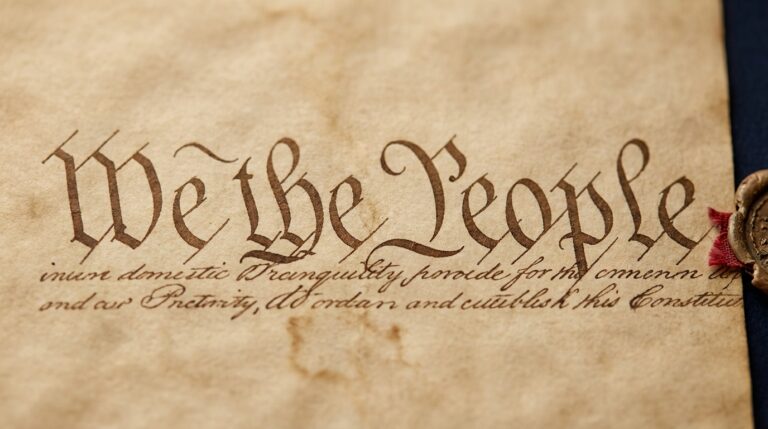
This guide explains the constitutional foundation, summarizes the key Supreme Court tests that shape modern doctrine, and points readers to practical resources to check primary sources and assess risk. It is written for civic-minded readers who want a clear, neutral explanation.
What the freedom of speech act means: constitutional foundation and basic rule
When people ask about the freedom of speech act, they are usually referring to the body of law that protects expression from government restriction under the First Amendment to the U.S. Constitution. The First Amendment is the primary legal protection against government limits on speech and is best read from the original text of the Bill of Rights as preserved in public records Bill of Rights transcript.
The constitutional protection applies against government actors, not private parties, which means that private employers and platforms have distinct powers and obligations under contracts and platform rules rather than the First Amendment itself Cornell Law School LII on the First Amendment. See our constitutional rights hub for related posts on how doctrines are organized.
Join campaign updates and informational briefings
This explainer is intended to clarify how constitutional rules and private policies interact. It does not give legal advice, but it helps voters and civic readers understand where to look for primary sources.
In everyday discussion, phrases like freedom of expression law or freedom of speech law are used interchangeably with the idea of a freedom of speech act, but in U.S. practice the Constitution and case law are the sources courts rely on rather than a single modern statute.
How courts interpret free speech: key Supreme Court precedents
Modern free-speech doctrine rests on a set of Supreme Court decisions that create bright-line tests and fact-focused standards. Important cases include the incitement test established in a major 1969 decision, the actual-malice rule for defamation from the 1960s, and the obscenity standard from the early 1970s; these decisions are treated as controlling guidance in many disputes Brandenburg v. Ohio opinion.
Each cited precedent addresses a different question: one governs when speech that urges illegal action can be limited; another determines when public figures must prove a particular state of mind to win defamation claims; and a third explains when obscene material lies outside constitutional protection. Courts apply these authorities case by case to shape the rules people call freedom of speech law.

Case law is central because it interprets constitutional text in the context of changing facts and technologies. There is no single federal law named ‘‘the freedom of speech act that replaces these judicially created standards; instead, courts continue to rely on the established opinions when they resolve disputes.
The Brandenburg incitement test: when speech can be limited for inciting harm
The leading test for incitement comes from a Supreme Court opinion that says speech can be restricted only if it is directed to producing imminent lawless action and is likely to produce such action; that two-part standard is the operative rule for incitement disputes Brandenburg v. Ohio (see the Oyez case page for a concise summary).
Quick steps for checking an incitement claim against official opinions
Use official opinion text for precise language
In practice, ‘‘directed to inciting imminent lawless action means the speaker intends the audience to act now, not at some indefinite future time, and ‘‘likely to produce such action asks whether the words make lawless conduct a real and immediate risk. Courts look at context, medium, and the speaker’s message when applying the test.
Short hypotheticals help show the boundary: a speech that urges a crowd to rush a building immediately while naming specific tactics is far more likely to meet the Brandenburg test than a political rant advocating general unrest at an unspecified time.
Defamation and public-figure standards: New York Times v. Sullivan
Defamation law balances reputational interests against robust debate about public officials and public figures. In a landmark decision, the Court held that public-figure plaintiffs must prove actual malice – that false statements were made knowing they were false or with reckless disregard for the truth – before they can recover in many cases involving political speech New York Times Co. v. Sullivan.
Who qualifies as a public figure matters because the actual malice standard raises the bar for liability in political and public-interest reporting. The rule protects candid criticism of officials while still allowing remedies when false statements are published with obvious disregard for accuracy.
Obscenity, fighting words, and other narrower categories outside First Amendment protection
Certain narrow categories of speech are not protected by the First Amendment. The Court set a three-part test for obscenity that asks whether material appeals to prurient interest, depicts sexual conduct in an offensive way under contemporary community standards, and lacks serious literary, artistic, political, or scientific value; that framework comes from a leading 1973 opinion Miller v. California.
Other recognized exceptions include true threats, fighting words, and similar narrow categories where the speech crosses into direct harm or targeted intimidation. Those exceptions are confined and fact specific, so labeling speech as unprotected requires careful legal analysis rather than broad claims that all offensive expression is excluded.
Why the First Amendment applies to government actors, not private platforms or employers
The constitutional limits in the First Amendment operate against government action, a principle often described as the state-action doctrine. That means public officials and governmental bodies must respect speech protections, but private companies generally are governed by contract law and corporate policy rather than the First Amendment itself Cornell Law School LII on the First Amendment.
For example, social media platforms and private employers may lawfully moderate or restrict speech under terms of service and workplace policies, though separate statutes and regulatory debates touch on whether and how platforms should be governed by new rules ACLU overview of free speech. See our article on freedom of expression and social media for more discussion of platform issues.
How courts and advocates are wrestling with online moderation, algorithms, and amplification
Applying traditional free-speech doctrines to platforms, recommendation systems, and algorithmic amplification remains contested and subject to evolving litigation and proposals. Courts and advocates debate when platform conduct might amount to state action and how amplification changes the practical effects of speech; see a recent analysis of the evolution of incitement online and ongoing commentary on platform amplification.

Observers are tracking litigation and legislative proposals that could affect platform moderation, but as of 2026 courts continue to apply established doctrines while seeing novel factual records about algorithms and content curation; outcomes remain fact dependent and unsettled ACLU overview of free speech.
Balancing speech and safety: how courts weigh harms, context, and intent
Judges weigh context, speaker intent, and the likelihood of real harm when deciding close free-speech cases. Different doctrines use different balancing mechanisms: the incitement standard focuses on imminence and likelihood, while obscenity analysis asks about value and community standards Brandenburg v. Ohio.
Context includes the audience, the medium, and surrounding facts. Courts often examine whether a communication was targeted, whether it included clear calls for illegal action, and whether it lacked redeeming social value before limiting speech under recognized exceptions Miller v. California.
Practical examples: scenarios showing protected and unprotected speech
Hypothetical 1: A commentator on a public stage argues that a current policy is unjust and urges listeners to contact their representatives and protest lawfully. This expression will usually be protected political speech because it does not call for imminent lawless action and contributes to public debate.
Hypothetical 2: A person uses a broadcast to tell a crowd to immediately block a highway and names a nearby time and place. That speech may meet the Brandenburg incitement test because it directs imminent lawless action and could be likely to produce that action Brandenburg v. Ohio.
The term commonly refers to constitutional protections under the First Amendment and the body of Supreme Court decisions that define exceptions and limits, rather than a single contemporary federal statute.
Hypothetical 3: Publishing false statements about a private business that injure its reputation might give rise to defamation claims, but statements about a public official will face the actual malice standard before a plaintiff can recover New York Times Co. v. Sullivan.
Common misunderstandings and mistakes about the freedom of speech act
Myth: The First Amendment protects speech from all consequences. Fact: The First Amendment restricts government action, so private moderation, employer discipline, or contract enforcement can lawfully limit expression in many contexts Cornell Law School LII on the First Amendment.
Myth: If speech is offensive it is not protected. Fact: Offensiveness alone does not strip speech of protection; courts look to specific categories like obscenity or true threats and apply tests rather than exclude broad swaths of disagreeable expression Miller v. California.
How to assess legal risk when speaking or moderating content
Checklist step 1: Ask whether the likely actor is a government entity. If so, constitutional doctrines may apply. If not, consider contract terms and platform policies.
Checklist step 2: Identify which legal test is most relevant: incitement, defamation, obscenity, or another narrow category. Verify facts, avoid reckless assertions about private individuals, and document sources before publishing.
Checklist step 3: For uncertain or high-risk situations, seek counsel. This article does not provide legal advice but offers starting points for assessing risk and deciding when professional advice is appropriate.
Recent trends and open questions in free-speech law through 2026
Through 2026, observers are focused on how courts will handle claims that platform policies or state laws alter the balance between private moderation and public-interest speech. Litigation themes include causes of action that challenge moderation, and legislative proposals aim to regulate platform practices in various ways Cornell Law School LII on the First Amendment.
One practical uncertainty is how algorithmic amplification affects real-world harms and whether amplification should change legal treatment of speech. These are active areas of litigation and policy debate rather than settled rules ACLU overview of free speech.
Where to find primary sources and how to read them
Start with the original text of the Bill of Rights to see the First Amendment language and purpose; primary transcriptions and historical documents are available from archival repositories Bill of Rights transcript.

For the leading opinions discussed here, official court pages and reputable legal repositories provide full texts and citations. Examples include the published opinions for the incitement, defamation, and obscenity decisions, which are available on established opinion sites Brandenburg v. Ohio. For a broader walkthrough of the amendments see our First Amendment explainer.
No. Constitutional speech protections limit government action, while private platforms generally act under contract and policy rules. Separate laws or terms may create other obligations.
Yes, but public-figure plaintiffs must meet the actual malice standard, proving statements were made knowing they were false or with reckless disregard for the truth.
Speech can be limited as incitement when it is intended to produce imminent lawless action and is likely to cause that action, based on the governing judicial test.
This piece is informational and not legal advice; it aims to help readers find authoritative sources and understand the basic contours of free-speech law.
References
- https://www.archives.gov/founding-docs/bill-of-rights-transcript
- https://www.law.cornell.edu/wex/first_amendment
- https://supreme.justia.com/cases/federal/us/395/444/
- https://michaelcarbonara.com/issue/constitutional-rights/
- https://www.oyez.org/cases/1968/492
- https://supreme.justia.com/cases/federal/us/376/254/
- https://supreme.justia.com/cases/federal/us/413/15/
- https://www.aclu.org/issues/free-speech
- https://michaelcarbonara.com/freedom-of-expression-and-social-media/
- https://www.medialaws.eu/the-evolution-of-incitement-online-from-brandenburg-v-ohio-to-depiction-of-zwarte-piet/
- https://michaelcarbonara.com/contact/
- https://michaelcarbonara.com/first-amendment-explained-five-freedoms/
- https://michaelcarbonara.com/freedom-of-expression-and-social-media/
- https://michaelcarbonara.com/issue/constitutional-rights/