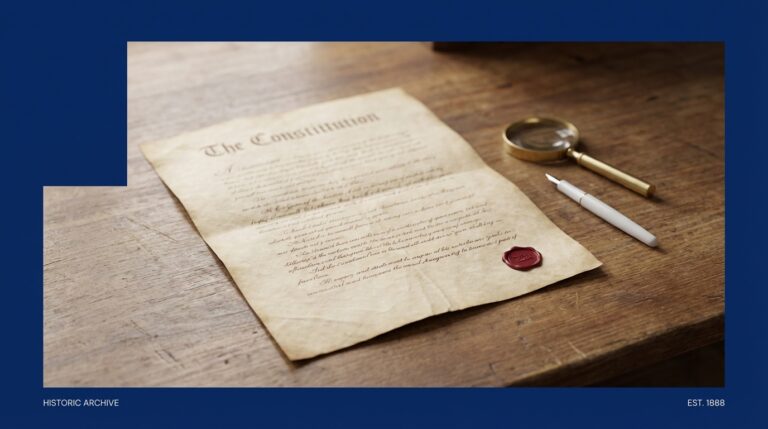
What is the Constitution? A simple definition for kids
Why a written plan matters
The Constitution is a short, written plan that tells how the United States government works, names basic rights people have, and sets rules for how decisions are made.
Think of the Constitution like the rulebook for a classroom or a game: it explains who makes the rules, what the rules do, and which rights everyone keeps while playing.
Teachers and families who want to show the original text can point students to the official copy and clear summaries held online by the National Archives.
Find the Constitution text and teacher summaries
See the Constitution text at the National Archives and short summaries at the Constitution Center for classroom use.
Preamble, articles, and the Bill of Rights in one sentence each
The Preamble is the short opening that explains the purpose of the plan, such as to form a better union and promote general welfare.
The articles are the main sections that describe how the federal government is set up and how it works.
The Bill of Rights is the first set of amendments that lists key protections for people, like free speech and fair legal process, and teachers can read short summaries to introduce these ideas.
For the full text and teaching notes, the National Archives offers the Constitution text and teacher-facing resources.
Three things kids should know: rules, rights, and roles
Rules: how laws work
One easy way to remember the Constitution is to split it into three parts: rules about how laws work, rights people keep, and roles for who runs government.
Rules explain how a law starts, how a vote can approve it, and how people must follow it once it is in place; a simple classroom parallel is that a class rule starts as an idea, gets agreed on, and then everyone follows it.
Reference works for teachers summarize these ideas in clear language for lessons and lesson planning.
Rights: examples from the Bill of Rights
The Bill of Rights gives early examples of protections, such as the freedom to speak ideas and the right to a fair trial before a judge or jury.
When teachers introduce these rights, showing short, age-appropriate examples helps students see the difference between a right and a regular rule.
Primary source collections and classroom materials provide short, child-friendly examples from the Bill of Rights for reading and discussion.
Roles: who runs the government

The Constitution also explains roles: the people who make laws, the people who carry out laws, and the people who decide what laws mean.
Those three kinds of jobs are called the legislative branch, the executive branch, and the judicial branch, and a trusted encyclopedia gives a clear summary of these roles for classroom reference.
The meaning of separation of powers in simple words
Who does what: the three branches in one line each
The meaning of separation of powers is that the government is split into three branches so no single group has all control.
The legislative branch makes laws, the executive branch carries out laws, and the judicial branch interprets laws when people disagree about them.
Teachers can point students to plain-language explanations and classroom guides that describe this division and why it matters.
Use a simple rulebook analogy, divide the lesson into rules, rights, and roles, run a short role-play for lawmakers, executive, and a review panel, and point students to primary sources and trusted educational guides.
A classroom analogy to illustrate the idea
A clear classroom analogy is to give students different jobs: some students make a class rule, one student acts like the person who carries out the rule, and a small panel checks if the rule follows the class agreement.
That short role split helps children feel how separate jobs work together, and civic resources offer activity templates that use the same idea for short lessons.

Checks and balances: how the branches limit each other
Short examples: veto, judicial review, confirmations
Checks and balances are the tools each branch uses to limit another branch, for example a veto can stop a new law from taking effect, and courts can review a law to see if it follows the Constitution.
Other tools include confirmations for important officials and oversight actions where one branch asks questions about how another branch is working.
Teacher guides explain each tool in plain words and suggest simple classroom demonstrations of these limits.
Why limits matter for fairness
These limits matter because they help keep power shared and reduce the chance that any single person or part of government will act without review.
Using reassuring, concrete examples helps students see checks and balances as ways to protect fairness instead of a contest to win.
Classroom activities that make the Constitution come alive
Role-play lawmaking simulation
A short lawmaking simulation works in three parts: propose a rule, debate it briefly, and vote; assign roles for lawmakers, an executive to approve or veto, and a small court to review the rule if asked.
Set a time limit, give each role a sheet with one or two prompts, and run the simulation in 20 to 30 minutes so it fits a single class period.
Teachers can adapt sample lesson plans from classroom-tested sites that provide clear roles and timing suggestions.
Short mock trial outline
A mock trial can be short: present a simple dispute over a class rule, let each side speak for a few minutes, and have a small panel decide whether the rule fits class agreements.
Keep the facts simple and the roles clear so younger students can follow the steps without complex legal language.

For detailed lesson templates and worksheets, many teacher pages offer free printable materials and scripted lines for students to read.
How to adapt activities by grade
For elementary students, shorten speaking turns and use concrete examples; for middle school, add short written prompts and a simple review step by a small panel.
Lesson pages for teachers include versions or variants aimed at different ages and offer tips for keeping the activity focused and age-appropriate.
How to explain tricky parts and common mistakes to avoid
Common misconceptions kids have
A common error is to treat a right as a privilege that a teacher or leader can give or take; instead, explain that rights are protections listed in the Bill of Rights and other amendments.
Another confusion is thinking that slogans or campaign phrases are the same as constitutional rules; encourage students to check the text or trusted summaries instead.
How to correct them gently
Use ‘try this’ corrections: when a student calls something a right that is not listed, ask them to find a short sentence in a trusted source that describes it.
Always link a claim back to a primary source or a clear teacher guide so students learn to rely on evidence, not slogans or hearsay.
Short examples and scripts teachers can use in class
Two-minute read-aloud script
“The Constitution is a short plan for government. It tells how the country makes big choices, who runs different parts, and which rights people keep. The Preamble explains the goal. The articles show how the government is set up. The Bill of Rights lists early protections.”
Five-step lawmaking role-play script
1. A student suggests a class rule and explains why they want it.
2. Two students give a short ‘yes’ and ‘no’ comment.
3. The group votes and the executive student says yes or vetoes.
4. If vetoed, the group discusses a change and votes again.
5. A small review panel decides if the final rule fits the class agreement and explains why.
Use short timed turns and cue cards to help students stay on task.
After the role-play, invite students to compare the activity to the Constitution text or a trusted summary to see parallels.
After the role-play, invite students to compare the activity to the Constitution text or a trusted summary to see parallels.

Where to find trustworthy sources and next steps for teachers and families
Primary sources and museum pages
The National Archives hosts the Constitution text and easy-to-find images of the original document for classroom viewing.
For plain-language explanations and interactive features, the National Constitution Center provides teacher-friendly summaries and background materials.
Free teacher resources and games
iCivics and the Library of Congress offer free lesson plans, printable materials, and simple online games that match role-play and mock-trial activities for classrooms.
quick pre-activity checklist for a classroom lawmaking role-play
Test timing with one short run
Key takeaways: what kids should remember about the Constitution and the meaning of separation of powers
Three short sentences to close the lesson
The Constitution is a written plan of rules for government to follow.
The meaning of separation of powers is that three branches share jobs so power is not all in one place.
Checks and balances are practical steps each branch can use to limit others and protect fairness.
Suggested quick homework or follow-up activity
Ask students to draw the three branches and write one sentence under each about what that branch does.
Encourage students to bring one question about the Constitution text or a classroom activity to the next lesson for a short group talk.
Use a simple analogy like a classroom rulebook, read a short passage from a trusted source, and follow with a quick role-play to show how rules are made.
Assign three classroom roles-lawmakers, an executive, and a small review panel-and run a short rulemaking activity to demonstrate each job.
Free, classroom-tested lesson plans and games are available from educational sites that specialize in civic learning and primary source collections.
References
- https://michaelcarbonara.com/issue/educational-freedom/
- https://michaelcarbonara.com/issue/constitutional-rights/
- https://michaelcarbonara.com/news/
- https://michaelcarbonara.com/contact/
- https://constitutioncenter.org/education/classroom-resource-library/classroom/separation-of-powers
- https://ed.icivics.org/games/branches-power
- https://sharemylesson.com/teaching-resource/separation-powers-whats-lunch-264503