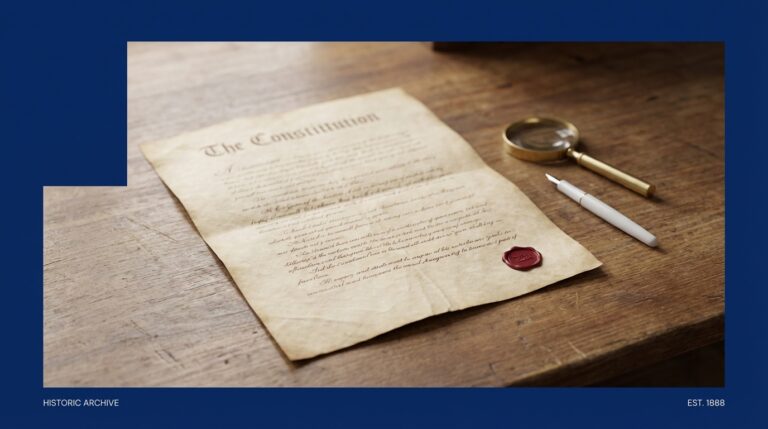
The aim is practical and archival: readers will find clear pointers to primary sources and cautious interpretation of motive. The focus is on evidence preserved in Founders Online and Library of Congress collections, which scholars use to reconstruct the drafting and amendment process.
What the proposed Bill of Rights was: a brief definition and context
The phrase proposed bill of rights refers to the package of constitutional amendments drafted and formally offered to Congress in 1789 for transmission to the states, together with related drafts and correspondence that record their development. Scholars treat these materials as the core documentary evidence for what was originally suggested and why those suggestions changed in committee and on the floor.
Copies of the drafts, Madison’s letters, and congressional records for the 1789 proposals are preserved in national collections and scholarly editions, which provide the primary basis for understanding the initial proposal and its path to the states; for a central public guide, see the Library of Congress Bill of Rights collection Library of Congress Bill of Rights collection. Also see the Bill of Rights full-text guide on this site Bill of Rights full-text guide.

The procedural timeline is compact: James Madison introduced a set of amendments in June 1789, Congress reviewed and revised them through committees and floor action, and the finished set of twelve amendments was transmitted to the states that year; ten were ratified by December 15, 1791 and are now known as the Bill of Rights.
James Madison and the June 1789 proposed bill of rights
James Madison is credited by scholars as the principal drafter who formally proposed the amendments in the U.S. House in June 1789, a point established in surviving drafts and correspondence held in major collections; see the Founders Online record of Madison’s proposed amendments for the primary texts and dates Founders Online text of Madison’s proposed amendments. Also consult the Library of Congress exhibit on religion and the federal government for context on related debates Religion and the Federal Government, Part 1. See a related Michael Carbonara overview of Madison’s proposals how Madison’s 1789 proposals led to the Bill of Rights.
Madison’s public role in the First Congress followed long involvement in constitutional debate during the ratification fights of 1787 and 1788, and his papers show he kept both political and theoretical questions in view as he drafted new language. Researchers rely on Madison-focused holdings and annotated guides to trace how an idea moved from discussion to formal proposal in the House; the Library of Congress maintains a comprehensive Madison resource guide that collects those materials Library of Congress Madison resource guide.
Find the primary documents on Madison's proposed amendments
For readers planning primary-source research, consult the collections and digitized letters cited above before drawing conclusions about motive or exact wording.
Because Madison left drafts and letters explaining his steps, historians can follow a chain of documentary evidence from private note to public submission; these sources show both the content he proposed and the context in which he proposed it.

Why Madison proposed the bill of rights: public pressure and political context
Madison introduced the amendments in part because several state ratifying conventions had asked for explicit protections, creating political pressure on the new federal government to respond; archival summaries and Madison’s correspondence document the requests and his reaction to them without implying a single private motive.
James Madison formally proposed the package of amendments in June 1789 in response to state convention requests and his own constitutional thinking. Congress edited and consolidated his drafts for political and procedural reasons, and some lawmakers resisted a federal listing because they saw it as redundant with state protections or feared enumeration could imply limits.
Scholarship therefore frames Madison’s initiative as a response to both public demands recorded during ratification and his own constitutional thinking, but it avoids treating motive as fully settled; primary letters and committee papers remain the best evidence for interpreting his intentions.
When reading Madison’s actions in 1789, it helps to separate the immediate cause-requests from state conventions and public debate-from longer-term intellectual commitments he had formed during debates about the structure of government and the limits of federal power.
How Congress changed Madison’s drafts: committees, consolidation and wording
Once Madison presented his list, the amendments passed into the congressional process, where committees reviewed, consolidated, and reworded proposals before sending a package to the states; contemporary congressional journals and committee reports record those edits and show where language was tightened or combined for political and procedural reasons Founders Online text of Madison’s proposed amendments. For a table showing the sources of Madison’s proposed amendments and subsequent action, see Founders Online: Amendments to the Constitution, [8 June] 1789 Founders Online: Amendments to the Constitution, [8 June] 1789.
Committee work in the First Congress often aimed to limit redundancy with state protections, avoid phrasing that might seem to exclude unlisted rights, and produce language acceptable to representatives from diverse states; the U.S. Senate Historical Office summarizes how those institutional concerns shaped amendment drafting and consolidation U.S. Senate Historical Office summary.
Steps to search Founders Online for Madison drafts
Use exact titles where possible
Concrete changes included merging closely related proposals, rephrasing clauses to reduce controversy, and omitting certain items that committee members judged unnecessary or legally duplicative; the combined effect of these edits produced the twelve amendments that Congress ultimately approved and transmitted to the states.
Why some lawmakers initially rejected or de-emphasized a federal bill of rights
Several members of the First Congress argued a federal bill of rights was unnecessary because state constitutions already protected many civil liberties, and they feared that listing rights federally could unintentionally limit unenumerated freedoms; the National Archives provides accessible transcriptions of contemporary arguments and the text of the final ratified amendments for context National Archives Bill of Rights transcript.
Other objections were procedural: some lawmakers worried that opening amendment debates in the new national legislature could unsettle fragile agreements reached during ratification or create political divisions that endangered the young union; the Senate Historical Office review discusses these political timing concerns as part of early resistance U.S. Senate Historical Office summary.
Opposition therefore combined constitutional reasoning and political calculation: framers and senators who emphasized state-level protections believed a separate federal list could be redundant, while others feared negative consequences from stating a limited list at the national level.
The procedural outcome: transmission, ratification and the final Bill of Rights
The First Congress approved twelve amendments in 1789 and transmitted them to the states under the Constitution’s amendment process, a step documented in congressional records and scholarly summaries of the First Congress’s actions Founders Online text of Madison’s proposed amendments.
By December 15, 1791, ten of those proposed amendments had been ratified by the required number of states and are collectively known today as the Bill of Rights; official overviews of the adoption process and its dates are available from the U.S. House historian’s office U.S. House Office of the Historian overview. For more on constitutional protections and their scope, see the site’s constitutional rights page constitutional rights.
Of the remaining original proposals, one later resurfaced and was ratified as the 27th Amendment in 1992, while another stayed unratified; the mixed fates of those proposals illustrate how the amendment process can produce long-delayed outcomes for some drafts and relatively quick adoption for others.
Common errors and historiographical debates about Madison’s motives
A common mistake is to assert a single motive for Madison without noting the plurality of documentary evidence; historians caution against treating private intent as fully recoverable and instead examine letters and committee records to weigh competing interpretations, as suggested by Madison-focused archival guides Library of Congress Madison resource guide.
Scholars continue to debate the balance between strategic compromise and principled advocacy in Madison’s work: some readings emphasize his responsiveness to ratifying conventions and political necessity, while others highlight continuity with his earlier constitutional thinking; both lines of argument rely on correlated readings of drafts and correspondence.
For readers, the practical implication is to prefer primary letters and committee records when weighing motives, and to treat confident claims about private intent as interpretations rather than settled facts.
Practical examples and short scenarios readers can use when researching primary sources
If you want to cite Madison’s draft language, a reliable approach is to locate the specific document on Founders Online and cite the document title, date, and the platform; for the June 1789 proposed amendments, Founders Online provides the transcription and citation details researchers typically use Founders Online text of Madison’s proposed amendments. The National Constitution Center also offers a classroom resource on Madison’s speech James Madison’s Speech in Support of Amendments (1789).
To compare committee edits, consult printed congressional journals and the Library of Congress’s manuscript collections to trace changes between Madison’s draft and the version Congress sent to the states; the Library of Congress Bill of Rights collection collects relevant manuscripts and explanatory notes Library of Congress Bill of Rights collection.
A short citation example: name the author or committee, give the document title or a description, include the exact date, and point to the digital repository and URL. Prefer the original transcription and archive record for precise wording and context.
Conclusion: what readers should take away about the proposed Bill of Rights
James Madison formally introduced the proposed amendments in June 1789, and his drafts and letters are the starting point for any grounded account of how a federal bill of rights reached the states; researchers rely on the Founders Online transcription and Library of Congress collections to follow that path Founders Online text of Madison’s proposed amendments.
Congress substantially edited and consolidated Madison’s proposals for political and procedural reasons, and some lawmakers initially opposed or de-emphasized a federal bill of rights because of redundancy concerns and worries that enumeration might imply limits; ten amendments were ratified by 1791 and form the Bill of Rights.
For deeper study, consult the primary documents cited here rather than secondary summaries, and read Madison’s letters and committee reports to form your own view about motive and drafting choices.
James Madison formally introduced a package of constitutional amendments to the U.S. House in June 1789; his drafts and letters survive in archival collections.
Opponents argued a federal list was unnecessary given state protections, feared that listing rights might limit unenumerated liberties, and worried about political timing during a fragile early republic.
Search the Founders Online transcription of Madison's proposed amendments and consult the Library of Congress Madison guides and manuscript collections for original letters and drafts.
If you are researching this topic for study or reporting, prefer archival transcriptions and the published records of the First Congress rather than secondary summaries alone.
References
- https://www.loc.gov/collections/bill-of-rights/about/
- https://michaelcarbonara.com/contact/
- https://founders.archives.gov/documents/Madison/01-11-02-0067
- https://www.loc.gov/rr/program/bib/madison/
- https://www.loc.gov/exhibits/religion/rel06.html
- https://michaelcarbonara.com/bill-of-rights-james-madison/
- https://founders.archives.gov/documents/Madison/01-12-02-0126
- https://www.senate.gov/about/powers-procedures/amendments-bill_of_rights.htm
- https://www.archives.gov/founding-docs/bill-of-rights-transcript
- https://history.house.gov/People/Detail/20078
- https://michaelcarbonara.com/bill-of-rights-full-text-guide/
- https://michaelcarbonara.com/issue/constitutional-rights/
- https://constitutioncenter.org/education/classroom-resource-library/classroom/5.4-primary-source-speech-in-support-of-amendments-madison