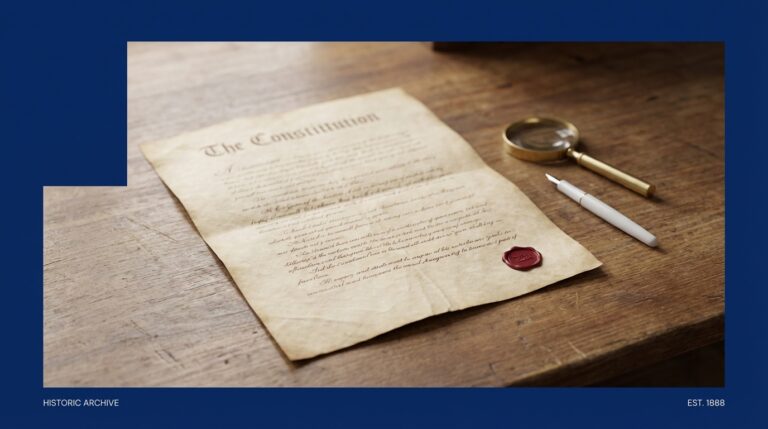
The aim is practical clarity for voters, students, and civic readers: identify the primary text, summarize historical arguments, and explain the contemporary legal posture without advocating outcomes or treating contested interpretations as settled law.
Readers who want to verify specific claims can consult the primary documents and legal summaries cited throughout the article.
Quick answer: where the Constitution uses the word republic
The Constitution explicitly uses the word Republican in Article IV, Section 4, commonly called the Guarantee Clause, which the text states requires the United States to guarantee to every state a Republican Form of Government. This is the document’s clear textual anchor for the idea of a republican form of government, and it is the starting point for legal and historical discussion about what that phrase means in practice, according to the National Archives transcript of the Constitution. Constitution transcript
Quick reference to primary texts and legal summaries
Use these links for primary reading
In short, the Guarantee Clause is the only place the word appears in the constitutional text and it commands that the United States guarantee a republican form of government to each state. That single clause anchors later discussion in law and history, but it does not supply a detailed judicial test on its face; readers looking for the primary text will find the clause in Article IV, Section 4 of the Constitution. Constitution transcript
The phrase “republican form of government” in the Guarantee Clause has been interpreted and debated in other settings, but as a textual matter the clause signals the Framers placed the idea of a republic among the Constitution’s core commitments. How that commitment should be enforced and what institutional features it requires are matters developed in political debates and legal commentary rather than settled doctrine within the courts. Guarantee Clause overview
How the Founders described a republic: Federalist and Anti-Federalist views
Federalist No. 39 on a representative republic
Federalist No. 39 sets out a Federalist understanding of a republican government as one grounded in representation, a written constitution, and the consent of the governed, describing the proposed Constitution as consistent with republican principles. In that essay, the authors argue the new plan combines national and federal elements while preserving rule by representatives under law. Federalist No. 39

The Federalist description framed the Constitution as building a constitutional republic where institutional checks, elections, and a written charter would channel popular consent into stable government. Federalist No. 39 was written to persuade readers during ratification that the plan of union did not abandon republican government but institutionalized it on a larger scale. Federalist No. 39
Anti-Federalist warnings about large republics (Brutus No. 1)
Anti-Federalist writings, most notably Brutus No. 1, countered that view by warning a large consolidated national government could threaten local republican self government and individual liberties, arguing that republican government worked best at smaller scales and closer to the people. Brutus urged caution about concentrating too much authority in distant institutions. Brutus No. 1
These debates were part of the ratification contest and functioned as political argument and persuasion; they inform modern interpretation but are not themselves judicial rules. Historians and legal scholars still draw on both sets of writings to explain the Framers’ competing concerns about representation, scale, and constitutional restraints. Federalist No. 39

How courts have treated the Guarantee Clause
Luther v. Borden and the political question doctrine
The Supreme Court in Luther v. Borden treated disputes under the Guarantee Clause as presenting political questions, holding that courts should not resolve certain controversies about whether a state government was republican in form and instead leaving such matters to Congress and the executive branch. That decision established a significant limit on judicial enforcement of the clause. Luther v. Borden (see the Constitution Center’s interpretation: Interpretation: The Guarantee Clause)
Because of that holding, the Guarantee Clause has been understood as less a direct vehicle for judicial remedy and more as a constitutional principle that the political branches can act upon. Courts have generally declined to create broad judicial tests from the clause, preferring political or legislative responses for disputes about state institutions. Guarantee Clause overview
Read the primary texts and legal summaries
Read the primary texts and legal summaries cited here to understand the constitutional language and how courts have approached the clause.
In practice, Luther v. Borden’s political question framing means that when citizens or officials dispute whether a state’s institutions qualify as republican under the clause, the judiciary often defers and looks to whether Congress or the President has acted or could act in response. This division of roles reflects a longstanding judicial reluctance to adjudicate politically sensitive structural claims about state governance. Luther v. Borden (case text also available on Justia: Luther v. Borden on Justia)
Practical limits on judicial enforcement
Legal commentary notes that the Guarantee Clause provides a constitutional grounding point rather than a detailed judicial rule, and that modern practice has resolved many disputes by political means rather than court orders. This is why legal summaries describe the clause as subject to political enforcement and congressional authority. Guarantee Clause overview
The judicial posture toward the clause has important consequences: it means remedies for perceived threats to republican institutions are more commonly sought in legislation, congressional oversight, or political mobilization, rather than in federal court. That dynamic continues to shape debates about the clause’s practical force. Luther v. Borden
What scholars and reference works mean by a “constitutional republic”
Core features: representation and rule of law

Scholarly treatments commonly describe a constitutional republic as government by representative institutions operating under and constrained by a written constitution, emphasizing separation of powers, rule of law, and regular elections as core features. This characterization draws on a range of scholarly work that distinguishes representative institutions from direct mechanisms of decision making. Stanford Encyclopedia entry on republicanism
That scholarly framing helps explain why commentators often contrast a constitutional republic with pure direct democracy, while also recognizing that many modern systems blend representative structures with direct democratic practices like referendums and initiatives. The literature stresses overlap and evolving institutional forms rather than a simple binary. Stanford Encyclopedia entry on republicanism
Overlap with democratic practices
Scholars note that representative institutions can coexist with democratic participation, and that using the term constitutional republic often highlights constraints on majority power, such as constitutional rights and judicial review, rather than denying democratic legitimacy. This nuance is why the phrase appears in both legal description and popular discussion about governance. Federalist No. 39
Those debates in scholarship inform how politicians, civic educators, and courts talk about the republic in contemporary settings, and they also shape expectations for how institutions should balance representation, law, and popular input. Readers should treat scholarly claims as interpretive, reflecting different emphases in political theory and legal history. Stanford Encyclopedia entry on republicanism
Historical examples of political resolution

Historically, controversies about whether state institutions satisfied the Guarantee Clause were often handled through political channels, including congressional debate, legislation, and national political responses, rather than direct judicial orders. The clause has functioned as a constitutional reference point that motivated political action. Constitution transcript
Because courts have treated the clause as non judicial in many contexts, political remedies have included congressional investigations, political recognition or non recognition choices, and legislative fixes to align state institutions with national norms. These are examples of how the clause has operated as a prompt for policy and politics rather than a self executing judicial standard. Guarantee Clause overview
Limits on judicial remedies and the role of Congress
Current practice through 2026 confirms that if questions arise about a state’s compliance with the Guarantee Clause, Congress and the executive have primary tools to respond, including oversight and legislation, while the courts typically avoid creating new tests from the clause itself. This allocation of responsibility follows from the Supreme Court’s political question approach. Luther v. Borden
For voters and policymakers, that means debates over whether institutions are sufficiently republican often play out in legislatures, public debates, and administrative actions, and remedies are political as much as legal. Readers seeking to press these issues should look to congressional procedures and political organizing alongside legal commentary. Guarantee Clause overview
Common misunderstandings and pitfalls
Misreading the Guarantee Clause as an automatic court remedy
A frequent misunderstanding is to assume Article IV, Section 4 automatically creates a routine judicial remedy for every dispute about state government; Luther v. Borden shows courts may refuse to adjudicate such claims and call them political questions instead. Readers should not assume a ready court pathway simply because the clause uses the word Republican. Luther v. Borden
Another pitfall is to equate the clause’s textual presence with a universal cure for political or policy concerns. The clause supplies constitutional language that anchors debate, but it does not prescribe specific policy remedies or guarantee judicial enforcement in every case. For contested questions, primary sources and scholarly commentary offer guidance rather than simple answers. Stanford Encyclopedia entry on republicanism
Confusing a republic with direct democracy
People sometimes conflate a republic with direct democracy, but scholarly and historical treatments stress that a constitutional republic centers representation and law rather than direct majority decision making, even while allowing democratic participation through elections. Careful reading avoids that category error. Stanford Encyclopedia entry on republicanism
To navigate these issues, consult the primary constitutional text, the ratification debates such as Federalist No. 39 and Brutus No. 1 for historical context, and modern legal summaries that explain how courts have treated the Guarantee Clause in practice. Those sources together provide a balanced foundation for analysis. Federalist No. 39 and our constitutional rights hub
Wrap up: how to read the Constitution on the question of a republic
In brief, the Constitution uses the term Republican in the Guarantee Clause of Article IV, Section 4; the Framers debated what republican government meant; courts have limited judicial enforcement by treating some Guarantee Clause disputes as political questions; and scholars describe a constitutional republic as representative government under law. These threads together show the clause is a constitutional anchor rather than a ready judicial rule. Constitution transcript
The Constitution explicitly uses the term Republican in Article IV, Section 4, the Guarantee Clause, which requires the United States to guarantee to every state a Republican Form of Government; how that requirement is enforced has been shaped by political debate and judicial restraint.
For further reading, consult the constitutional text and the key historical documents and legal summaries discussed above: Federalist No. 39, Brutus No. 1, Luther v. Borden, and scholarly entries on republicanism that explain the conceptual differences and overlaps. Federalist No. 39 – see also a detailed law review essay for scholarly discussion, and learn more about the author
For local voters seeking candidate information alongside constitutional background, campaign profiles and public filings can provide context about how candidates frame constitutional themes within their public communications. Public records and primary sources remain the most reliable way to confirm factual claims about institutions and political positions. Guarantee Clause overview and you can contact the campaign for specific inquiries.
The Guarantee Clause is Article IV, Section 4 of the Constitution; it states the United States will guarantee to every state a Republican Form of Government and serves as the textual basis for later legal and political discussion.
Courts have often treated Guarantee Clause disputes as political questions and generally avoid imposing direct remedies, leaving enforcement and political responses primarily to Congress and the executive.
Scholars typically describe the United States as a constitutional republic, meaning representative institutions governed by law, while noting that democratic practices like elections operate within that framework.
For voters and civic readers, the best next step is to read the cited primary sources and follow congressional or state procedures when evaluating specific institutional concerns.
References
- https://www.archives.gov/founding-docs/constitution-transcript
- https://www.law.cornell.edu/wex/guarantee_clause
- https://avalon.law.yale.edu/18th_century/fed39.asp
- https://michaelcarbonara.com/contact/
- https://avalon.law.yale.edu/18th_century/antifed01.asp
- https://www.law.cornell.edu/supremecourt/text/48/1
- https://constitutioncenter.org/the-constitution/articles/article-iv/clauses/42
- https://supreme.justia.com/cases/federal/us/48/1/
- https://plato.stanford.edu/entries/republicanism/
- https://michaelcarbonara.com/issue/constitutional-rights/
- https://harvardlawreview.org/wp-content/uploads/2018/12/602-688_Online.pdf
- https://michaelcarbonara.com/about/
{"@context":"https://schema.org","@graph":[{"@type":"FAQPage","mainEntity":[{"@type":"Question","name":"What does the Constitution say about a republic?","acceptedAnswer":{"@type":"Answer","text":"The Constitution explicitly uses the term Republican in Article IV, Section 4, the Guarantee Clause, which requires the United States to guarantee to every state a Republican Form of Government; how that requirement is enforced has been shaped by political debate and judicial restraint."}},{"@type":"Question","name":"What is the Guarantee Clause?","acceptedAnswer":{"@type":"Answer","text":"The Guarantee Clause is Article IV, Section 4 of the Constitution; it states the United States will guarantee to every state a Republican Form of Government and serves as the textual basis for later legal and political discussion."}},{"@type":"Question","name":"Can courts force a state to change under the Guarantee Clause?","acceptedAnswer":{"@type":"Answer","text":"Courts have often treated Guarantee Clause disputes as political questions and generally avoid imposing direct remedies, leaving enforcement and political responses primarily to Congress and the executive."}},{"@type":"Question","name":"Is the United States a republic or a democracy?","acceptedAnswer":{"@type":"Answer","text":"Scholars typically describe the United States as a constitutional republic, meaning representative institutions governed by law, while noting that democratic practices like elections operate within that framework."}}]},{"@type":"BreadcrumbList","itemListElement":[{"@type":"ListItem","position":1,"name":"Home","item":"https://michaelcarbonara.com"},{"@type":"ListItem","position":2,"name":"Blog","item":"https://michaelcarbonara.com/news/%22%7D,%7B%22@type%22:%22ListItem%22,%22position%22:3,%22name%22:%22Artikel%22,%22item%22:%22https://michaelcarbonara.com%22%7D]%7D,%7B%22@type%22:%22WebSite%22,%22name%22:%22Michael Carbonara","url":"https://michaelcarbonara.com"},{"@type":"BlogPosting","mainEntityOfPage":{"@type":"WebPage","@id":"https://michaelcarbonara.com"},"publisher":{"@type":"Organization","name":"Michael Carbonara","logo":{"@type":"ImageObject","url":"https://lh3.googleusercontent.com/d/1eomrpqryWDWU8PPJMN7y_iqX_l1jOlw9=s250"}},"image":["https://lh3.googleusercontent.com/d/1nNcrnV5UtkoBkWVQ1EdsBzAy_zSbK2Y4=s1200","https://lh3.googleusercontent.com/d/1N2Ap-UZ_bUNFcmNxIaNMmF_MoKKp8hSY=s1200","https://lh3.googleusercontent.com/d/1eomrpqryWDWU8PPJMN7y_iqX_l1jOlw9=s250"]}]}