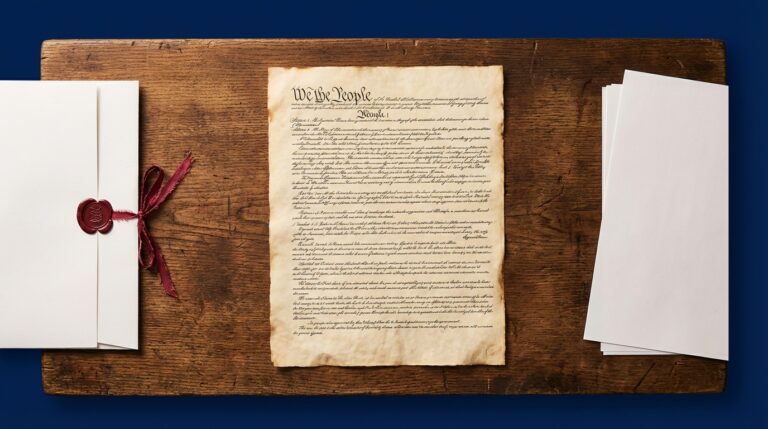
Readers will find clear summaries of the major categories the Court has allowed the government to restrict and practical examples for applying those standards to real-world situations.
What the First Amendment says and who it binds
Text and ratification
The First Amendment begins with a simple restraint on government power: Congress may not make laws abridging freedom of speech, or of the press, or the right of the people peaceably to assemble, or to petition the government for a redress of grievances, and it protects religious exercise and belief. For the full text and historical context, see the Legal Information Institute First Amendment text at the Legal Information Institute Legal Information Institute First Amendment text.
The amendment was ratified in 1791 as part of the Bill of Rights. That date grounds the amendment in early constitutional design and explains why its language is concise and broad. Courts interpret that language through later precedent.
Stay informed about Michael Carbonara's campaign and updates
Consult primary sources such as the constitutional text and controlling Supreme Court opinions to check claims about limits on speech.
To whom the Amendment applies
The First Amendment restrains government actors. It bars actions by Congress and, through later constitutional doctrines, most state actors from infringing the listed freedoms. The text itself names Congress as the initial target, and courts have long read it to limit state power through incorporation doctrines and Fourteenth Amendment analysis.
Private companies and individuals are generally not bound by the First Amendment in the same way the government is. When private platforms remove content or set rules, those actions are typically governed by separate contractual, statutory, or policy rules rather than the constitutional text.
Core freedoms the First Amendment protects
Freedom of speech and press
The amendment protects a wide range of expression, from spoken words to written editorials. Protected speech includes political argument, commentary, reporting, and many forms of artistic expression. Courts treat these protections as broad, but not unconditional.
Freedom of the press covers editorial media and reporting. That protection ensures critics, journalists, and publishers can publish views about public affairs with robust constitutional backing. Limits on press content must still face the same legal tests that apply to other expressive activity.
Freedom of religion, assembly, and petition
Religion is protected in two ways: a prohibition on laws establishing religion and safeguards for free exercise. Peaceful assembly covers organized marches, protests, and public meetings. Petition protects formal requests to government, such as petitions, letters, or requests for redress.
Examples include a church service, a neighborhood petition to a city council, and a peaceful protest in a public square. These activities are core First Amendment conduct, though specific limits may apply when a government shows a compelling interest under established tests.

Although protections are broad, the Supreme Court has carved narrow categories where government regulation has been upheld. Understanding these exceptions helps evaluate whether a restriction is constitutional or an overreach.
The recognized categories are deliberately narrow so that the general rule of protection remains strong. Courts emphasize precedent when deciding whether speech falls into an exception rather than treating the exceptions as broad loopholes.
The government may restrict certain narrow categories defined by the Supreme Court: incitement to imminent lawless action, obscene material under Miller, certain defamation claims involving actual malice, and true threats or conduct-based exclusions; courts apply specific tests and factual balancing to each category.
The main recognized categories
The main categories where courts have allowed regulation include incitement to imminent lawless action, obscenity, certain defamation claims subject to public-figure standards, and true threats or conduct-based exclusions. Modern debates consider how these categories apply online and to new technologies; legal analysis notes continued reliance on established Supreme Court tests in resolving those questions Brennan Center analysis of First Amendment limits.
These categories are exceptions and are narrowly defined by case law rather than by the amendment text itself. Courts require specific factual showings before allowing criminal or civil penalties to apply to speech in these areas.
Incitement: the Brandenburg standard and how courts apply it
The Brandenburg test explained

The leading test for incitement asks whether the advocacy is directed to inciting imminent lawless action and is likely to produce such action. This two-part standard confines government power to punish only the most dangerous forms of speech, preserving political advocacy that is abstract or hypothetical. See the Brandenburg v. Ohio opinion for the controlling phrasing of direction and likelihood Brandenburg v. Ohio opinion at LII and the Brandenburg test.
Key words in the test are directed, imminent, and likely. Directed means the speech targets producing unlawful conduct. Imminent means the harm is immediate rather than remote. Likely requires a real probability that the speech will produce the unlawful act. Courts weigh these factors together rather than in isolation.
A close hypothetical is a speaker at a rally who gives a timed instruction to a crowd to attack a named target within minutes and the crowd begins to advance immediately. Under Brandenburg v. Ohio, such targeted, time-sensitive instruction with a clear probability of producing violence is the type of advocacy the government may criminalize.
By contrast, general calls for protest or heated rhetoric without a clear, imminent plan do not meet the Brandenburg threshold. The test protects robust political debate while allowing narrow punishment where speech is essentially a plan to cause immediate lawless action.
Obscenity and the Miller test
Miller three-part test
Obscene material falls outside First Amendment protection when it meets the three-part Miller test: the average person, applying contemporary community standards, would find that the work appeals to the prurient interest; the work depicts sexual conduct in a patently offensive way as defined by state law; and the work lacks serious literary, artistic, political, or scientific value. This framework lets courts and legislatures regulate hard-core obscenity while protecting other sexual or expressive content. See the Miller v. California opinion for the test language Miller v. California opinion at LII.
Because the test relies on community standards and a value inquiry, outcomes can differ across jurisdictions. Courts apply the three parts carefully, and the exception remains narrowly applied rather than a broad allowance to police sexual content generally.

How community standards factor in
Community standards mean that what is legally obscene in one locality may not be in another. The test therefore allows local juries and courts to consider prevailing standards while the third Miller prong protects materials with demonstrable serious value from being labeled obscene.
Regulation under Miller focuses on content that lacks redeeming value and that is patently offensive by local measures. Courts balance the three parts to avoid suppressing legitimate artistic, scientific, or political expression.
Defamation, public-figure standard, and the actual malice rule
Sullivan and public-figure protection
The Supreme Court held that public-official plaintiffs seeking damages for defamatory falsehoods must prove actual malice to recover, meaning the defendant published the statement with knowledge of its falsity or with reckless disregard for the truth. That ruling raises the bar for defamation claims involving public figures and helps protect vigorous debate about public officials. See the New York Times Co. v. Sullivan opinion for the controlling standard New York Times Co. v. Sullivan opinion at LII.
Actual malice is a demanding standard. It requires evidence about the defendant’s state of mind rather than merely showing the statement was false. For private individuals, courts allow lower burdens in many jurisdictions, but constitutional concerns still shape defamation law.
How defamation claims interact with the First Amendment
Defamation remains actionable in many circumstances, but the First Amendment narrows how courts and juries can assess cases involving public discourse. Statements of opinion, rhetorical hyperbole, and errors made without malice often receive protection or dismissal under constitutional principles.
When readers or listeners evaluate claims about public figures, the actual-malice rule means courts look for evidence of knowing falsity or reckless disregard rather than punishing every incorrect factual statement about a public person.
True threats and conduct-based exclusions
What courts call a true threat
Speech that amounts to a serious, credible threat of violence, or targeted intimidation likely to produce fear or harm, can be excluded from First Amendment protection. The Court has treated such threats differently from rhetorical exaggeration or political argument, focusing on the context and the speaker’s intent. For foundational guidance, consult the Virginia v. Black opinion and related rulings Virginia v. Black opinion at LII.
quick judicial factors to assess whether speech is a true threat
Use primary opinions for source checks
Overlap with criminal statutes
True-threat doctrines overlap with criminal laws that punish targeted threats, stalking, or intimidation. Courts examine whether the speech was meant to intimidate a specific victim and whether a reasonable person would interpret the words as a real threat of violence.
Because context matters so much, courts look at the speaker’s history, the setting in which the words were spoken, and surrounding conduct. These fact-specific inquiries explain why outcomes can vary across similar-looking cases.
Applying the tests to online speech and platform moderation
Government limits versus private moderation
The First Amendment restricts government actors; private platforms generally set their own rules and may remove or moderate content under company policies without running afoul of the constitutional text. That distinction is crucial for readers evaluating content moderation actions on social media.
Courts continue to consider when state action might be present-for example, if government pressure or law compels a platform’s choice-but the baseline remains that private moderation is not identical to government censorship.
Open questions for platforms and courts
Applying Brandenburg, Miller, Sullivan, and true-threat doctrines to online posts, algorithmic amplification, and AI-generated content raises novel questions. Recent legal analysis notes courts still rely on established tests while acknowledging unresolved issues about intent, context, and enforcement in digital settings Brennan Center discussion of online speech issues.
Because platform moderation mixes private policy and public interest, readers should watch how courts define state action and how precedent adapts to technologies that change how speech spreads and how audiences form.
Decision criteria: how courts balance context, intent, and likelihood of harm
Key factors judges consider
Judges routinely weigh factors such as the speaker’s intent, the imminence of the threatened harm, the likely effect on the audience, and the context in which the speech occurred. Those factors are central to applying Brandenburg and other tests.

A practical checklist includes examining whether the advocacy was targeted or general, whether harm was imminent, and whether the speech likely produced unlawful conduct. Courts look for a factual record that ties speech to a concrete risk before permitting restrictions.
Brandenburg emphasizes direction and likelihood in incitement cases; Miller centers community standards and lack of serious value for obscenity; Sullivan focuses on the defendant’s state of mind for public-figure defamation. Understanding which test applies helps predict how courts will balance the listed factors.
Because the legal standards differ by category, the same speech may survive scrutiny under one test but fail under another, depending on context and the nature of the alleged harm.
Common mistakes and pitfalls when people discuss restrictions on speech
Conflating private moderation with government censorship
A common error is treating a private platform’s content removal as unconstitutional censorship. The First Amendment limits government power; private actions are governed by different rules and contractual arrangements, so readers should not equate the two without clear evidence of state involvement.
Another frequent mistake is using slogans or absolute language to describe complex legal outcomes. Phrases that claim the amendment “always” or “never” do something obscure how courts balance competing interests and factual contexts.
Overbroad or slogan-based claims
When encountering bold claims about speech restrictions, look for primary citations to cases or reputable legal analysis. Vague references, unnamed tests, or reliance on slogans are red flags that a report may oversimplify or misstate legal standards.
Relying on primary decisions and authoritative summaries helps readers separate legal rules from political rhetoric and evaluate whether a claimed restriction fits established precedent.
Practical examples and short scenarios
Political rally speech
Scenario: A speaker at a rally urges attendees to confront a named public official at a specific location immediately. Analysis: The Brandenburg test would be most relevant because the speech is time-sensitive and directed; if the speech is likely to produce imminent lawless action, it could be regulated under that standard Brandenburg v. Ohio opinion at LII.
In evaluating the scenario, courts would focus on whether the speech created a real risk that the crowd would act at once, not on heated rhetoric alone.
Online posts that approach incitement
Scenario: A social media post calls for followers to travel to a particular address and “do what is necessary” within the next hour. Analysis: The incitement framework is again the guiding test; courts would assess directedness, imminence, and likelihood in the online context and may consider how the post was amplified and to whom it was visible.
Because online posts spread differently than in-person speech, courts and analysts are actively debating how to adapt traditional tests to platform dynamics while relying on established precedents for baseline guidance Brennan Center perspective on online adaptation.
Alleged defamation of a public figure
Scenario: A news outlet publishes a false factual claim about an elected official. Analysis: New York Times Co. v. Sullivan sets the controlling standard for public-official plaintiffs; the plaintiff must show the publisher acted with actual malice to succeed, which requires proof of knowledge of falsity or reckless disregard for the truth New York Times Co. v. Sullivan opinion at LII.
The actual-malice requirement protects open debate about public officials while preserving remedies when falsehoods are published knowingly or with reckless disregard.
How to evaluate news and claims about First Amendment limits
Checking sources and case citations
When you read about a claimed restriction, check whether the report cites primary sources, such as the Supreme Court opinions that define the controlling tests. Primary opinions and reputable legal summaries provide the context needed to understand how precedent applies to a specific fact pattern. The Legal Information Institute and established legal centers are useful starting points for primary texts.
Reports that lack named cases, precise test references, or links to governing opinions should be treated cautiously. Good reporting links to primary materials or quotes jurists and experts who identify the relevant tests.
Where the law is unsettled and what to watch next
AI-generated content and deepfakes
Courts continue to apply established tests but face new questions when speech is synthetic, algorithmically amplified, or anonymous. Analysts note that while the core tests remain controlling, applying them to AI-generated content raises open questions about intent, attribution, and audience effect Brennan Center analysis of emerging issues.
Watch how courts address cases where generated content is used to mislead, intimidate, or coordinate harmful actions, and whether standards for intent or knowledge evolve in those settings.
Enforcement of platform rules and legal claims across borders creates complexity. Legal systems differ in how they regulate speech, and cross-jurisdictional enforcement can raise conflicts about applicable standards and remedies. Observers should note how courts reconcile local community standards with the global reach of online platforms.
Legislative developments and high-profile court cases will likely shape how precedent adapts to multinational and algorithmic contexts over the next years.
Short concluding summary: what the First Amendment actually prohibits
The First Amendment broadly protects speech, the press, religion, assembly, and petition, and it prevents government from enacting laws that abridge those freedoms. At the same time, courts have recognized narrow, court-defined categories where the government may lawfully restrict speech, including incitement to imminent lawless action, obscene materials under the Miller framework, certain defamation claims subject to the actual-malice rule, and true threats or conduct-based exclusions; each category is shaped by Supreme Court precedent and careful factual inquiry.
Readers should consult primary opinions and reputable legal analysis to assess claims about limits on speech and monitor ongoing developments as courts apply these tests to online and AI-era challenges.
No. The First Amendment limits government action. Private companies generally set and enforce their own moderation policies under contractual and platform rules.
Speech can be restricted for incitement only if it is directed to produce imminent lawless action and is likely to cause that action under the Brandenburg test.
No. Public-figure plaintiffs must show actual malice, meaning the speaker knew the statement was false or acted with reckless disregard for the truth.
This explainer aims to give readers a steady, source-based overview they can use to evaluate claims about speech limits.
References
- https://www.law.cornell.edu/constitution/first_amendment
- https://michaelcarbonara.com/issue/constitutional-rights/
- https://www.brennancenter.org/our-work/research-reports/what-first-amendment-protects-and-doesnt
- https://www.law.cornell.edu/supremecourt/text/395/444
- https://www.law.cornell.edu/wex/brandenburg_test
- https://supreme.justia.com/cases/federal/us/395/444/
- https://www.law.cornell.edu/supremecourt/text/413/15
- https://michaelcarbonara.com/contact/
- https://www.law.cornell.edu/supremecourt/text/376/254
- https://www.law.cornell.edu/supremecourt/text/538/343
- https://www.oyez.org/cases/1968/492
- https://michaelcarbonara.com/about/
- https://michaelcarbonara.com/news/