
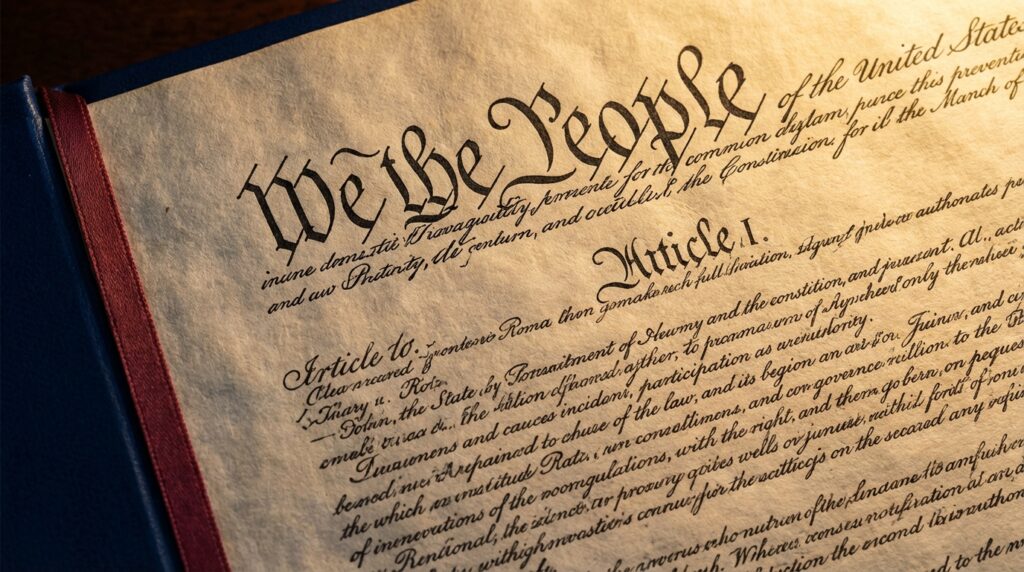
The discussion is neutral and source based. Read the Constitution text and the cited decisions to check claims directly.
Short answer: the us constitution is the supreme law of the land and what that means
The Constitution itself names the rule: Article VI, clause 2 declares that the Constitution, federal laws made pursuant to it, and treaties are the supreme law of the land.
That text sets a hierarchy for conflicts between federal and state law, and courts are the institutions that apply the rule when disputes arise, most fundamentally through judicial review.
In practice, the Supreme Court has long treated valid federal laws as capable of displacing conflicting state laws, a principle that appears in early decisions and in modern preemption cases.
Quick primary-source checklist for readers who want to verify constitutional text and key cases
Use official sources where possible
Below we outline the text, the framers context, the judicial mechanisms courts use, and key categories of preemption so readers can follow how the rule works today.
Where the Supremacy Clause appears in the Constitution and its original purpose
Article VI, clause 2 contains the Supremacy Clause and names three categories as supreme: the Constitution, federal laws made pursuant to it, and treaties. The clause supplies the textual basis for saying the federal system has a rule for resolving conflicts when both federal and state rules claim authority.
The Constitution transcript shows the clause in context and is the starting point for any textual analysis of federal supremacy Constitution transcript
Founding-era commentary helps explain why the framers included such a clause. For example, Federalist No. 33 articulates a concern that federal power must be able to operate uniformly across the states so federal laws would not be frustrated by inconsistent local rules.
The Federalist essay provides interpretive context used in original-meaning analysis, even though courts balance that history with later precedents when applying the Clause to modern disputes Federalist No. 33

Judicial review is the mechanism that allows courts to determine whether a state action is consistent with the Constitution and with valid federal law; this principle was set out in Marbury v. Madison.
Marbury v. Madison established the judiciary’s authority to interpret the Constitution and to invalidate government acts that conflict with it, giving federal courts the power to enforce federal supremacy in specific cases Marbury v. Madison, 1803
Another foundational case, McCulloch v. Maryland, illustrates how the Court limited state interference with federal functions and described aspects of federal power and its supremacy in practice.
The McCulloch decision is an early example of the Court reinforcing federal authority against state measures that would obstruct or tax federal operations McCulloch v. Maryland, 1819
Join the campaign for updates and ways to get involved
For readers who want to check primary sources and decisions cited here, consult the Constitution text and primary court reports linked in the article.
In modern litigation, the doctrine of preemption is the main analytical tool courts use to determine whether a federal law displaces state law; courts look to the relevant statute and precedent to reach that conclusion. See CRS report on federal preemption.
Kinds of preemption courts recognize: express, field, and conflict preemption
Express preemption occurs where Congress includes a clear statement in a statute that federal law supersedes state law in a particular area. Courts begin with the statutory text to identify whether Congress spoke directly to preemption.
Legal summaries emphasize that express statements in the statute are dispositive when present, and courts will enforce the explicit language Congress enacted Article VI analysis
Field preemption is recognized when federal regulation is so pervasive that it can be inferred Congress intended to occupy an entire regulatory field, leaving no room for state law to operate alongside it.
Modern cases have found field preemption in select areas where federal oversight is comprehensive and exclusive, though courts assess the statutory scheme and context closely before concluding the field is occupied Arizona v. United States
Conflict preemption arises when it is impossible to comply with both federal and state law, or when the state law stands as an obstacle to Congress’s objectives. Courts separate impossibility and obstacle variants when framing the issue.
Because conflict preemption depends on the relationship between federal objectives and state measures, courts compare the statutory purpose and the practical effect of the state rule in question Article VI analysis
How courts decide preemption: statutory text, intention, and balancing tests
Courts begin preemption analysis with statutory text. If a statute clearly and expressly preempts state law, that language controls and the court enforces Congress’s choice to occupy a regulatory space. See current doctrine on the Supremacy Clause.
Secondary resources on Article VI and preemption explain that courts seek a clear statement from Congress when preemption is asserted, and absent clear textual direction, courts are cautious about displacing state authority Article VI analysis
When the text is ambiguous, courts look to congressional intent reflected in the statute’s structure, legislative history, and purpose. Different contexts produce different analytic approaches. See Justice Department analysis.
The Supreme Court’s 2012 decision in Arizona v. United States illustrates how modern preemption analysis can limit state enforcement in areas where federal law has a strong presence, while still leaving room for state roles in other domains Arizona v. United States
Ultimately, the balance between federal uniformity and state autonomy turns on close reading of statutes and precedent, and on an understanding that the Supremacy Clause is a rule for resolving conflicts rather than a standalone grant of new federal power.
Common misunderstandings and legal pitfalls about federal supremacy
A frequent misconception is that the Supremacy Clause by itself creates federal power. The Clause does not create authority; it declares how to resolve conflicts where federal authority already exists under the Constitution or valid federal statutes.
Put differently, federal supremacy applies when federal law is validly exercised; courts will not find federal preemption unless the statute or constitutional provision actually grants the federal power at issue Constitution transcript
Another mistake is assuming that state laws are automatically void if they might conflict with federal policy. In practice, courts must be asked to rule and will apply preemption tests rather than treating every state rule as invalid on its face.
Legal discussions note that courts examine the statutory text, the practical effect of state laws, and precedent before concluding that preemption applies, so legal conclusion follows careful analysis rather than political assertion Article VI analysis
Practical examples: landmark cases and modern applications
Marbury v. Madison is the foundational decision that recognized judicial review, allowing the courts to say whether laws and actions conform to the Constitution. That decision underpins the judiciary’s role in applying the Supremacy Clause.
The Marbury opinion remains central to the judiciary’s self-understanding and to the practice of reviewing state actions against federal law and constitutional text Marbury v. Madison, 1803
McCulloch v. Maryland followed and exemplified the Court’s role in limiting state interference with federal functions, including state taxation that would obstruct federal operations.
The McCulloch ruling is often cited for its principles about federal power and the limits on state action that would impede federal purposes McCulloch v. Maryland, 1819
Yes. Article VI, clause 2 declares the Constitution, federal laws made pursuant to it, and treaties to be the supreme law of the land, and courts enforce that rule through judicial review and preemption doctrines.
In a modern context, Arizona v. United States addressed state efforts to enforce immigration rules and clarified how preemption doctrines apply when federal law occupies a central role in a policy area.
The Arizona decision shows how courts may strike down certain state measures that intrude on federal authority while leaving other state initiatives intact, depending on statutory text and federal objectives Arizona v. United States and related discussion on state vs federal immigration powers.
These cases together demonstrate the layered way courts apply the Supremacy Clause: text, intent, and precedent guide decisions rather than a single bright-line rule.
What this means for citizens, states, and ongoing debates
For readers who want to verify source documents, the Constitution text and reported Supreme Court decisions are the primary materials to consult; starting with official transcripts and the reported opinions provides direct access to the governing texts. For a local guide to reading and citing the Constitution, see read the Constitution online and consult site materials on constitutional rights.
Court decisions continue to refine preemption doctrine in specific policy areas, so attentive readers should follow new opinions and statutory developments to see how the balance between federal uniformity and state autonomy evolves.

Article VI, clause 2 states that the Constitution, federal laws made pursuant to it, and treaties are the supreme law of the land; that clause provides the textual rule courts use when conflicts arise.
No. Federal law overrides state law only when Congress has authority and the statute or constitutional provision covers the subject, and courts apply preemption doctrines to decide specific conflicts.
Consult the Constitution transcript at official archives and reported Supreme Court opinions for the cases cited, such as Marbury v. Madison and McCulloch v. Maryland.
For primary texts, consult the Constitution transcript and reported opinions mentioned in the article.





