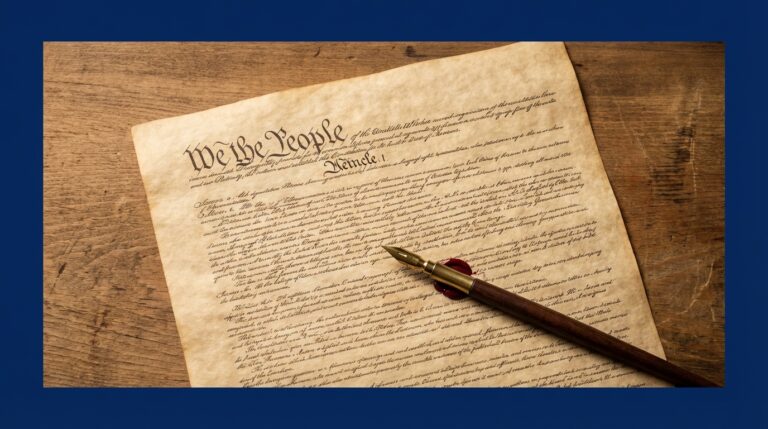
The explanation uses federal sources and archival collections to show what each observance means for schools, employers and the public. Where appropriate, the piece points to government guidance for verification and classroom materials.
What is Constitution Day and why it exists
us constitution day explained
Constitution Day, formally called “Constitution Day and Citizenship Day”, commemorates the adoption of the U.S. Constitution on September 17, 1787, and was established in federal law to ensure public attention to that document and to civic education, as the statute explains Public Law 105-225.
The day is intended as an educational observance. Federal guidance and archival collections support classroom materials, historical context and civic programming without creating a paid federal holiday for employees.
Stay updated and get involved with the campaign
For primary texts and official resources on Constitution Day, consult the law and archival collections listed by government institutions.
Collections at institutions such as the National Archives and the Library of Congress gather founding documents and teaching resources that explain why September 17 remains a focal date for civic learning.
Local organizers and educators use those materials to plan lessons or citizenship events that highlight the Constitution’s text and its historical adoption.
What is Independence Day and how it differs in status
Independence Day marks the adoption of the Declaration of Independence on July 4, 1776 and is designated as a federal holiday observed each year on July 4, with official listings in federal holiday calendars U.S. Office of Personnel Management federal holidays.
As a federal holiday, Independence Day typically results in office closures for federal employees and is associated with broadly visible public celebrations across the country.
The public face of the day includes parades, fireworks and ceremonies focused on national independence and public commemoration, often organized by parks, municipalities and historical sites.

Key legal and practical differences at a glance
Key legal and practical differences at a glance
One main difference is legal status: Constitution Day is a federal observance codified by statute, while Independence Day is a federal holiday with paid-time implications for federal employees, according to the law and federal practice Public Law 105-225 (see the CRS fact sheet).
Because Independence Day is on the federal holiday list, agencies follow the Office of Personnel Management guidance for scheduling closures and alternative days off when July 4 falls on a weekend OPM federal holidays.
No. Constitution Day and Independence Day are distinct observances. Constitution Day is a federal observance on September 17 focused on the Constitution and civic education, while Independence Day is a federal holiday on July 4 marking the Declaration of Independence.
Constitution Day remains a commemorative observance intended for civic education and events, not a day that automatically grants paid leave under federal holiday rules.
For practical planning, note that both days are fixed to calendar dates. Independence Day observance can shift in operational practice when it falls on a weekend, while Constitution Day is observed on September 17 regardless of weekday.
How each day is commonly observed in practice

Constitution Day programming typically focuses on classrooms, civic education and naturalization events, with federal and educational offices offering lesson plans and materials to mark the date Department of Education Constitution Day resources.
These activities often include readings from the Constitution, discussions about civic responsibilities and events for new citizens; many school districts use archival materials to design short modules for students.
By contrast, Independence Day is structured around public celebration. Fireworks, parades and large public ceremonies are common and often supported by parks and local governments that plan family friendly gatherings and commemorative programs National Park Service on Independence Day.
Because Independence Day is a federal holiday, that day is a practical marker for business and government scheduling, and communities build traditions of large outdoor events and civic ceremonies that emphasize national independence.
Why people confuse Constitution Day with Independence Day
People mix the two days because both commemorate foundational events in early U.S. history and both are national in character, which makes the differences easy to overlook in casual conversation National Archives Constitution Day background.
Another reason for confusion is timing: the founding era spans the 1770s and 1780s, so the topics overlap when discussing the early republic and its founding documents.

A quick way to avoid mistakes is to check the date and whether offices are closed, and to remember the different emphases: civic education and the Constitution on September 17, and public national celebration on July 4.
What the differences mean for schools, federal agencies and employers
Schools and educators are often the primary users of Constitution Day resources; the Department of Education and the National Archives provide lesson plans and collections designed for classroom use and civic programming Department of Education Constitution Day resources.
For federal agencies and employers, Independence Day appears on the OPM federal holiday list and that listing affects schedules and paid time for federal employees, as reflected in OPM guidance and agency policy OPM federal holidays.
State and local jurisdictions vary. Some employers or local governments choose to add observances or closures around Constitution Day, but these practices are not required by federal law and are decided locally or by employers.

quick checklist for verifying observance and holiday status
Use official sites for verification
When planning events, schools and employers should consult the Department of Education for classroom materials and OPM or local HR for schedule rules rather than assuming a uniform national practice.
Common mistakes to avoid when writing or planning events
Do not refer to Constitution Day as a paid federal holiday; distinguish an observance from a holiday and cite the statute or OPM guidance when you need to justify the difference Public Law 105-225.
Avoid swapping dates. Constitution Day is September 17 and Independence Day is July 4. Confusing those dates can cause scheduling errors for events or classroom lessons.
Also avoid assuming closures. If you need to know whether a workplace or public office will be closed, check OPM or local employer communications instead of assuming that an observance equals a paid day off.
Bottom line: Are Constitution Day and Independence Day the same?
Bottom line: Are Constitution Day and Independence Day the same?
They are distinct: Constitution Day is a federal observance on September 17 focused on the Constitution and civic education, while Independence Day is a federal holiday on July 4 marking the Declaration of Independence OPM federal holidays.
For verification or to find materials, consult the Public Law text, National Archives resources and the Department of Education or OPM listings so you can confirm status and planning guidance.
No. Constitution Day is a federal observance on September 17 focused on the Constitution and civic education, while Independence Day is a federal holiday on July 4 with federal office closures.
No. Constitution Day is an observance and does not automatically grant paid leave under federal holiday rules; check OPM listings for federal holidays.
The U.S. Department of Education and the National Archives publish lesson plans and archival materials suitable for schools and civic programs.
For campaign related contact or local questions, use the campaign contact page provided by the candidate if you need to get in touch with campaign staff about community events.
References
- https://www.govinfo.gov/content/pkg/PLAW-105publ225/pdf/PLAW-105publ225.pdf
- https://www.archives.gov/news/topics/constitution-day
- https://www.opm.gov/policy-data-oversight/snow-dismissal-procedures/federal-holidays/
- https://michaelcarbonara.com/events/
- https://www.ed.gov/constitution-day-resources
- https://www.nps.gov/inde/learn/historyculture/independence-day.htm
- https://www.archives.gov/founding-docs/constitution-day
- https://michaelcarbonara.com/contact/
- https://www.congress.gov/crs-product/R48174
- https://michaelcarbonara.com/issue/constitutional-rights/
- https://michaelcarbonara.com/issue/educational-freedom/