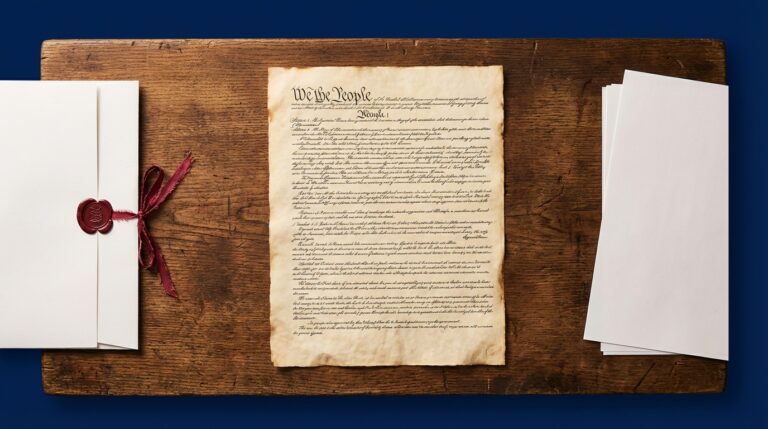
It points readers to the National Archives as the primary archival transcription and to accessible legal repositories for quick lookup and to the Constitution Annotated for interpretive references.
Quick answer: where to read the exact words of the U.S. Constitution
The short answer is that the exact wording of the us constitution is available in public-domain transcriptions published by the National Archives and by several stable legal repositories.
For the primary archival transcription of the original 1787 parchment, consult the National Archives Charters of Freedom transcription for the authoritative text and reproduction guidance National Archives Charters of Freedom transcription. You can also view the dedicated transcript page for a line-by-line transcription The Constitution of the United States: A Transcription.
For practical, hyperlinked copies useful for quotation and quick lookup, reliable alternatives include Cornell Law School’s Legal Information Institute and Yale Law School’s Avalon Project, both of which publish the full text in accessible formats Legal Information Institute’s U.S. Constitution page. See the constitutional rights hub on this site for related posts.
For the primary archival transcription of the original 1787 parchment, consult the National Archives Charters of Freedom transcription for the authoritative text and reproduction guidance National Archives Charters of Freedom transcription.

Cornell Law School’s Legal Information Institute offers a convenient, hyperlinked copy of the full text that many writers and researchers use for quick lookups and quotation Legal Information Institute’s U.S. Constitution page.
Authoritative full-text sources and how to access them
The National Archives publishes a public-domain transcription of the Constitution based on the original parchment, and that transcription is considered the primary archival source for the exact wording National Archives Charters of Freedom transcription.
Cornell Law School’s Legal Information Institute offers a convenient, hyperlinked copy of the full text that many writers and researchers use for quick lookups and quotation Legal Information Institute’s U.S. Constitution page.
Join the Campaign
For the exact, line-by-line text, start with the National Archives transcription; it is the archival source most widely used for official reproductions.
Yale’s Avalon Project maintains a reliable historical transcription useful for scholarly context and for checking earlier editorial presentations of the text Avalon Project transcription.
How the Constitution is organized: Preamble, Articles, Amendments

The Constitution opens with the Preamble, then presents Articles I through VII that set the structure and powers of the federal government, followed by the Amendments which modify or clarify rights and procedures.
The National Archives publishes a public-domain transcription of the Constitution and other repositories like Cornell LII and Yale's Avalon Project provide accessible copies for quotation and research.
Standard naming conventions place the Preamble first, then Articles I-VII in order, and then numbered Amendments where the Bill of Rights is the collective name for the first ten Amendments; for clause-level citation practice, a common format is Article, Section, Clause or Amendment and paragraph when needed, as illustrated in the Constitution Annotated Constitution Annotated.
Article-by-article quick guide (Articles I 6VII)
Article I focuses on the legislative branch and describes the structure and enumerated powers of Congress, including the clause-level listings that are commonly cited for specific authorities.
Article II sets out executive powers and qualifications for the presidency, and Article III establishes the federal judiciary and its jurisdictional outline; the remaining Articles address federal-state relations, amendments, federal authority and ratification language, with the full original wording available in the primary transcriptions National Archives Charters of Freedom transcription.
How to find the exact wording of a clause or amendment
When you need the exact wording of a clause or an amendment, use clause-level citation practice: cite Article, Section, Clause or the Amendment number and paragraph where applicable, and then locate the precise transcription in an authoritative repository Constitution Annotated. You can also consult the Library of Congress guide for supplementary references Guide to Law Online: U.S. Federal: United States Constitution.

To reach the exact text quickly, use the National Archives search or Cornell LII’s navigation by Article and Amendment; both provide stable anchors that let you copy the precise wording for academic or journalistic citation Legal Information Institute’s U.S. Constitution page. For related updates and posts see the news section on this site.
Amendments overview: the Bill of Rights through the 27th Amendment
The first ten Amendments together are known as the Bill of Rights and are followed by later amendments that address a range of constitutional changes, including voting rules, term limits, and procedural matters.
The most recently adopted amendment remains the 27th Amendment, ratified in the 1990s, and readers can find the official amendment texts in the National Archives transcription and in annotated collections for commentary Constitution Annotated.
Where to go for interpretation: Constitution Annotated and expert essays
For clause-level explanation, Supreme Court citations, and practical interpretive background, the Constitution Annotated on Congress.gov is the standard annotated resource that links each provision to relevant cases and explanations Constitution Annotated.
Recommend interpretive resources for clause-level context
Use these for authoritative commentary
The National Constitution Center’s Interactive Constitution provides essays from multiple scholars and can help readers see competing interpretive approaches without replacing primary sources National Constitution Center’s Interactive Constitution. The Constitution Center also hosts an overview of the document The U.S. Constitution.
Public domain status and reuse rules for the Constitution text
The text of the Constitution is in the public domain and may be reproduced without seeking permission from a rights holder, but users should cite the specific transcription they used for accuracy and transparency National Archives Charters of Freedom transcription.
When reproducing text for publication, prefer the National Archives transcription or a stable legal repository like LII to avoid transcription differences introduced by secondary summaries Legal Information Institute’s U.S. Constitution page.
Where to find images and original-document scans of the Constitution
High-resolution images and scans of the original parchment are available through the National Archives Charters of Freedom pages, which host official images and display notes for reproduction and citation National Archives Charters of Freedom transcription.
The National Constitution Center also offers interactive features that can be helpful for reading the document and comparing clause-level extracts with modern commentary National Constitution Center’s Interactive Constitution.

Common errors and pitfalls when quoting the Constitution
Modern presentations sometimes adjust punctuation, capitalization, or formatting for readability, and those editorial differences can cause small wording discrepancies; for exact quotes rely on the National Archives transcription or a stable legal copy.
Avoid using paraphrases when the exact wording is required for legal or academic purposes, and double-check citation anchors rather than copying from summaries or secondary articles.
Practical citation examples: Article I Section 8, First Amendment, and Fourteenth Amendment
Article I, Section 8 is commonly cited for congressional powers; a practical citation format is: U.S. Const. art. I, sec. 8, cl. 1, followed by the exact quoted clause copied from a primary transcription such as the National Archives or LII Constitution Annotated.
A copy-ready line for the First Amendment might read: “Congress shall make no law respecting an establishment of religion, or prohibiting the free exercise thereof; or abridging the freedom of speech” with the citation U.S. Const. amend. I and the transcription source noted for verification Legal Information Institute’s First Amendment text.
Comparing transcripts: National Archives, Avalon, and LII
Transcriptions can differ in presentation, notes, or editorial formatting; compare the National Archives transcription to Yale’s Avalon Project and LII to see presentation differences and to verify punctuation and capitalization against the archival source Avalon Project transcription.
For scholarly work, note which transcription you used in your citation and include a stable URL to the specific transcription page when possible Legal Information Institute’s U.S. Constitution page.
When to consult primary sources versus annotated summaries
Consult the National Archives transcription when you need the exact wording for quotation or legal drafting, and use annotated resources like the Constitution Annotated for interpretive background and case citations when context is required National Archives Charters of Freedom transcription.
Campaign materials, candidate statements, and other secondary sources may summarize constitutional principles for a public audience, but for precise legal or academic citation refer back to the primary transcription and to the Annotated collection for authoritative examples of clause-level citation.
Conclusion and next steps: where to read, cite, and learn more
Key takeaways: the National Archives transcription is the primary archival source for the exact words of the Constitution, the text is public domain, and the Constitution Annotated provides clause-level guidance and links to Supreme Court materials for interpretation Constitution Annotated.
For further reading, start with the National Archives transcription, use Cornell LII for quick citation and copying, and consult the Interactive Constitution and Constitution Annotated when you need interpretive essays or case citations Legal Information Institute’s U.S. Constitution page. Learn more about the author about.
The National Archives publishes a public-domain transcription of the Constitution, and reliable copies are also available from Cornell Law School's LII and Yale's Avalon Project.
No. The text of the Constitution is in the public domain and may be reproduced without permission, though you should cite the specific transcription used.
For interpretation and case citations, consult the Constitution Annotated and linked Supreme Court opinions; use the National Archives transcription for exact wording.
References
- https://www.archives.gov/founding-docs/constitution
- https://www.archives.gov/founding-docs/constitution-transcript
- https://www.law.cornell.edu/constitution/
- https://avalon.law.yale.edu/18th_century/const01.asp
- https://constitution.congress.gov/
- https://www.law.cornell.edu/constitution/first_amendment
- https://michaelcarbonara.com/contact/
- https://michaelcarbonara.com/issue/constitutional-rights/
- https://michaelcarbonara.com/news/
- https://guides.loc.gov/us-federal-law/constitution
- https://constitutioncenter.org/interactive-constitution
- https://constitutioncenter.org/the-constitution
- https://michaelcarbonara.com/about/