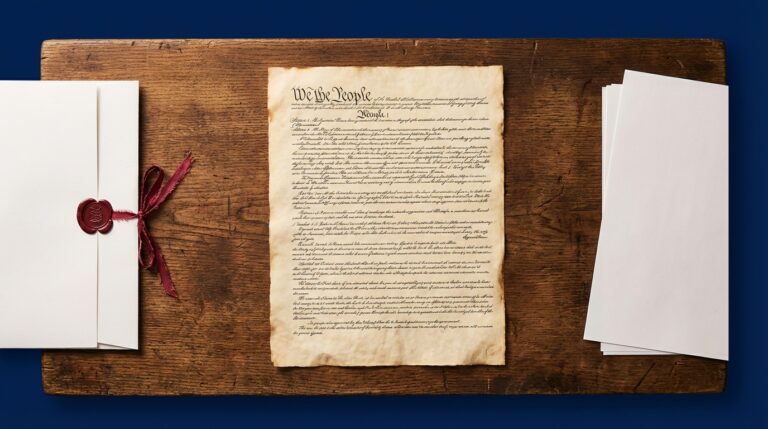
The content relies on primary transcriptions and leading Supreme Court decisions. Links point to official sources so readers can verify the exact language and review the opinions mentioned.
What the Eighth Amendment says and why it matters (us constitution text)
The Eighth Amendment of the United States Constitution reads, in full: “Excessive bail shall not be required, nor excessive fines imposed, nor cruel and unusual punishments inflicted.” This verbatim wording appears in federal transcriptions and is archived in the National Archives for primary reference, where readers can verify the exact text National Archives.
Plainly put, the amendment has three short clauses that limit government power: limits on bail, limits on fines, and a prohibition on cruel and unusual punishments. Each clause uses concise language but courts and commentators interpret those words in context and over time.
Quick sources to search the amendment text
Use primary sources first
The wording shown above is the Eighth Amendment full text as commonly cited in legal and historical materials, and the Legal Information Institute provides a widely used legal transcription for reference.
The phrase “cruel and unusual punishments” has prompted sustained legal debate, while the bail and fines clauses often arise in everyday pretrial and criminal-procedure contexts. Understanding the plain text is the first step to reading how courts apply it.

Authoritative sources for the us constitution text and where to read it
If you need the exact amendment text, go first to primary sources and then to reputable legal summaries. A primary source transcription, such as the National Archives reproduction of the amendments, preserves the wording as recorded in official documents National Archives.
Legal summaries and annotated texts, like those at university law libraries, add context and citations to cases that interpret the amendment; they are useful for research but should not replace the primary wording when an exact quote is needed Legal Information Institute.
Read the amendment at primary sources
If you want to view the amendment text in a primary transcription, check the National Archives or a recognized law library for the official wording.
When quoting the amendment in reporting or scholarship, cite the source you used and include the exact phrase in quotation marks. When you cite a case that interprets a clause, link to the case record or official opinion so readers can check how the Court applied the words.
Clause by clause: bail, fines, and cruel and unusual punishments
The Excessive Bail Clause says that bail should not be required in an amount greater than necessary to ensure a defendant returns for court. Courts have read this to mean bail must be individualized and reasonable, not set only to punish or to keep someone detained without cause; this interpretation is discussed in Stack v. Boyle Stack v. Boyle.
The Excessive Fines Clause bars penalties that are excessive in relation to the offense and the defendant. A key modern step in enforcing that limitation at the state level came in Timbs v. Indiana, which treated the clause as applicable to states under the Fourteenth Amendment Timbs v. Indiana opinion (see analysis at Harvard Law Review Timbs v. Indiana).

The Cruel and Unusual Punishments Clause is evaluated by courts against community standards and evolving legal principles. That phrase has been central in decisions that define sentencing limits and the constitutionality of particular punishments.
How the Supreme Court has shaped ‘cruel and unusual’ doctrine
In Trop v. Dulles the Court articulated the idea that what counts as “cruel and unusual” may change as society’s standards evolve, an approach called the “evolving standards of decency” test; readers can consult the case record for the original opinion Trop v. Dulles (see coverage at SCOTUSblog Timbs v. Indiana).
The Eighth Amendment reads, "Excessive bail shall not be required, nor excessive fines imposed, nor cruel and unusual punishments inflicted." Courts interpret its clauses through precedent such as Trop v. Dulles, Furman v. Georgia, Timbs v. Indiana, and Stack v. Boyle, applying standards like proportionality and evolving societal norms to the facts of each case.
That evolving-standards approach does not produce a fixed list of forbidden penalties. Instead, the Court looks for national consensus and other markers when deciding whether a punishment offends contemporary standards of decency.
Furman v. Georgia affected death penalty law by finding that the application of capital punishment at the time produced arbitrary results; the decision led states to revise statutes and spurred further constitutional analysis of capital sentencing Furman v. Georgia.
Later opinions build on Trop and Furman, and the Court often emphasizes that the Eighth Amendment analysis is fact sensitive and framed by precedent as well as current standards.
Modern developments: incorporation and state application
Recent decisions show how parts of the Eighth Amendment apply to state governments through the Fourteenth Amendment’s incorporation doctrine. The Court’s ruling in Timbs v. Indiana is a prominent example of that approach and clarified that the Excessive Fines Clause limits state actions as well as federal ones Timbs v. Indiana opinion (see coverage at SCOTUSblog Timbs v. Indiana).
Incorporation means state courts and legislatures must consider constitutional limits when imposing fines or allowing civil-asset procedures. The practical effect is that people challenging state fines can raise an Eighth Amendment claim in state or federal court under incorporated protections.

These developments show that the amendment’s reach is not static: court rulings determine how protections apply across jurisdictions, and practitioners watch new opinions for shifts in how clauses are enforced.
How courts evaluate excessive bail and typical case patterns
Stack v. Boyle explained that bail must not exceed what is necessary to ensure appearance. That case guides judges to consider a defendant’s ties to the community, history of appearances, and flight risk when setting bail Stack v. Boyle.
In practice, courts weigh factors such as the severity of the alleged offense, the defendant’s criminal history, risk of flight, and danger to the public. Defense advocates often present community ties, employment, and supervision plans to argue for lower bail or release on nonmonetary conditions.

Excessive bail claims are fact specific. A challenge can succeed where bail appears aimed at punishment or where the amount is plainly unrelated to assuring court appearance. Judges balance individual liberty and public safety in these decisions.
Common mistakes and misunderstandings about the Eighth Amendment
A common error is treating “cruel and unusual” as a static list of banned punishments. The phrase is a legal standard that courts interpret over time, not a fixed catalog of forbidden practices Trop v. Dulles.
Another misunderstanding is assuming all harsh or unpopular penalties violate the Eighth Amendment. Courts apply tests that look at proportionality, precedent, and societal standards, so severity alone does not determine constitutionality.
Readers should consult primary cases and reputable legal summaries rather than rely on slogans. Trusted sources reduce the risk of mischaracterizing complex constitutional doctrine.
Practical scenarios: how an Eighth Amendment claim might arise
Example 1, a bail hearing dispute. A defendant charged with a nonviolent offense receives a very high bail amount. Counsel might cite Stack v. Boyle and argue that the amount exceeds what is necessary to secure appearance. The court would examine risk factors and whether less restrictive conditions could suffice.
Example 2, a civil fine or asset seizure. A person challenges a large civil fine or forfeiture as excessive. Under the Excessive Fines Clause, and in light of Timbs v. Indiana, the argument would be that the penalty is disproportionate to the offense and therefore unconstitutional; the court would assess proportionality and precedent Timbs v. Indiana opinion (see an overview at Fines and Fees Justice Center Timbs v. Indiana).
Example 3, a sentence or death penalty review. A defendant or an appellate lawyer might argue that a particular sentence violates the Cruel and Unusual Punishments Clause, relying on standards developed in Trop and Furman and in subsequent decisions that analyze proportionality and evolving standards Furman v. Georgia.
Wrap up: reading the us constitution text on the Eighth Amendment today
Key takeaway: the Eighth Amendment full text is brief but foundational: “Excessive bail shall not be required, nor excessive fines imposed, nor cruel and unusual punishments inflicted.” Verify the wording in primary records such as the National Archives when exact quotation matters National Archives.
The amendment’s application has been shaped by cases like Trop v. Dulles, Furman v. Georgia, Timbs v. Indiana, and Stack v. Boyle; courts evaluate claims on the facts and on the governing precedents, and outcomes depend on those details.
For local readers assessing candidate materials or civic resources, consult primary sources and reputable legal summaries. Campaign pages and public filings can provide context about a candidate’s background while separate legal sources show how constitutional protections apply.
The Eighth Amendment states, "Excessive bail shall not be required, nor excessive fines imposed, nor cruel and unusual punishments inflicted." Check primary sources for exact punctuation and wording.
Yes. The Supreme Court has applied parts of the Eighth Amendment to the states through incorporation, for example in the decision addressing the Excessive Fines Clause.
Courts assess cruel and unusual claims by looking at precedent, national consensus, proportionality, and evolving standards of decency developed in case law.
For local civic information, campaign pages and public filings provide candidate context, while primary legal sources clarify constitutional protections.
References
- https://www.archives.gov/founding-docs/amendments-11-27
- https://www.law.cornell.edu/constitution/amendment_viii
- https://www.oyez.org/cases/1940-1955/342us1
- https://www.supremecourt.gov/opinions/18pdf/17-1091_h3dj.pdf
- https://harvardlawreview.org/print/vol-133/timbs-v-indiana/
- https://www.oyez.org/cases/1957/40
- https://www.scotusblog.com/cases/case-files/timbs-v-indiana/
- https://www.oyez.org/cases/1971/69-5003
- https://finesandfeesjusticecenter.org/articles/timbs-v-indiana/
- https://michaelcarbonara.com/issue/constitutional-rights/
- https://michaelcarbonara.com/contact/
- https://michaelcarbonara.com/michael-carbonara-launches-campaign-for-congress/
- https://michaelcarbonara.com/news/