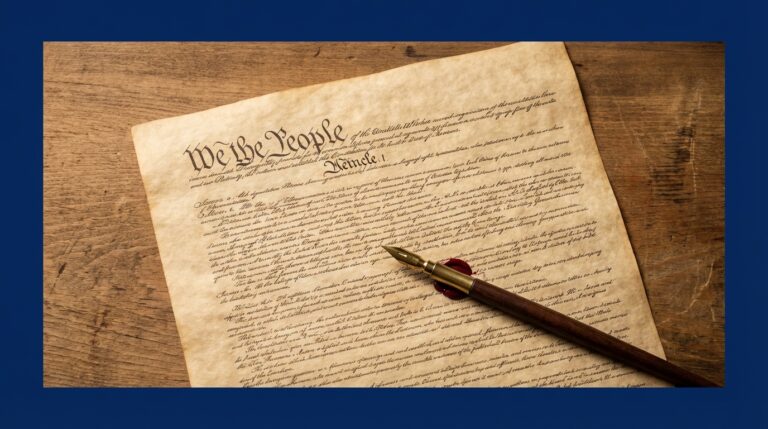
You will find the verbatim text first, then a numbered breakdown, notes on how courts use the Preamble, common mistakes to avoid, study tips, and a short historical timeline.
Canonical text: the Preamble, verbatim
Exact transcription
We the People of the United States, in Order to form a more perfect Union, establish Justice, insure domestic Tranquility, provide for the common defence, promote the general Welfare, and secure the Blessings of Liberty to ourselves and our Posterity, do ordain and establish this Constitution for the United States of America.

This exact wording is the canonical transcription used by major archival sources and legal reference sites. For the authoritative text, see the National Archives transcript National Archives Preamble transcript
Quick reading note
For quick study, note that the opening phrase begins with the popular authority statement, followed by the statement of purpose, then a compact list of objectives. A direct archival transcription preserves this order and wording. See related educational resources educational freedom.
What the Preamble is and where it appears in the Constitution
Definition and purpose
The Preamble is an introductory statement that sets out the Constitution’s purposes; it summarizes the Framers’ aims rather than creating a standalone legal grant of powers or individual rights, according to annotated constitutional sources Constitution Annotated
The correct order begins with the call to popular authority, "We the People," followed by the statement of aim to form a more perfect Union, then the list of objectives in the canonical sequence, and ends with the clause that ordains and establishes the Constitution.
Where does the Preamble appear and what does it do? See the full Constitution transcription at the National Archives National Archives Constitution transcription.
Placement at the Constitution’s start
Authoritative transcriptions place the Preamble at the very start of the Constitution and the wording has remained the same since the founding era; archival resources and library transcriptions reproduce the text verbatim for study and citation Library of Congress transcription and background
Phrase-by-phrase order: numbered breakdown and short explanations
Numbered list of the Preamble’s main phrases in order
Below is a numbered breakdown that follows the canonical order exactly. Each item names the phrase and offers a brief plain-language explanation drawn from standard archival and legal descriptions.

- “We the People” – This opening phrase places the source of constitutional authority in the people rather than in a monarch or single legislature; it acts as a call to popular authority and frames the document’s democratic claim Legal Information Institute Preamble
- “in Order to form a more perfect Union” – This clause states the Framers’ aim to improve the political union among the states and to refine the Confederation into a stronger national structure National Archives Preamble transcript
- “establish Justice” – A concise objective indicating that the Constitution seeks to create a legal framework for fair adjudication and equal application of laws Legal Information Institute Preamble
- “insure domestic Tranquility” – This phrase reflects a priority on internal peace and public order within the states and among citizens National Archives Preamble transcript
- “provide for the common defence” – A provision that indicates duties related to national security and defense as a shared responsibility of the union Legal Information Institute Preamble
- “promote the general Welfare” – A broad objective to advance the material and civic well-being of the nation, described in many annotated discussions as a policy aim rather than a specific grant of power Constitution Annotated
- “and secure the Blessings of Liberty to ourselves and our Posterity” – This clause ties the present generation to future ones and frames liberty as an enduring public value National Archives Preamble transcript
- “do ordain and establish this Constitution for the United States of America” – A closing clause that formally declares the Constitution’s enactment and ties together the previous objectives into a single founding act Legal Information Institute Preamble

How courts and scholars use the Preamble in interpretation
The Preamble as interpretive aid
Judges, scholars, and annotated sources frequently consult the Preamble to clarify the Constitution’s purposes and to provide interpretive context, but they generally treat it as an aid rather than a source of enforceable powers Constitution Annotated Preamble
Want the primary sources?
For deeper reading, consult the primary transcriptions at the National Archives and the Constitution Annotated for expert commentary and case-linked analysis.
Limits to legal authority
The Preamble’s wording helps explain intent and values, yet annotated and scholarly references emphasize that courts normally do not derive independent rights or powers from the Preamble alone; questions about legal effect turn on case law and statutory text National Constitution Center Preamble analysis
Where to find annotated analysis
Readers seeking scholarly notes and connections to case law can start with the Constitution Annotated and with expert overviews available from constitutional centers and legal commentaries Constitution Annotated
Common mistakes and misconceptions about the Preamble
Typical ordering errors
A common error is misordering the list of objectives, for example swapping the order of “establish Justice” and “insure domestic Tranquility”; the canonical transcription fixes the sequence and primary sources should be used to confirm the correct order National Archives Preamble transcript

Readers sometimes cite political slogans or paraphrases as if they were the Preamble’s text; reliable practice is to reproduce the verbatim transcription and then annotate paraphrases separately Legal Information Institute Preamble
Study aids and classroom tips to remember the correct order
Simple mnemonic options
Use a short mnemonic that maps to the sequence of objectives; for example, a memory key built from the initial letters of each objective can help students recall the order in classroom drills National Archives Preamble transcript
Practice exercises include recitation, writing the numbered phrases from memory, and pairing the verbatim text with the breakdown to reinforce both wording and order.
Simple daily practice routine for learning the Preamble
Use short sessions
Flashcards that show the verbatim phrase on one side and the numbered position on the other support rapid recall; teachers can time short recitations to build fluency and test order under pressure Legal Information Institute Preamble
Suggested classroom activities include group recitation, peer testing of the numbered breakdown, and short writing prompts that ask students to explain one phrase’s meaning in their own words while citing the canonical text National Archives Preamble transcript and see the author about page.
A brief timeline: drafting in 1787 and ratification context
Drafting at the Constitutional Convention
The Preamble and much of the Constitution took shape during the 1787 Constitutional Convention in Philadelphia, where delegates debated the national framework that the Constitution would set out Library of Congress Constitution transcription
Ratification and early reception
After drafting in 1787, the Constitution including the Preamble underwent state-by-state ratification in 1788 and was then held as the founding charter; historical summaries and encyclopedic articles provide context for how contemporaries received the document Encyclopaedia Britannica Preamble article
The correct order begins with the call to the people, moves to a statement of aim to form a more perfect Union, lists the objectives in the canonical sequence, and closes with the clause that ordains and establishes the Constitution; reproduce the verbatim Preamble first and then use a numbered breakdown for study National Archives Preamble transcript
When citing the Preamble, reference archival transcriptions such as the National Archives and annotated resources like the Constitution Annotated or the Legal Information Institute to ensure correct wording and reliable interpretive notes Constitution Annotated and see our constitutional rights hub.
The opening words are the canonical phrase that begins, "We the People of the United States," as reproduced in official archival transcriptions.
No. The Preamble is an interpretive statement of purpose; courts may consult it for context but generally do not treat it as an independent source of enforceable powers.
Primary archival sites such as the National Archives and institutional transcriptions like the Library of Congress provide authoritative, verbatim versions of the Preamble.
The Preamble remains a stable, short statement of purposes; questions about legal effect are matters for case law and scholarly analysis.