The focus is historical and evidence based. Readers will find a concise definition, a short intellectual history, an account of how the founders applied the idea, and guidance for evaluating contemporary claims about institutional resilience.
What checks and balances means: a clear definition and political context
Checks and balances refers to a system of institutional restraints and mutual oversight among different branches of government designed to limit concentration of power and protect liberty. This concept links the idea of separate institutions with mechanisms that allow one branch to constrain or review another, which is central to many accounts of constitutional design, and scholars describe it as a core organizing principle rather than a guarantee of outcomes Stanford Encyclopedia of Philosophy.
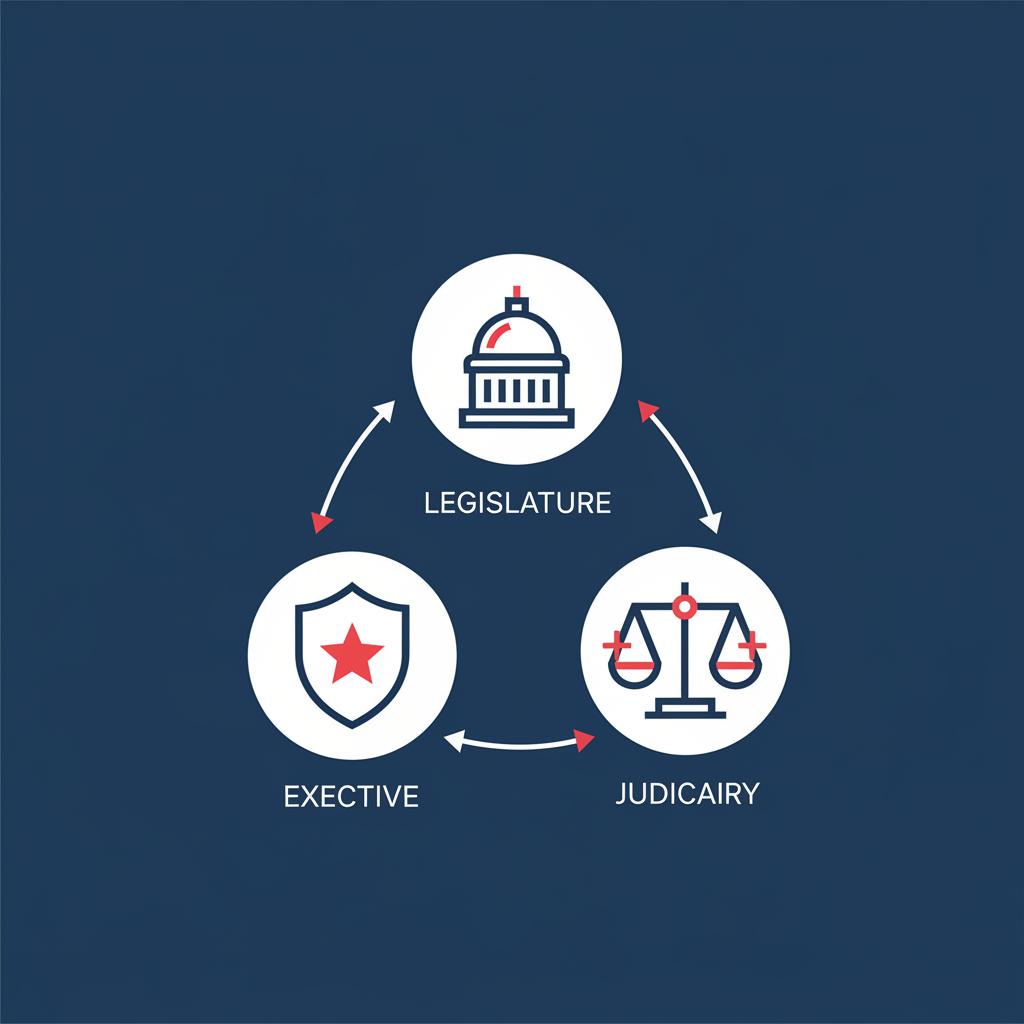
In practice, the phrase sits alongside the broader term separation of powers, which refers to assigning governmental functions to distinct branches. Separation of powers identifies the functional division, while checks and balances emphasizes the tools and interactions that let branches limit each other. This distinction helps explain why constitutional designers often pair structural division with active oversight mechanisms Stanford Encyclopedia of Philosophy.
Political scientists and legal scholars use the language of checks and balances to evaluate systems, noting that institutional restraints work only when institutions and political actors operate as intended. That caution keeps the concept descriptive and evaluative rather than promotional, and it frames checks and balances as a matter for historical and empirical study rather than a simple slogan Stanford Encyclopedia of Philosophy.
Join the campaign mailing list to receive updates and reading recommendations
See the primary texts listed later in this article to review how these ideas were argued and implemented by thinkers and framers.
Early roots: classical and medieval precedents for checks and balances
Before the modern phrase existed, classical writers described the idea of a mixed constitution, where elements of monarchy, aristocracy and democracy balance one another. Those discussions offered conceptual precedents that later thinkers cited when thinking about institutional restraints and shared rule Stanford Encyclopedia of Philosophy.
Medieval and early modern commentators also described institutional limits, often in relation to churches, councils, and local governments. These treatments did not provide a single blueprint for modern constitutions, but they helped transmit the idea that balanced structures can reduce the risk of domination by a single person or faction Stanford Encyclopedia of Philosophy.

Scholars who trace the origin of checks and balances treat this early material as antecedent thinking rather than direct ancestry. The long trajectory from classical mixed government through medieval practice to early modern theory shows continuity of concern about concentrated power, even as institutional contexts changed Stanford Encyclopedia of Philosophy.
Montesquieu and the modern doctrine of checks and balances
Montesquieu is widely credited with articulating the modern doctrine in The Spirit of the Laws, where he argued that political liberty depends on separating the legislative, executive and judicial functions so that no single branch can dominate the others Encyclopaedia Britannica.
The idea evolved over centuries, with classical and medieval precedents, a clear modern formulation by Montesquieu, and institutional implementation by the American founders in the Constitution.
Montesquieu did not invent the concern about mixed rule, but his account tied the separation idea to practical rules and a theory of prevention of tyranny, and many later writers and framers treated his book as a turning point in political thought Encyclopaedia Britannica, Liberty Fund.
Readers approaching The Spirit of the Laws will find a systematic effort to link institutional form and political outcomes, including specific recommendations about institutional independence and the dangers of concentrated authority. Montesquieu framed his argument in ways that influenced Anglo-American conversations about constitutional design in the eighteenth century Encyclopaedia Britannica.
How the American founders translated the idea into practice
During the debate over the new Constitution, writers and delegates drew on the separation-of-powers idea to justify dividing authority among branches and chambers. Federalist No. 47 explained that separation was a key constitutional principle even if it was not absolute, and that public argument relied on showing how division of functions supported liberty Federalist No. 47 – Avalon Project.
James Madison, writing in Federalist No. 51, framed the problem as one of ambition countering ambition, arguing that institutional design should channel personal and institutional motives to keep power in check. That formulation helped the founders think about mutual restraints as a practical design goal rather than purely abstract theory Federalist No. 51 – Avalon Project.
The Constitution translated these arguments into text and structure by creating separate branches, assigning different powers, and establishing processes for appointments and review. Those textual choices were intended to operationalize the principles set out by commentators and by Federalist writers during the ratification debates U.S. Constitution transcription – National Archives.
Constitutional mechanisms that implement checks and balances
The Constitution includes several structural devices meant to create internal checks. Bicameralism gives the legislative branch two chambers with different constituencies and procedures, which operates as an internal check on legislative action U.S. Constitution transcription – National Archives.
Appointments, removals and congressional oversight are other tools that distribute power between branches. The appointment power, confirmation processes, and oversight hearings create points where branches interact and constrain one another, as part of the constitutional design of shared authority U.S. Constitution transcription – National Archives.

The veto power, enumerated powers, and the limits the Constitution places on legislative action are further examples of how the document aims to divide authority and create veto points where different actors must negotiate or consent. These mechanisms are practical expressions of the checks-and-balances idea embedded in the constitutional text U.S. Constitution transcription – National Archives.
The judiciary’s role and how judicial review developed
The Constitution framed an independent judiciary, but its modern role as a reviewer of other branches developed through practice and jurisprudence rather than a single clause that spelled out judicial review. Scholars note that the judiciary’s checking function emerged over time as courts interpreted their role within the constitutional system U.S. Constitution transcription – National Archives.
Judicial independence is a key feature that enables courts to act as a constraint on the other branches, since independence allows judges to hear claims about government action without direct political pressure. Constitutional scholarship treats this independence as essential for the judiciary to exercise a checking function in practice Stanford Encyclopedia of Philosophy.
How checks and balances operate in practice: interaction among branches
In real political life, checks and balances show up as legislative oversight hearings, executive vetoes or negotiations with the legislature, and judicial review when courts assess the legality of other branches’ actions. These are examples of mutual restraint playing out through routine politics rather than only through formal text Stanford Encyclopedia of Philosophy.
Steps to verify a citation in a primary source
Use this to mark verification progress
The logic of ambition countering ambition, as Madison described it, helps make sense of why political actors often contest power through institutions rather than simple appeals to authority. That practical logic depends on competitive incentives, public opinion, and institutional norms that enable branches to check one another without collapsing into paralysis Federalist No. 51 – Avalon Project.
Formal separation can be limited in practice by political coordination, emergency powers, or partisan alignment across branches. Observing how the branches interact in specific episodes is necessary to assess whether checks and balances are functioning as intended in any given period Stanford Encyclopedia of Philosophy.
Contemporary pressures: scholars’ views on resilience and strain
Recent scholarship and policy analysis document pressures on traditional checks and balances from partisan polarization and tendencies toward executive expansion, raising questions about institutional resilience in the 2020s Brookings Institution.
These analyses do not conclude that constitutional mechanisms have failed, but they show that their effectiveness depends on political practice, norms, and enforcement. Scholars therefore treat resilience as an empirical question that requires careful evidence and ongoing study Brookings Institution.
When reading contemporary claims about institutional breakdown or strength, it is important to look for careful empirical work, clear attribution of causal claims, and attention to how partisan dynamics affect institutional rules and practices Stanford Encyclopedia of Philosophy.
How to evaluate contemporary claims about checks and balances
To assess arguments about the health of checks and balances, ask whether authors cite primary legal texts, use empirical data, and acknowledge partisan framing. These criteria help separate opinionated claims from evidence-based analysis and ground evaluation in documented sources Stanford Encyclopedia of Philosophy.
Seek primary sources when a claim traces back to doctrine or constitutional text. For questions of theory, consult The Spirit of the Laws; for founders’ intent, read Federalist Nos. 47 and 51; for constitutional text, use the National Archives transcript. These steps let readers verify claims against original material rather than relying on secondhand summaries Encyclopaedia Britannica.
Prefer peer-reviewed scholarship or reputable policy analysis when evaluating modern institutional pressures. Careful work will separate normative claims from empirical evidence and will explain how specific practices or events affect the balance of powers over time Brookings Institution.
Common misunderstandings and pitfalls when discussing checks and balances
A common error is treating slogans about checks and balances as equivalent to legal mechanics. Phrases that sound authoritative can obscure how textual rules, procedures, and political norms actually function in practice, so always check the underlying sources rather than relying on shorthand claims Stanford Encyclopedia of Philosophy.
Another pitfall is attributing modern constitutional practices directly to a single thinker. While Montesquieu and the Federalist writers are central articulators, the doctrine developed over time with contributions from many sources, and treating it as a single-person invention distorts that history Encyclopaedia Britannica.
Good practice is to avoid absolute language and to cite primary texts or empirical studies when making causal claims about institutional change. That approach preserves neutrality and helps readers evaluate claims against evidence rather than rhetoric Stanford Encyclopedia of Philosophy.

Practical scenarios: reading primary sources and testing claims
Step 1: Locate the relevant passage in The Spirit of the Laws and read the surrounding argument to see how Montesquieu links institutional separation to liberty. Using a reputable edition or overview helps with context before drawing conclusions Encyclopaedia Britannica.
Step 2: Compare what Montesquieu says with Federalist No. 47 and No. 51 to see how American framers adapted the theory. Reading those Federalist essays in sequence shows how the founders translated theoretical concerns into arguments about institutional design Federalist No. 47 – Avalon Project.
Step 3: Check the U.S. Constitution transcript for the textual devices discussed, such as bicameralism, appointment rules, and veto points. Cross-checking theory, argument and text helps readers evaluate claims about origin and implementation with primary evidence U.S. Constitution transcription – National Archives.
Primary sources and further reading list
The Spirit of the Laws is the central early modern text for the modern doctrine; consult a reliable edition or reference summary to read Montesquieu’s argument directly Encyclopaedia Britannica, Constitution Center.
Federalist Nos. 47 and 51 offer the founders’ public argument about separation and mutual checks; the Avalon Project hosts accessible transcriptions of those essays for direct reading Federalist No. 47 – Avalon Project.
The U.S. Constitution transcription at the National Archives provides the authoritative text for constitutional mechanisms such as bicameralism, appointments, and veto points, which readers should consult when testing claims about implementation U.S. Constitution transcription – National Archives.
Conclusion: main takeaways about the origin and meaning of checks and balances
The idea of checks and balances evolved over centuries, drawing on classical and medieval precedents before being articulated in a modern form by Montesquieu and then translated into institutional design by the American founders Encyclopaedia Britannica.
The Constitution implements these principles through concrete mechanisms such as bicameralism, appointments, vetoes and judicial review, but scholars warn that their effectiveness depends on political practice and norms and that recent partisan pressures raise empirical questions about resilience U.S. Constitution transcription – National Archives.
The idea evolved over centuries. Classical writers discussed mixed constitutions, Montesquieu articulated the modern doctrine, and American founders applied it in the Constitution.
They are related: separation of powers divides governmental functions, while checks and balances emphasizes mechanisms that let branches restrain one another.
Scholars debate current resilience; many point to partisan pressures and executive expansion as factors that affect how well institutional checks function.
For direct questions about the material in this article, use the contact page provided in the product link to reach campaign staff for additional context about the author's perspective.
References
- https://plato.stanford.edu/entries/separation-powers/
- https://www.britannica.com/topic/The-Spirit-of-the-Laws
- https://avalon.law.yale.edu/18th_century/fed47.asp
- https://avalon.law.yale.edu/18th_century/fed51.asp
- https://www.archives.gov/founding-docs/constitution-transcript
- https://michaelcarbonara.com/contact/
- https://www.brookings.edu/articles/how-resilient-are-checks-and-balances-partisan-pressures-on-us-institutions/
- https://oll.libertyfund.org/pages/montesquieu-and-the-separation-of-powers
- https://historyofeconomicthought.mcmaster.ca/montesquieu/spiritoflaws.pdf
- https://constitutioncenter.org/the-constitution/historic-document-library/detail/montesquieuthe-spirit-of-the-laws-1748
- https://michaelcarbonara.com/issue/constitutional-rights/
- https://michaelcarbonara.com/news/
- https://michaelcarbonara.com/about/