
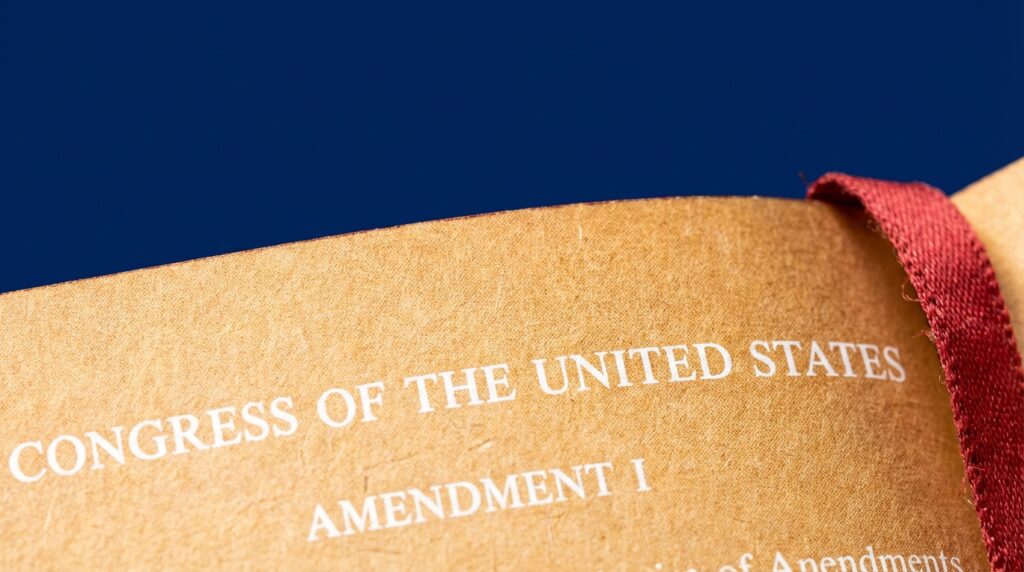
The article summarizes the official transcription, shows the common excerpt many call the "famous quote," and points to primary and trusted secondary sources for verification. It also outlines practical citation steps and common pitfalls to avoid when using constitutional wording.
What the first amendment wording actually says
The first amendment wording begins with the clause that opens the Bill of Rights and is the authoritative source for how the nation defines several core protections. The best practice is to read the full official transcription rather than rely on fragments when accuracy matters, especially in reporting or research. The primary transcription records the complete clause as the opening line of the First Amendment.
For clarity, here is the official text as transcribed in the primary source, reproduced for accuracy: “Congress shall make no law respecting an establishment of religion, or prohibiting the free exercise thereof; or abridging the freedom of speech, or of the press; or the right of the people peaceably to assemble, and to petition the Government for a redress of grievances.” This exact wording is preserved in the founding documents and is the starting point for legal interpretation, reporting, and classroom discussion. National Archives transcription

Because the clause is the first sentence of the Bill of Rights, many secondary citations condense or excerpt parts of it for convenience. When you must explain or quote constitutional text, note the source and use the full clause for precise legal or scholarly work; explanatory resources are helpful but secondary to the transcript. For context and plain-language annotation, legal summaries are commonly used by teachers and reporters. Cornell LII commentary (see our Bill of Rights full-text guide)
Why the free speech excerpt is the most famous quote
The fragment most readers recognize is the free speech and press portion, often shortened in conversation to “Congress shall make no law… abridging the freedom of speech, or of the press.” That excerpt is memorable because it directly names the protections most often invoked in civic debate and news coverage, and because it has been central to many landmark court decisions. National Archives transcription and see also the Library of Congress transcription at Congress.gov
Reporters, educators, and lawyers often use the short form as a shorthand when the discussion focuses on speech or press issues. Legal guides and classroom materials typically remind readers that the excerpt sits inside a longer sentence that also names religion, assembly, and petition, so the short form should be used carefully. Many introductory legal summaries that explain the free speech clause refer readers to fuller annotations for nuance. Cornell LII commentary
Breaking the text into its clauses: establishment, free exercise, speech, press, assembly, petition
Reading the first amendment wording as a single sentence can obscure how it functions as a set of related protections. Editors and teachers commonly break the sentence into clauses to explain what each part covers, which helps readers see where legal tests and doctrines apply.
Verify a quoted excerpt against primary transcript and brief glossary
Use before publishing a quote
Here is a concise clause map in plain language. For each clause the parenthetical shows the phrase from the official text so readers can match summary to source. Establishment clause: “Congress shall make no law respecting an establishment of religion” – this identifies limits on official sponsorship of religion. Free exercise clause: “or prohibiting the free exercise thereof” – this protects private religious practice. Speech and press clauses: “or abridging the freedom of speech, or of the press” – these protect expression and publication. Assembly and petition: “or the right of the people peaceably to assemble, and to petition the Government for a redress of grievances” – these protect collective action and requests to government. Each short explanation links back to the formal words in the transcript. National Archives transcription
Court opinions and scholarly commentary often treat these clauses as distinct analytical categories, but practice shows overlap. For example, a case about a government restriction on a protest may engage assembly and speech doctrine simultaneously. For clear reporting, name the clause you are discussing and show the matching phrase from the official text so readers can see how the summary maps to the original wording. Cornell LII commentary

For example, a case about a government restriction on a protest may engage assembly and speech doctrine simultaneously. That overlap means reporting should identify which clause or clauses are at issue so readers can follow how the legal test applies to each right.
Editors and teachers commonly break the sentence into clauses to explain what each part covers, which helps readers see where legal tests and doctrines apply.
Free speech and press: the quoted wording and its legal meaning
The free speech and free press phrase in the first amendment wording is frequently quoted on its own because it identifies the twin protections most often litigated and discussed in public forums. In plain language, the clause prohibits Congress from making laws that substantially limit public expression and the distribution of information, within the limits the courts recognize. National Archives transcription
Legal resources explain that the text sets a broad principle, but doctrine has developed tests and exceptions. Summaries by established legal guides describe how courts evaluate claims under that clause, differentiating categories of speech that receive robust protection from those that can be limited under specific tests. When explaining scope, refer back to those guides to avoid overstating the text as absolute. Cornell LII commentary
Key Supreme Court cases that apply the First Amendment wording
Several Supreme Court decisions illustrate how the first amendment wording is applied. New York Times Co. v. Sullivan shaped modern defamation law by establishing that public-figure plaintiffs must prove actual malice to recover for press-related false statements, a rule that ties directly to how the press clause is read in practice. New York Times Co. v. Sullivan
The most commonly cited excerpt is the free speech and press fragment, typically written as "Congress shall make no law… abridging the freedom of speech, or of the press," which is best verified against the full official transcription.
Brandenburg v. Ohio set the modern standard for restricting speech that risks violent or illegal action by requiring intent to incite imminent lawless action and a likelihood that such action will occur. That test is routinely cited in cases dealing with protests, online commentary, and political advocacy where speech may be provocative but not immediately actionable. Brandenburg v. Ohio
West Virginia State Board of Education v. Barnette is another foundational precedent showing that the First Amendment protects people from compelled speech, such as forced recitation or state-imposed pledges. The case is often used to explain negative liberties, where the Constitution bars government from forcing certain expressions. West Virginia State Board of Education v. Barnette
How courts limit speech and what that shows about the wording
Courts have created categories where certain speech receives less protection, and these limits come from doctrinal tests that interpret the first amendment wording rather than from new text. For example, defamation law balances reputation interests with press protections and relies on the actual malice standard in cases involving public figures. That approach shows how the press clause is applied in practice when reputational harm and public interest collide. New York Times Co. v. Sullivan
Incitement doctrine demonstrates another limit: the Brandenburg test allows restriction only where speech is intended to, and likely to, produce imminent lawless action. This emphasizes that broad phrases in the first amendment wording are interpreted through narrow legal tests when public safety concerns arise. Brandenburg v. Ohio
Compelled speech rulings, exemplified by Barnette, show that the Amendment also protects negative liberties, preventing government from forcing an individual to speak or endorse a message. These distinctions help explain why the text must be read alongside case law rather than as an all-purpose rule that overrides other legal considerations. West Virginia State Board of Education v. Barnette
Common misquotes and misunderstandings about the first amendment wording
A frequent misquote is to say the First Amendment contains the exact phrase “separation of church and state.” That wording does not appear in the Amendment; instead the text speaks separately about establishment and free exercise of religion, and commentators later used shorthand language to describe the relationship. For accuracy, avoid attributing that exact phrase to the text itself. SCOTUSblog coverage
Stay informed and involved with Michael Carbonara
For accurate citation, check the National Archives transcription and a reliable legal summary like Cornell LII before publishing an excerpt.
Another common misunderstanding treats the protections as absolute. The first amendment wording establishes broad protections, but courts use doctrinal tests to balance rights with other interests in specific cases. It is clearer to explain when a protection applies and to cite the relevant case law or guides rather than to say a right is limitless. Cornell LII commentary
How to evaluate a quoted First Amendment wording: source and accuracy checks
When you encounter a quoted excerpt, first check the primary transcription to confirm wording, punctuation, and placement in the sentence. The National Archives maintains an authoritative transcription of the Bill of Rights, and comparing a quotation to that version is the simplest verification step. National Archives transcription
Next, use a reliable legal summary for explanatory context but not as a substitute for the primary text. Resources such as Cornell LII provide concise annotations and discussion of how courts have applied the first amendment wording, which is useful for understanding doctrine while preserving the original wording in citation. Cornell LII commentary and check the Library of Congress Constitution page at Congress.gov
When publishing, show whether you have omitted material by using an ellipsis and provide a clear source credit. Simple attribution language like “the National Archives transcribes the Amendment as…” keeps readers informed about where the text came from and reduces the chance of misquotation. National Archives transcription
Typical mistakes writers make when quoting or summarizing the Amendment
One frequent editorial error is truncating a quote without indicating that material has been omitted. Leaving out intervening text can change legal meaning, so use ellipses and a source line to make omissions transparent. When in doubt, quote the full clause and add a short paraphrase for readers. National Archives transcription
Another mistake is citing a popular slogan or shorthand as if it were the text. For example, attributing “separation of church and state” directly to the amendment misleads readers; instead, point readers to the transcript and, if useful, provide the historical origin of the slogan. Editorial clarity matters more than brevity when legal meaning is at stake. SCOTUSblog coverage
Practical examples and scenarios: correct citations and brief annotated quotes
Example 1, full clause with attribution. Accurate citation for scholarly or legal use might read: “Congress shall make no law respecting an establishment of religion, or prohibiting the free exercise thereof; or abridging the freedom of speech, or of the press; or the right of the people peaceably to assemble, and to petition the Government for a redress of grievances” (National Archives transcription). This reproduces the official text and cites the primary source so readers can verify the wording. National Archives transcription
Example 2, correct short excerpt and annotation. When the focus is press or speech, a reporter might write: The commonly cited excerpt is “Congress shall make no law… abridging the freedom of speech, or of the press,” which is useful shorthand for the speech and press protections but should be linked to the full clause for precision in legal contexts. Use the ellipsis to show omission and add a parenthetical citation to the transcript or a legal summary. Cornell LII commentary
When reproducing the first amendment wording, use neutral attribution such as “according to the National Archives” and avoid drawing legal conclusions from a short quotation alone. Present the text, then explain limits or tests in a separate sentence so readers can see the distinction between text and doctrine. National Archives transcription
Balance brevity and accuracy by choosing the full clause when legal meaning matters and the short excerpt only when the context is explicitly about speech or the press. Give readers a pointer to case law or a legal guide if doctrinal nuance matters for understanding the claim. Cornell LII commentary
Trusted sources and further reading for the First Amendment wording
Primary source: check the official transcript at the National Archives for the exact wording and original punctuation. That transcript is the canonical source to which scholars and courts refer when accuracy matters. National Archives transcription
Accessible legal commentary: Cornell LII offers annotated text and plain-language explanation that is useful for classroom or newsroom context. For ongoing coverage of how the Amendment is argued in new cases, SCOTUSblog provides topical reporting and analysis. For full doctrinal detail, consult the actual Supreme Court opinions listed below. Cornell LII commentary and our constitutional rights hub. Also see educational materials at the Reagan Library: Amendment 1 – Reagan Library
Suggested primary opinions for doctrinal depth include New York Times Co. v. Sullivan for press and defamation, Brandenburg v. Ohio for incitement, and Barnette for compelled speech; reading those opinions gives concrete examples of how the first amendment wording is translated into judicial tests. New York Times Co. v. Sullivan
Takeaway: quoting the First Amendment responsibly
The single most important rule when using the first amendment wording is to verify the text against the primary transcript and to attribute that source clearly. Short excerpts are useful in many contexts but can mislead when readers need doctrinal nuance; the official wording remains the touchstone for interpretation. National Archives transcription
When a legal question arises, pair the quoted text with references to authoritative summaries or to the controlling opinions that apply the clause; that practice helps readers understand how a brief quotation fits into the broader body of doctrine. For press or legal writing, use the full clause when context matters, and add an explanatory note or case citation for readers who want the judicial background. Cornell LII commentary
The most quoted fragment refers to the free speech and press protections often cited as "Congress shall make no law… abridging the freedom of speech, or of the press."
The official transcription of the Bill of Rights, including the First Amendment, is available from the National Archives and is the authoritative source for exact wording.
No. The exact phrase does not appear in the Amendment; it is a later shorthand used in commentary to describe the relationship between establishment and free exercise clauses.
If you are citing the First Amendment in research or in the newsroom, link to the primary source and add a concise note explaining any omissions so readers can follow your sourcing.



