The approach emphasizes short read alouds, primary-source excerpts, and scaffolded activities that build civic skills alongside factual knowledge. The resources named here are neutral and intended for classroom use.
What the U.S. Constitution is, in kid-friendly terms
The U.S. Constitution is a short set of rules people wrote so the country can run fairly and predictably. One simple way to explain it to children is to say the Constitution is like a rulebook everyone agrees to use for how the government works and how people keep certain freedoms. This plain description can help a teacher start a brief read aloud or a 5-minute class talk about shared agreements.
Use the Preamble as a friendly opener. Read it as a sentence about the goals of the rulebook, then say what those goals mean for class life. For phrasing examples and classroom printables that show the Preamble and the Constitution text in a form suitable for students, teachers can download primary materials from the National Archives National Archives Constitution page.
The Preamble explained in one sentence
Write a one-line script for children: We the people made these rules so we could work together, be fair, and help each other stay free. Use that script as a read aloud and then ask a short question like, What does it mean to work together? Keep the sentence short and concrete so children can repeat it back.
Why a written constitution matters
A written constitution gives one clear place to find the most important rules. For kids, compare it to a classroom rule chart that everyone can read. That comparison helps children understand why a written set of agreements matters for fairness and for knowing what to expect from leaders.
Short glossary: amendment, federal, rights
Amendment: A change or addition to the rulebook. Explain it to students as a new rule people agree to add when the old rules need updating. Branch: One of the main parts of government that has a different job. Rights: Things people can do or have that the government should not take away. Federal: The part of government that covers the whole country, not just one state.
Keep definitions short enough for a teacher to read aloud. Small cards with each word and a one-sentence definition work well for quick review and for forming the basis of a simple matching game.
Why teach the Constitution to children?
Teaching the Constitution to children helps them learn facts about how government is set up and, equally important, civic skills like asking questions, reading sources, and making reasoned arguments. Educational resources that support classroom skill-building stress the value of combining factual knowledge with civic practice so students learn to use evidence and talk about differing views.
Use a one sentence Preamble script, a short vignette that connects the Preamble to classroom rules, and a 10 minute activity such as a timeline or role-play. Pair the activity with a one page primary source excerpt and a brief formative check.
Primary sources and short stories make abstract ideas concrete and help children see the Constitution as a document people used and changed over time. For classroom-ready, student friendly explainers and interactive materials suited to K to 12, the National Constitution Center offers resources that teachers often use to turn a short passage into a story or vignette National Constitution Center educational resources.

Age-appropriate goals vary by grade. For young children, aim for curiosity and respectful discussion rather than formal testing. For older students, plan activities that build analysis and civic reasoning. Practical classroom goals include being able to name one reason the Constitution exists and to explain one simple example of how a branch of government has a role.
Core concepts to cover early: Preamble, three branches, and the Bill of Rights
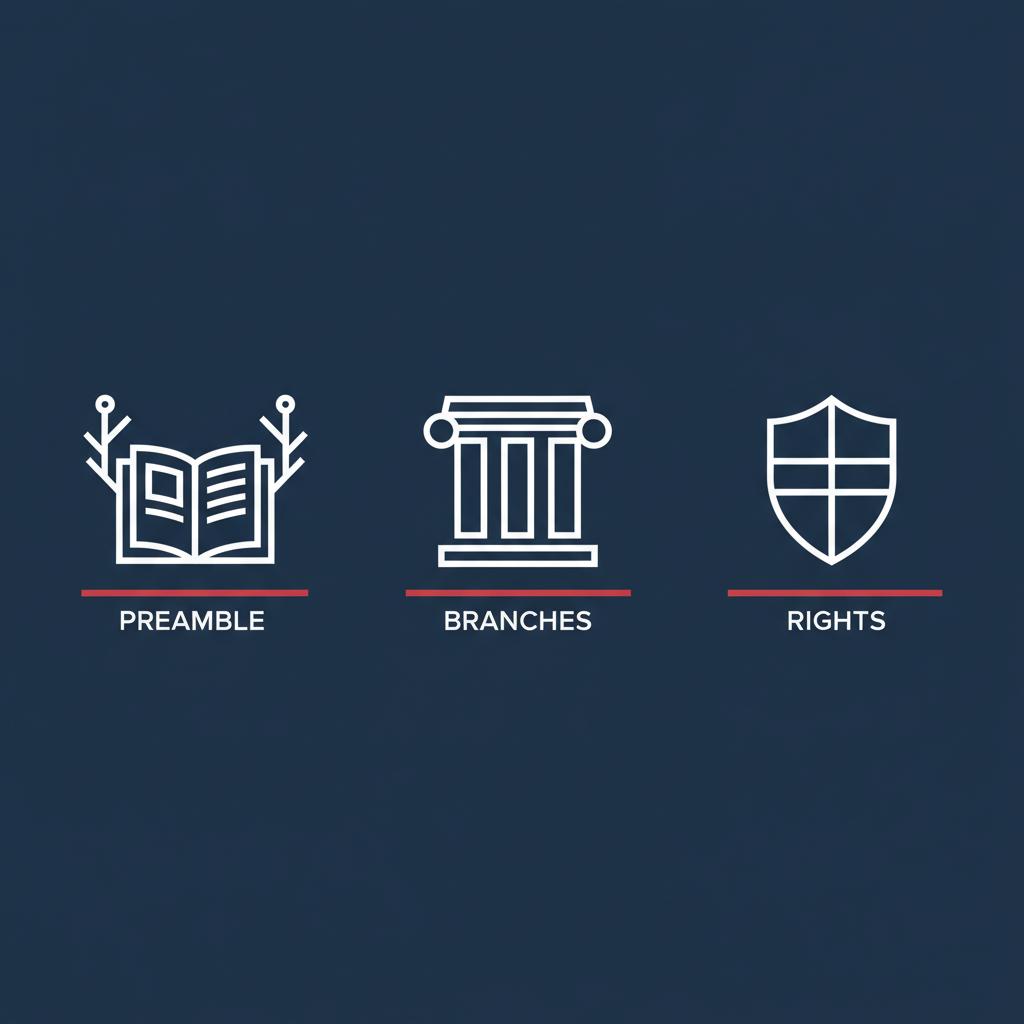
Begin with three short ideas children can remember: the Preamble tells why the rulebook exists, the three branches split power so no single part makes all the decisions, and the Bill of Rights lists basic protections people have. Present each idea with a quick example teachers can tell in a minute.
For presenting the Preamble as a shared-goals statement, read a short teacher script and then show a one sentence vignette that connects the language to a classroom situation. The National Archives hosts the Constitution text and sample teacher facing materials that make short, printable excerpts useful for that kind of vignette National Archives Constitution page.
Preamble: purpose and simple examples
Teacher script idea: Read the Preamble and say, This is a list of things the rulebook tries to do. Then give a one minute classroom story, for example: the class decides playground rules so everyone is safe and can play. Ask children how classroom goals match the Preamble. Short stories help students imagine what those big words mean.
Three branches: roles and a short role-play idea
Explain the three branches as jobs: one makes the rules, one applies or enforces them, and one decides if rules fit the rulebook. Use a brief role-play where three students act as lawmakers, a president figure, and a judge. A time boxed activity showing how a law is made and checked demonstrates separation of powers in action; teachers can model the parts and then let students try a simplified version inspired by classroom activities used by civic education programs iCivics lesson plans.
Bill of Rights: five kid-friendly examples
Pick five rights to explain simply: free speech as saying what you think kindly, religion as choosing beliefs, press as sharing news, trial by jury as having neighbors hear a case, and protection from unfair searches as privacy. Use one short student prompt for each right to start discussion, for example, What would you do if someone took your homework without asking? That prompt opens a conversation about property and fairness without legal terms.
For lesson and handout styles that reduce the first ten amendments into classroom prompts and one page summaries, the Bill of Rights Institute provides age-adapted lesson plans and printable handouts teachers can use directly with students Bill of Rights Institute resources.
A simple, grade-by-grade framework to teach the Constitution
Kindergarten to grade 2 should focus on stories, routines, and repeating one short script about the Constitution. Use read alouds, a classroom rule chart, and a short daily question for a week. Materials like ready to print one-page summaries can be used as visual aides for this age band.
Grades 3 to 5 can handle short projects and primary documents. Have students work in small groups to create a timeline of a simple event such as how a classroom rule was made. For teacher printables and facsimiles suitable for this grade band, national institutions provide one-page materials that fit a single class period and are designed to be student friendly National Archives Constitution page.

Middle school lessons are a good time for role-plays and scenario debates where students take roles and test how separation of powers works in practice. High school students can move to primary source analysis and civic action projects that link classroom study to community questions. For interactive classroom ideas and scaffolding by grade, the National Constitution Center and iCivics offer tools and lesson structures teachers often adapt National Constitution Center interactive Constitution.
Across all bands, scaffold complexity by starting with a story based prompt, then add a short primary source excerpt, and finally ask a brief written reflection. Time estimates: a single read aloud or vignette takes 10 minutes, a short role-play 20 to 30 minutes, and a primary-source project can be scheduled across two class periods.
Hands-on activities and classroom-ready exercises
Timelines help students place the Constitution in a story. Ask students to create a simple timeline of three events: writing the rules, adding a change, and a classroom rule example. Timelines can be low tech with paper and markers or digital in a shared slide. Civic education groups recommend timelines as a first activity to give historical context and a scaffold for later analysis iCivics lesson plans.
Role-plays for separation of powers let students act out making, enforcing, and reviewing a rule. Provide roles with one line instructions and a 15 minute script. After the role-play, do a 10 minute debrief using questions that prompt students to compare their experience to the idea of checks and balances.
Timelines and history maps
Make a classroom history map showing where important documents came from and who was involved. Use labeled index cards and let groups place cards on the map. This visual helps students connect people, places, and documents without reading long passages.
Role-plays for separation of powers
Script example for a short role-play: One student suggests a new recess rule, another group acts as lawmakers who vote, a third group acts as an enforcer who decides how to carry out the rule, and a final student acts as a judge who checks fairness. Keep turns brief so the activity fits a single class period and use a debrief sheet with three questions to check understanding.
Rights scenarios and mock debates
Present a short scenario to illustrate a right, for example a student thinks a rule limits their right to share a classroom newsletter. Ask small groups to discuss and then report a solution that balances school rules and the right being discussed. These scenario based exercises develop civic reasoning alongside factual knowledge; classroom assessment prompts can be quick oral checks or short exit ticket reflections that map to civic skills U.S. Courts educational resources.
Primary sources and ready-to-print resources teachers can use
The National Archives hosts the full Constitution text and teacher facing lesson plans and printables designed for classroom use. Teachers can download facsimiles and one page excerpts to hand out or display during a lesson, which makes the document feel tangible to students National Archives lesson plans.
Library of Congress pages provide contextual primary documents teachers can use to show how the Constitution came to be and how key clauses were discussed at the time. Those primary documents help students connect clauses to the people and debates that shaped them Library of Congress primary documents and see related classroom lesson plans Library of Congress lesson plans.
Free classroom printables from national archives
Teachers can download free printable excerpts and one page summaries from the National Archives and the Bill of Rights Institute to use in the next lesson.
The Bill of Rights Institute and the National Constitution Center both supply concise handouts and classroom ready explainers that simplify complex language into student prompts and questions. These printable summaries let a teacher present the first ten amendments as short classroom activities and discussion starters Bill of Rights Institute educator resources (see our Bill of Rights full-text guide).
Assessment, mixed-age groups, and adapting activities
Use formative checks that map to civic skills rather than relying only on factual recall. Simple exit tickets, quick oral summaries, and short written reflections let teachers see if students can explain a concept in their own words. Federal and civic education resources emphasize pairing factual teaching with skill practice when assessing younger students U.S. Courts educational resources.
For mixed-age classrooms, group students by ability and assign layered tasks. Younger students can draw a timeline panel while older students write a one paragraph summary of a clause. Keep materials minimal and reuse the same primary source excerpt for different depth of work.
Assessment approaches for younger students are variably documented and may require local piloting. Teachers can try a two week pilot of a short sequence and record what students can do at the end of the unit, then adapt prompts or time allocations based on those observations.
Sample lesson plans and scripts: three ready-to-use classroom scenarios
Short Preamble vignette for grades K to 2, objective: introduce the idea of shared goals. Materials: a printed Preamble excerpt, a short illustrated vignette, and three discussion cards. Script: Read the Preamble excerpt, tell the vignette about classmates agreeing on a game rule, then ask two simple questions. Assessment: quick show of thumbs up, thumbs down, or a one sentence answer read aloud.
a quick teacher checklist for a single lesson
Use as a pre lesson reminder
Separation of powers role-play for grades 3 to 5, objective: show how different parts of government have different jobs. Materials: role cards, a one page scenario, and a debrief sheet. Script: introduce roles, run a 15 minute enactment of a classroom rule making process, then spend 10 minutes debriefing with three focused questions. Assessment: short written reflection that asks students to name one check and one balance they saw in the enactment. The structure and timing follow activity styles used by classroom civic education groups and can be shortened for limited time.
Bill of Rights scenario and debate for middle school, objective: practice weighing rights versus rules. Materials: a scenario worksheet, debate norms chart, and a simple rubric. Script: read the scenario, assign positions, run a timed debate, then use the rubric for a quick formative score. For source aware prompts and printable worksheet models, teachers can use Bill of Rights Institute formats that map each amendment to student prompts and discussion questions Bill of Rights Institute resources.
Common mistakes teachers and parents make when introducing the Constitution
One frequent error is starting with too much legal detail too soon. Long legal text can confuse young students. Instead, begin with a short vignette and a primary source excerpt that is one paragraph long. The National Constitution Center models short story based explainers that make this approach practical for early grades National Constitution Center resources.
Avoid removing context from primary sources. Oversimplifying a document can strip away useful questions teachers want students to ask. Keep at least one guided question for each excerpt and allow students to explore answers before offering a full explanation.
Do not present rights as guaranteed outcomes without discussion. Rights are protections to discuss and consider; present them as topics for weighing and conversation rather than promises. Attribute summaries to source materials and use neutral phrasing when modern examples arise.
Wrapping up: practical tips, next steps, and authoritative sources
Quick checklist for the first three lessons: pick a clear objective, use one primary source excerpt, and plan a 10 minute activity that prompts student reflection. This three item plan helps teachers avoid overwhelm when they begin.
Where to download primary sources and handouts: the National Archives for the Constitution text and facsimiles, the Library of Congress for contextual primary documents, the Bill of Rights Institute for one page summaries and teacher prompts, the National Constitution Center for interactive explainers, and iCivics for activity styles and lesson scaffolds Library of Congress primary documents. For related materials on this site see constitutional rights resources.
Encourage local piloting of assessment approaches where the evidence base is thin. Small scale testing helps teachers learn what works for their students and adapt timing and prompts accordingly.
Start with a short story or vignette and a single sentence version of the Preamble, then use a simple question to prompt discussion. Keep activities under 10 minutes for initial lessons.
Authoritative printables and facsimiles are available from the National Archives, the Library of Congress, the Bill of Rights Institute, and the National Constitution Center for teacher use.
Use formative checks such as exit tickets, quick oral summaries, or a short written reflection tied to the activity to see if students can explain a concept in their own words.
Good classroom practice combines curiosity, clear examples, and repeated opportunities to talk about what the Constitution means in daily life.
References
- https://www.archives.gov/founding-docs/constitution
- https://constitutioncenter.org/interactive-constitution
- https://www.archives.gov/legislative/resources/education
- https://www.archives.gov/legislative/resources/education/constitution
- https://www.loc.gov/programs/teachers/classroom-materials/lesson-plans/
- https://www.icivics.org/teachers/lesson-plans
- https://billofrightsinstitute.org/educate/educator-resources
- https://www.uscourts.gov/about-federal-courts/educational-resources/kids
- https://www.loc.gov/rr/program/bib/ourdocs/Constitution.html
- https://michaelcarbonara.com/ten-amendments-for-kids
- https://michaelcarbonara.com/bill-of-rights-full-text-guide
- https://michaelcarbonara.com/issue/constitutional-rights/
- https://michaelcarbonara.com/contact/